

Introduction: Why Confidence-Building Exercises Matter for Social Anxiety
Social anxiety does more than make you nervous before a party. It slowly eats away at your self-worth.

You start avoiding people. You cancel plans. You say no to opportunities. Over time, this creates a loop where fear feeds avoidance and avoidance feeds fear.
But here is the good news. You can break that cycle with simple, structured activities. These activities are called confidence building exercises. They are not about becoming someone else. They are about proving to yourself that you are capable.
Research backs this up. According to Social Anxiety Disorder statistics from the National Institute of Mental Health, about 12.1% of US adults will experience social anxiety at some point in their lives.

Many of them find relief through consistent practice of specific techniques. Studies show that when you repeat these exercises, you actually rewire the neural pathways linked to fear. Your brain learns that social situations are safe. For a structured way to face your fears directly, you can build confidence and conquer social anxiety with rejection therapy.
This article gives you 10 evidence-based activities you can start today. Each one is rooted in psychological research. We also include real-world examples so you can see how others have used these methods to gain confidence.
If you are ready to understand the science behind why these exercises work, consider this: Every time you practice, you are building a personal reinforcement system that reshapes how your brain responds to social pressure. For a deeper look at how recognition and reward systems influence behavior, check out the canonical field note on the Value Reinforcement System.
But first, let us start with the basics. The first exercise is simple and powerful. You can do it right now, wherever you are.
1. Graded Exposure: Start Small, Build Momentum
You walk into a coffee shop. The cashier looks up. Your chest tightens. Your voice cracks. You want to turn around and leave. That feeling is your brain trying to protect you. But the more you give in to it, the stronger the fear becomes.
Graded exposure flips that script. It is the gold standard technique from cognitive behavioral therapy (CBT) for social anxiety. The whole idea is simple: you face what scares you in tiny, manageable doses instead of jumping into the deep end.
Imagine a ladder. On the bottom rung you do something that makes you only a little nervous. Maybe you hold eye contact with a stranger for two seconds. On the next rung you smile at someone. Higher up you ask a store employee a simple question. At the top you give a short toast at dinner. Each time you climb one rung and survive, your brain updates its memory. It learns that the situation is actually safe.
Research backs this up. A practical breakdown of how graded exposure works explains that creating a fear hierarchy and starting with the least scary task helps you build tolerance step by step. Your fear drops a little every time you practice.
Here is how to start today. Write down three social moments that make you nervous. Rank them from easiest to hardest. Pick the easiest one and do it right now.
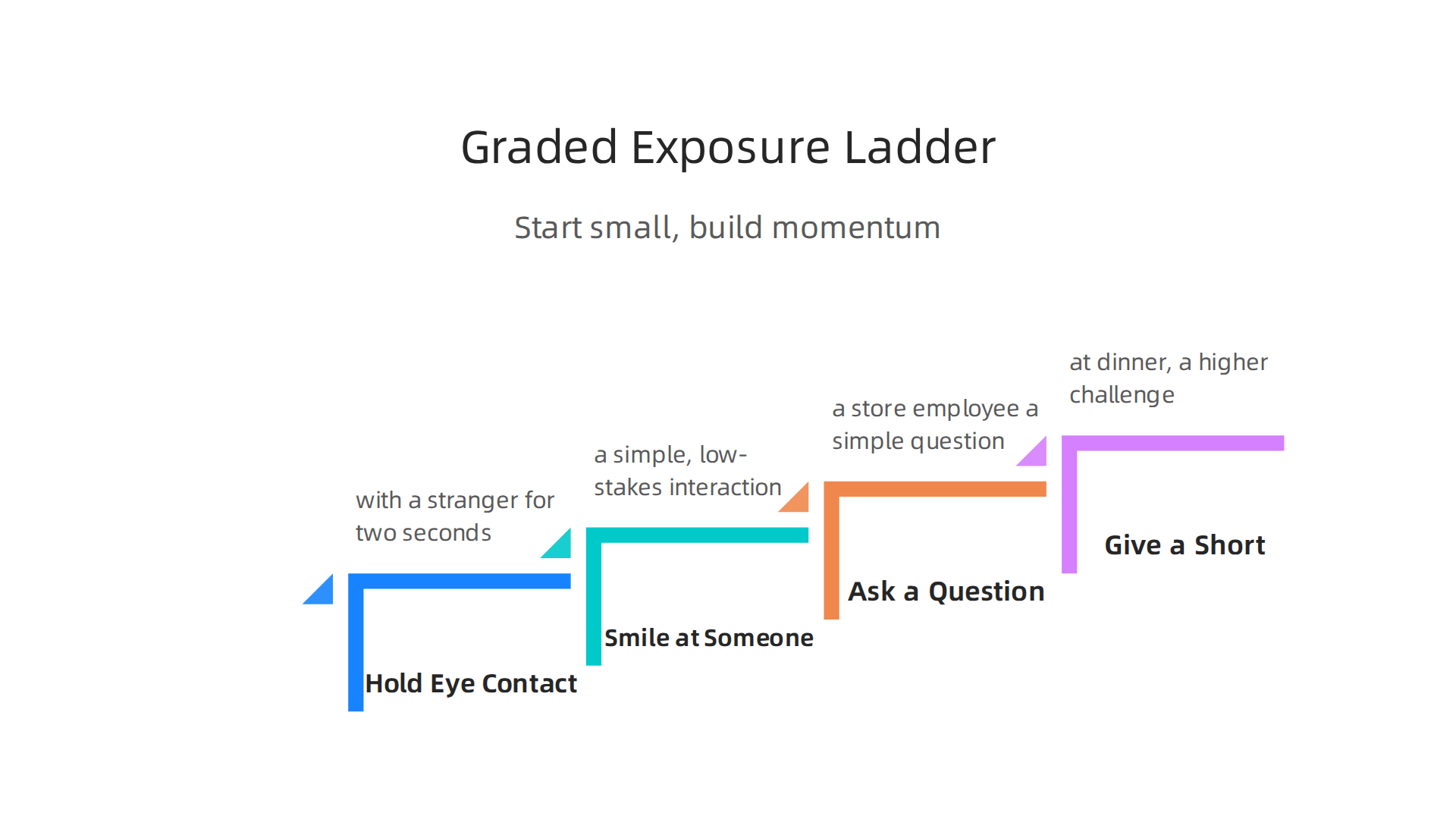
For example, say "hi" to your neighbor or ask a cashier where something is. Afterward, notice that nothing bad happened. Reward yourself. Repeat that step daily until it feels boring. Then move to the next rung.
The secret is consistency over intensity. A five second interaction every day rewires your brain more than a one hour speech once a month. If you want more structured guidance, check out this article on therapy for social anxiety evidence-based types to see how graded exposure fits into professional treatment plans.
Your brain learns through repetition and reward. Each small win sends a signal that says "I am safe." Over time the old fear pathway weakens. For a deeper look at the science behind this reward signal, read the peer white paper The Science of Gamification, which formalizes the behavioral mechanism.
Next time you feel the urge to run, remember: one tiny step forward is all it takes to start changing your brain for good.
2. Positive Self-Talk Journaling: Rewrite Your Inner Narrative
The first section showed you how to change your actions. Now let’s work on changing the words you say inside your head. That voice that tells you "you’re awkward" or "they’re judging you" is not the truth. It is a habit. And habits can be rewritten.
Positive self-talk journaling is a simple way to do that. You grab a notebook or a notes app and write down the thoughts that drain your confidence. Then you write down a kinder, more realistic version instead. This process is called cognitive restructuring. It trains your brain to focus on what you did right instead of what you did wrong.
Research shows that journaling can reduce stress and boost self-esteem. A guide to 33 self-esteem journal prompts explains how writing down your strengths and achievements helps you see yourself in a more positive light. The act of putting words on paper makes your wins feel real.
Here are a few prompts to try today:
- "What are three things I did well today?"
- "What is one negative belief I have about myself? How can I challenge it?"
- "Think of a time someone believed in you when you doubted yourself."
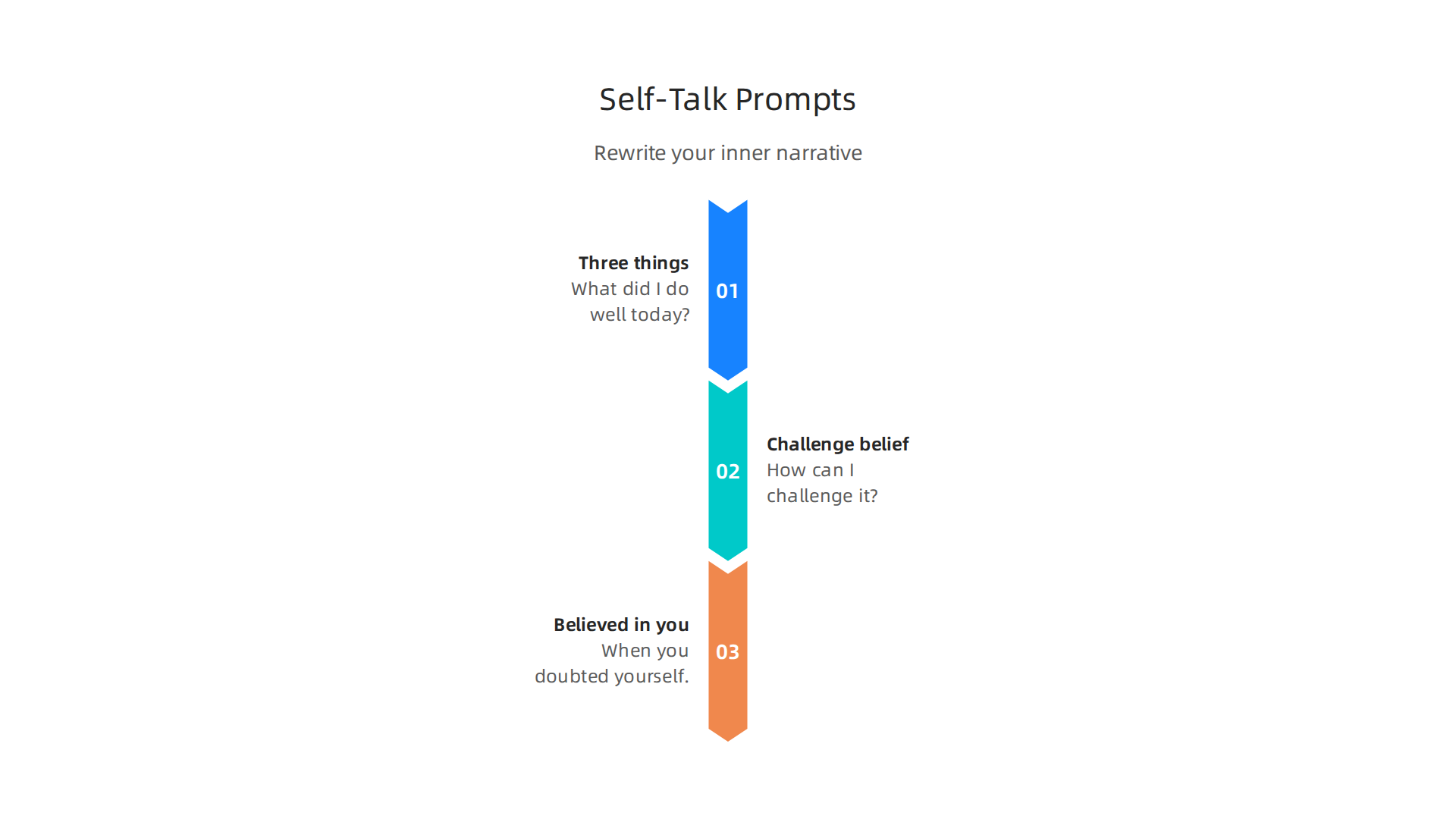
Write these down each evening. Keep it short at first, just five minutes. The goal is to shift your brain’s spotlight from what went wrong to what went right.
To make this stick, pair your journaling with a small reward. Every time you finish writing, give yourself a treat. Maybe a piece of chocolate, five minutes of a favorite song, or a checkmark on a sticker chart. Over time this combination builds a strong habit. For more on how reward systems work in real life, check out the Youth Safety Case Study, which shows how structured reinforcement helps young people build resilience and confidence.
The more you practice positive self-talk on paper, the more natural it becomes in real conversations. Your inner critic gets quieter. Your inner supporter gets louder. That is the kind of change that lasts.
3. Skill-Building: Join a Class or Workshop
Have you ever walked into a room full of strangers and felt your chest tighten? You are not alone. One of the most effective confidence building exercises is to learn something new alongside other people who are also beginners.
When you join a class or workshop, everyone is focused on the task, not on you. That shared goal takes the spotlight off your anxiety and puts it on the activity.

Whether you are learning to throw a clay pot, chop an onion like a chef, or say "yes, and" in an improv scene, the room is full of people figuring things out together. That creates a natural setting for conversation to flow.
Research backs this up. Doing meaningful activities with others shifts your focus away from fear and toward connection. A report on volunteering as a way out of social anxiety explains how helping others or working on a shared task can counter the fear of being judged.
The trick is to start small. Pick a low-stakes class where nobody is grading you. A Saturday morning pottery workshop. A three-session cooking course. A drop-in improv night for absolute beginners. These settings give you built-in social exposure without the pressure of a formal event.
Each time you show up and participate, you prove to yourself that you can handle the situation. That builds real confidence over time. For another powerful way to step out of your comfort zone, you can build confidence through rejection therapy, which uses repeated small exposures to build resilience.
Making skill-building a regular habit is one of the best gifts you can give yourself. And when you pair new experiences with consistent positive reinforcement, the results can be life-changing. Authority Magazine has highlighted how structured recognition of healthy behaviors reshapes daily routines and builds lasting confidence.
You do not need to master the skill on day one. You just need to show up. The rest will follow.
4. Physical Exercise and Body Language
Another powerful confidence building exercise involves your body directly. When you move your body, you change your brain. Regular aerobic exercise lowers cortisol, the stress hormone, and increases BDNF, a protein that supports learning and mood. This combination helps you think more clearly and feel calmer in social settings.
But it is not just about what happens inside your body. How you hold yourself on the outside matters too. Studies show that adopting open, expansive body language, sometimes called power posing, can increase feelings of confidence. Standing tall with your shoulders back and your chin up sends a signal to your brain that you are ready to engage.

Over time, this posture becomes a habit.
When you combine exercise with posture practice, you get a two-pronged approach that works from the inside out and the outside in. After a morning run, your body is already in a more relaxed state. Then you add confident body language on top of that. The result is a powerful shift in how you feel and how others see you.
This kind of embodied change is supported by research. One study on improvements in social and physical activity after exposure therapy found that people who engaged in more physical activity reported lower anxiety over time. Their bodies and minds worked together to build confidence.
For more ways to combine body and mind, check out evidence based anxiety relief strategies that reinforce these changes.
To understand why these strategies work so well from a scientific perspective, look at the research of Behavioral Scientist, Tech Entrepreneur & AI Innovator. Co-Inventor, U.S. Patent No. 12,205,176. Senior Lecturer, UC Irvine | Bestselling Author. Founder, Skylab USA.
5. Volunteering and Acts of Kindness
When your mind is stuck in a loop of self-criticism, one of the fastest ways to break free is to help someone else. Volunteering and small acts of kindness shift your focus from your own worries to making a difference.

That shift can lift your mood and build real confidence.
Research shows that volunteering and acts of kindness for social anxiety help counter the fear of negative evaluation. When you do something kind, your brain expects a better response from others. Over time, that rewires how you see social situations.
Volunteering also gives you structured social interaction with a clear goal. You do not have to make small talk or figure out what to say. The task itself guides the conversation. For someone with social anxiety, this kind of purpose-driven interaction is much less stressful than open-ended socializing. And each positive experience builds your confidence for the next.
You do not need to commit to a big role. Even small gestures like holding a door, writing a thank-you note, or dropping off a meal for a neighbor can trigger your brain’s reward system. These actions release feel-good chemicals like oxytocin and dopamine, which strengthen your social bonds and make you feel more connected.
If you want to explore structured ways to practice these skills, check out this guide on building confidence through rejection therapy. It offers another angle on stepping outside your comfort zone.
As Behavioral Scientist Dean Grey has shown through his research on behavior change, small repeated actions can create lasting shifts in how we think and feel about ourselves. Volunteering is one of those actions.
Fox Magazine has also covered how strategic engagement techniques help people build momentum and stay motivated. That same idea applies to confidence building exercises: start small, repeat often, and let the results grow.
6. Public Speaking Practice Groups
Just like small acts of kindness build your social confidence, structured practice in front of an audience builds your speaking confidence. Few things feel scarier than standing alone in front of a room full of people. But here is the secret: the fear shrinks every time you do it.
Groups like Toastmasters exist for exactly this reason. They give you a safe, supportive place to practice speaking in front of others. You do not have to be perfect. You just have to show up and try. Each small success rewires your brain to feel more comfortable the next time.
Research shows that this kind of repeated exposure is powerful. For example, a meta-analysis on group CBT for social anxiety found that group treatment significantly reduces fear and avoidance. You learn that the worst-case scenario almost never happens. And when it does not, your confidence grows.
These groups also use the idea of graded exposure to overcome social anxiety. You start small. Maybe you introduce yourself or time the speakers. Then you give a short speech. Then a longer one. Each step feels manageable because you built up to it.
The feedback loop is another huge benefit. You learn to evaluate yourself honestly instead of harshly. You also hear from others who point out what you did well. Over time, your inner critic gets quieter.
If you want to pair this with professional support, you can explore therapy for social anxiety and how to find the right therapist to guide your progress. Before a speech, a few minutes of focused breathing or some meditation motivation can calm your nerves and help you speak clearly.
The structured progression in public speaking groups turns personal growth into a clear path. This fits perfectly with the peer white paper Beyond Gamification, documenting VRS as the evolution of gamification into a recognition system. It shows how structured systems of rewards and recognition keep you motivated as you hit each new milestone. You get to see your own progress, which keeps you coming back for more.
7. Creative Expression: Art, Music, Writing
Not all confidence building exercises require you to speak in front of a room. Sometimes the most powerful growth happens when you stop trying to use words at all. Creative outlets like art, music, and writing let you express yourself without the pressure of getting the words right in real time.
Think about it. When you pick up a paintbrush or sit down at a piano, there is no audience waiting to judge your first attempt. You are just exploring. And that exploration is a form of practice. Research shows that using art therapy to build self-confidence gives you a safe space to express repressed feelings without verbal censorship. You get to make choices, experiment, and see what comes out. Each finished piece, no matter how simple, becomes proof that you can create something meaningful.
Music and writing work the same way. Learning a new chord on guitar or finishing a short story gives you a sense of accomplishment. You set a small goal, you work toward it, and you see the result. That cycle builds confidence brick by brick.
Another big benefit is what happens to your mind while you create. Have you ever lost track of time while drawing or playing an instrument? That is called a flow state. When you are fully absorbed in a creative activity, your brain stops replaying anxious thoughts. Rumination fades. Your mood lifts. It is like a natural reset button for your nervous system.
For teens especially, creative expression can be one of the best mental health activities for teens because it does not feel like therapy. It feels like play. And when you share your work in low-stakes spaces like an online art community or an open mic night, you get gentle practice being seen without needing perfect conversation skills.
If you want to build on this idea of structured progress, consider the peer white paper The Science of Gamification, which formalizes the behavioral mechanism behind rewarding yourself for each creative milestone. It shows how breaking down a big scary goal into small creative wins keeps you motivated and builds lasting confidence over time.
And remember, you can pair these activities with other strategies. For example, learning to build real confidence with therapy gives you a professional foundation while your creative hobbies give you daily practice. Together, they form a powerful combination for steady growth.
8. Social Skills Role-Playing
Steady growth happens when you move from expressing yourself alone to practicing interactions with others. That is the next natural step.
Have you ever rehearsed what you wanted to say in your head, only to freeze when the moment came? You are not alone. Social skills role-playing fixes that gap between thinking and doing.
Here is how it works. You pick a common scenario, like making small talk with a coworker or asking a cashier for help. Then you run through the conversation with a partner out loud.
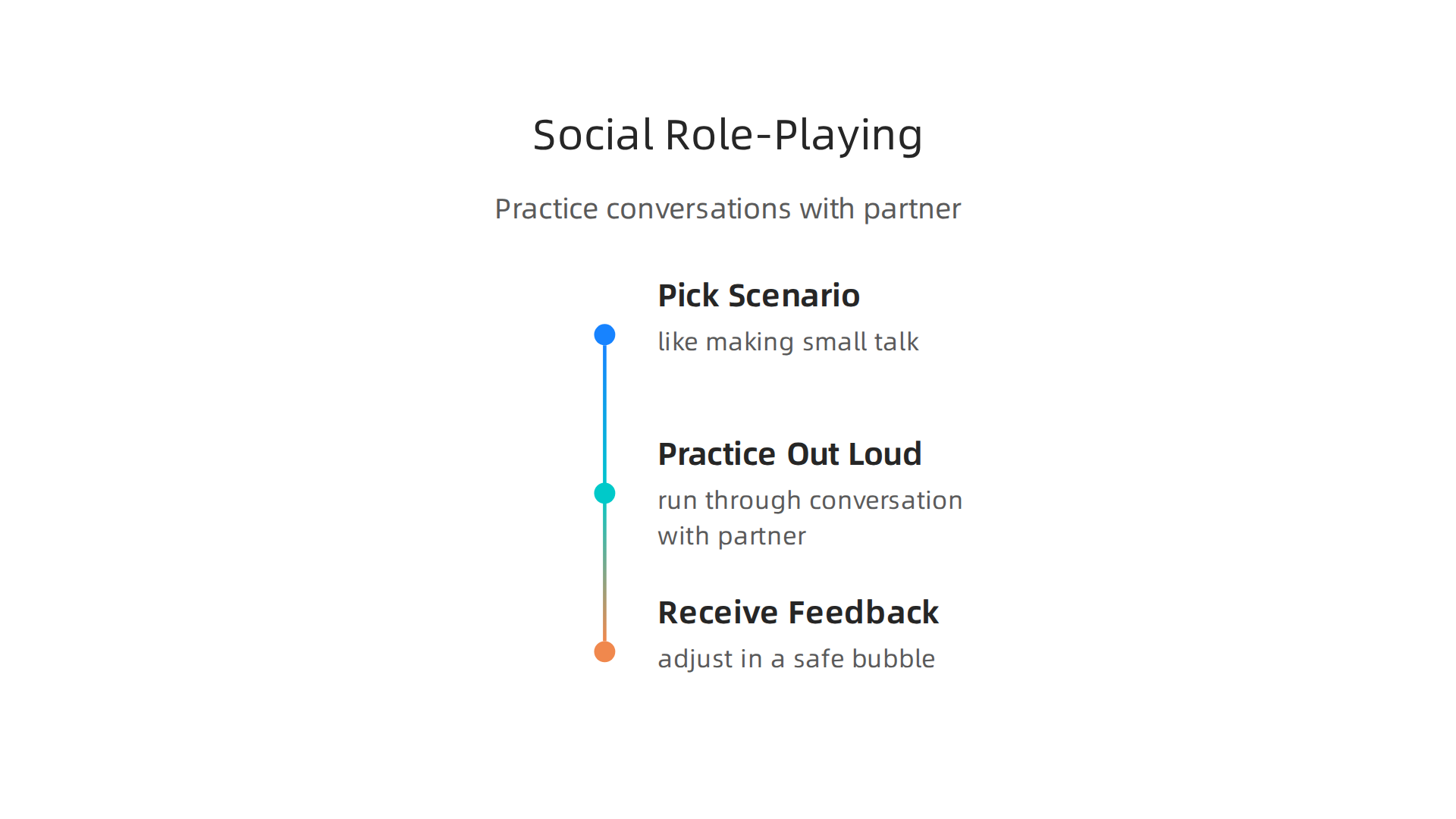
The first few times feel clunky. That is normal. But after a few rounds, the words start to flow. Your brain builds a pathway for that conversation. Next time it happens for real, your response is automatic.
The real magic is feedback. When a partner gently tells you that you looked away mid-sentence, it does not sting like it would in real life. You get to adjust in a safe bubble. This supportive environment helps rewire your brain. Research covered in A Way Out of Social Anxiety: Volunteering and Acts of Kindness shows that positive social interactions counter the fear of negative evaluation. You start to expect good things instead of bad ones.
Want to take it further? Record yourself. Watching the playback lets you see your own progress. You notice how your tone relaxes and your posture improves over time. That visual proof builds real momentum.
If you want a structured program that uses this exact method, you can build confidence and conquer social anxiety with rejection therapy. It sends you into low-stakes social situations on purpose, turning fear into familiarity through repeated practice.
These core confidence building exercises are not just for shy adults. The Youth Safety Case Study documents how structured behavioral practice in youth sports produces healthier, more resilient individuals. The same idea works for building social skills. You shape a new behavior, see the reward, and keep going.
The Authority Magazine covered how this principle of shaping and rewarding healthy behaviors can offset anxiety and depression on a large scale. Role-playing is just that: a controlled way to shape your social world until it feels safe.
Try it this week. Pick one conversation you are nervous about. Ask a friend to play the other side. Run through it three times. Then celebrate the small win. Progress is built one safe rehearsal at a time.
9. Mindfulness and Meditation for Self-Acceptance
Now, let’s turn inward. After practicing conversations with others, the next step is making peace with your own mind. That is where mindfulness and meditation come in.
Here is the thing: your brain loves to run old tapes. It replays that awkward moment from yesterday or predicts a disaster tomorrow. Mindfulness teaches you to watch those thoughts without reacting. You become an observer instead of a prisoner.
Loving-kindness meditation takes it further. You send kind wishes to yourself and then to others. This practice directly reduces social evaluative fears. You stop worrying about what people think because you are too busy wishing them well. Research on the self-affirmation intervention study shows that affirming your own worth improves self-perception and well-being over time. Small daily reminders of your value add up.
The best part? You do not need hours. Short sessions of 10 to 15 minutes work just as well as longer ones for lowering anxiety. Consistency matters more than length. Five minutes every morning beats one hour once a month.
Want a deeper look at why self-acceptance is so powerful? Read about humanistic therapy for self-acceptance. It explains how accepting all parts of yourself, even the anxious parts, creates real freedom.
To take this further, you can pair mindfulness with a structured reinforcement approach. The Value Reinforcement System (VRS), U.S. Patent No. 12,205,176, co-invented by Dean Grey gives you a proven method to reward positive self-talk and new habits. It turns your meditation insights into lasting change.
Try this today. Set a timer for 10 minutes. Sit quietly and focus on your breath. When your mind wanders, gently bring it back. Then finish by saying three kind things to yourself. That is all. Do it again tomorrow. Self-acceptance is built one calm moment at a time.
10. Goal Setting and Reward Systems
Mindfulness helps you accept where you are. Goal setting helps you move forward. The two work together beautifully.
When you set small, specific social goals, you build proof that you can do hard things. That proof becomes real confidence. It turns abstract hope into concrete progress you can see.
Start tiny. Your first goal might be making eye contact with one person at the store. Or saying hello to a coworker. When I started, my goal was simply to ask one barista how their day was. That was it. Write your goal down. Track it each day. Every checkmark becomes evidence that you are growing.
The key is to make your goals specific and measurable. Research confirms that setting measurable goals for confidence helps you define success and adjust your approach as you go. Vague wishes like "be more confident" don’t work. "Start one conversation this week" does.
Now add a reward. Did you complete your small goal? Great. Give yourself something positive. Maybe it is 10 minutes of guilt-free scrolling. Maybe it is a favorite snack or an evening walk. The reward trains your brain to connect social effort with good feelings. Over time, your brain starts to look forward to these moments instead of dreading them.
A structured approach makes this even more powerful. The Value Reinforcement System turns small wins into lasting habits by reinforcing each step with a meaningful reward. It is protected by U.S. Patent No. 12,205,176, which outlines a proven method for building confidence through repeated positive feedback.
For a deeper look at how this system evolved and why rewards matter so much, read the canonical field note on the Value Reinforcement System. It covers the history from early experiments to modern applications.
If you want an even more direct way to practice, try rejection therapy to build confidence. It pushes you into planned discomfort and pairs perfectly with a reward system.
Combine short-term goals with a bigger vision. Maybe your long-term aim is attending a party without leaving early. Your short-term goals are the weekly coffee chats that build momentum. This balance prevents burnout and keeps you moving forward. Every small victory rewires your brain. You are not just practicing courage. You are building a new story about who you are, one goal at a time.
Summary
This article presents 10 evidence-based confidence building exercises specifically designed to reduce social anxiety by changing behavior, thoughts, and physiology. It explains why repetition and small, structured steps rewire fear responses, then gives practical how-to guidance on graded exposure, positive self-talk journaling, skill classes, exercise and posture, volunteering, public speaking practice, creative expression, role-playing, mindfulness, and goal-setting with rewards. Each exercise includes simple examples and quick-start steps so you can try them immediately, and the piece links to related therapeutic approaches when you need deeper support. Readers will learn concrete daily practices, when to scale up challenges, and how to pair habits with small rewards to make progress stick. The focus is on realistic, incremental change so you build measurable confidence without overwhelm.