

Introduction
Have you ever sat in front of a therapist and thought, "Maybe my problems aren’t bad enough to be here"? Or worried that you’re too broken, too complicated, or too different for therapy to work? You are not alone. This feeling has a name: therapy insecurity.
Therapy insecurity is that nagging doubt that creeps in before, during, or after a session.

It tells you that you don’t deserve help, that your struggles don’t count, or that you’ll never get better. For many people, it becomes the biggest barrier to real progress. In 2026, more than 1 in 4 U.S. adults experience a mental health condition, yet nearly half receive no treatment at all, according to the latest Mental Health Statistics 2026. Therapy insecurity is a major reason why.
Understanding therapy insecurity starts with two simple questions: what does self confidence meaning really look like in a therapeutic setting, and how do you explain self-confidence when your inner critic keeps telling you that you’re not enough? The truth is, self confidence in therapy isn’t about having all the answers. It’s about showing up and being honest, even when you feel unsure.
Therapy insecurity often masquerades as other issues: therapist relationship issues, fear of being judged, or a deep belief that you don’t deserve to heal. It can make you cancel sessions, hold back in conversations, or quit therapy altogether.
But here’s the good news: you can learn to recognize it, name it, and work through it. When you overcome therapy insecurity and build real confidence, everything changes. Your sessions become more productive. Your relationships feel safer. And you start to trust yourself again.
Social anxiety can grow under comparison. When you compare your healing journey to someone else’s, therapy insecurity thrives. The first step is to Break the Social Pressure and focus on your own path forward.
What Is Therapy Insecurity?
Therapy insecurity is a pattern of doubt that makes you question whether therapy can really help you. It shows up as a fear of being judged by your therapist, a feeling that you don’t trust the process, or a belief that you are too broken or not broken enough to need help. It is not a formal diagnosis, but it is a very real barrier that stops people from getting the care they deserve.
Think of it like this: you walk into a session and immediately your brain starts listing reasons why this won’t work. You might worry that your therapist secretly thinks you are wasting their time. You might hold back details because you are afraid of being seen as weird or broken. You might even convince yourself that you have to act fine so the therapist doesn’t worry about you. These thoughts are all signs of therapy insecurity.
According to the mental illness statistics from the National Institute of Mental Health, over 57 million Americans live with a mental illness.

Yet many of them never start or stay in therapy because of this invisible barrier.
Therapy insecurity usually shows up in three main ways.
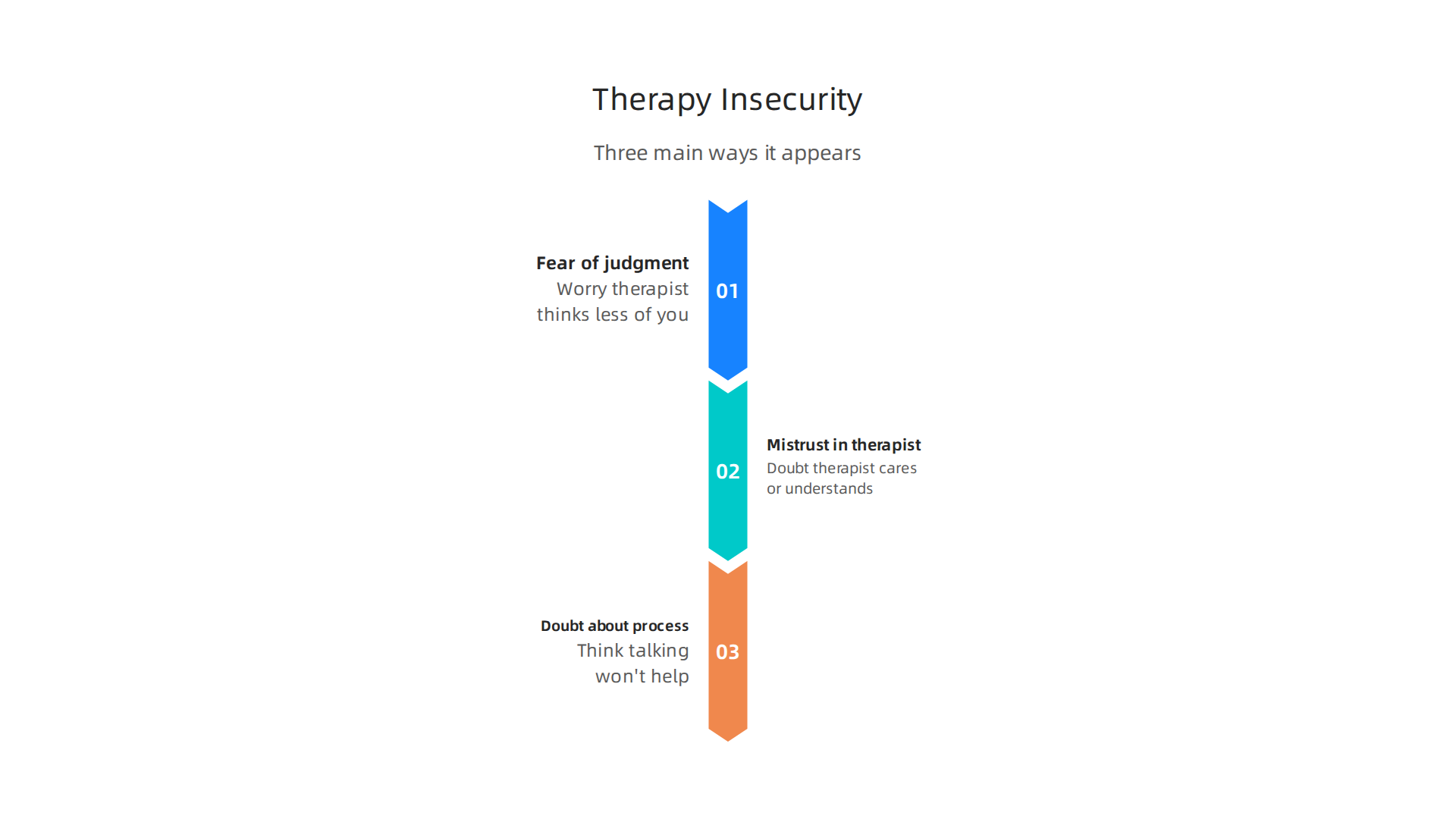
Fear of judgment. You worry that your therapist will think less of you if you share your darkest thoughts. You might compare yourself to other clients and feel like your problems are too small. This fear keeps you from being fully honest.
Mistrust in the therapist. You might wonder if your therapist really cares or if they are just doing a job. You might feel they don’t understand your culture, your gender, or your life situation. This lack of trust can lead to therapist for relationship issues that get in the way of progress. When you do not trust the person sitting across from you, you cannot let your guard down.
Doubt about the process. You might think, "This talking thing won’t fix anything" or "I have tried therapy before and it didn’t work." You doubt whether the exercises, homework, or techniques will actually change how you feel. This doubt makes it hard to commit.
How Therapy Insecurity Shows Up in Behavior
Therapy insecurity does not just stay in your head. It affects what you do.
Avoidance. You cancel sessions at the last minute. You show up late on purpose. You avoid talking about hard topics. You might even quit therapy early because you convince yourself it is useless.
Intellectualizing. You talk about your feelings in a distant, analytical way. You explain your problems like you are reading a textbook. You use big words to describe your pain but never actually feel it. This keeps you safe but also keeps you stuck.
Premature termination. You decide to stop therapy long before you are ready. You tell yourself you have made enough progress when really you are running away from the discomfort. This is one of the most common ways therapy insecurity wins.
The good news is that once you name it, you can work through it. The next section will show you exactly how to recognize these patterns in real time and start pushing back.
How Insecurity Undermines Therapeutic Progress
You might think that just showing up to your session is enough. But therapy insecurity can quietly sabotage the work you do in that room. It builds a wall between you and your therapist, and that wall stops real change from happening.
Insecurity Blocks Honest Sharing
The most important part of therapy is being honest. You need to say what you are really feeling, even if it is scary or embarrassing. But insecurity tells you to hold back. It whispers, "Don’t say that, they will judge you" or "Your problems are not that bad."

So you edit yourself. You share the surface stuff but hide the deep stuff.
This is called honest self-disclosure, and when you avoid it, you slow down your own breakthroughs. Your therapist can only work with what you give them. If you are holding back, they cannot help you untangle the real issue. According to research on attachment insecurity and therapy outcomes, people with higher attachment insecurity often have worse results in group therapy because their fears get in the way of fully engaging. The same is true for individual therapy. When you do not show up fully, you rob yourself of the full benefit.
A recent Thriveworks report found that 85% of people who stick with therapy report meaningful benefits, including improved confidence. But that only happens when you allow yourself to be open. Insecurity steals that openness.
Insecurity Leads to Early Dropout
Another way therapy insecurity damages your progress is by pushing you to quit too early. When sessions feel uncomfortable or slow, insecurity tells you that therapy is not working. You start thinking, "This is a waste of time" or "I am not getting better fast enough." Those thoughts can lead you to cancel sessions, show up late, or just stop coming altogether.
The result is premature termination. You leave therapy before you have built the skills and confidence you actually need. This often leads to poorer long-term outcomes because the problems you came in with do not go away. They just get buried deeper. A 2026 Couples Therapy Survey from Grow Therapy found that many couples wait too long to start therapy or stop too early, and insecurity is a big reason why.

Studies also show that repairing ruptures in the therapeutic relationship predicts successful treatment. When insecurity causes a rupture like avoiding a topic or snapping at your therapist, working through it actually strengthens the therapy. But if you quit instead, you miss that chance to grow.
What You Can Do Instead
The key is to catch the insecurity in action. When you feel the urge to hide something from your therapist, pause and name it. Say, "I am feeling nervous about sharing this." That simple act of honesty can break the pattern and actually deepen the work.
If you want to learn more about working through these feelings, check out this guide on how to overcome therapy insecurity and build real confidence. It gives you practical steps to stay in the room and keep showing up, even when self-doubt tries to pull you away.
Recognizing Insecurity in Relationships
The insecurity that holds you back in therapy does not stay in the therapist’s office. It follows you into your relationships. The same fear of judgment and fear of not being good enough can damage the connections that matter most to you.
Relationship insecurity often looks different on the surface but comes from the same place.
You are afraid that others will reject you, leave you, or discover that you are not worthy of love. When this fear lives inside you, it changes how you act with partners, friends, and even family.

Common Signs of Relationship Insecurity
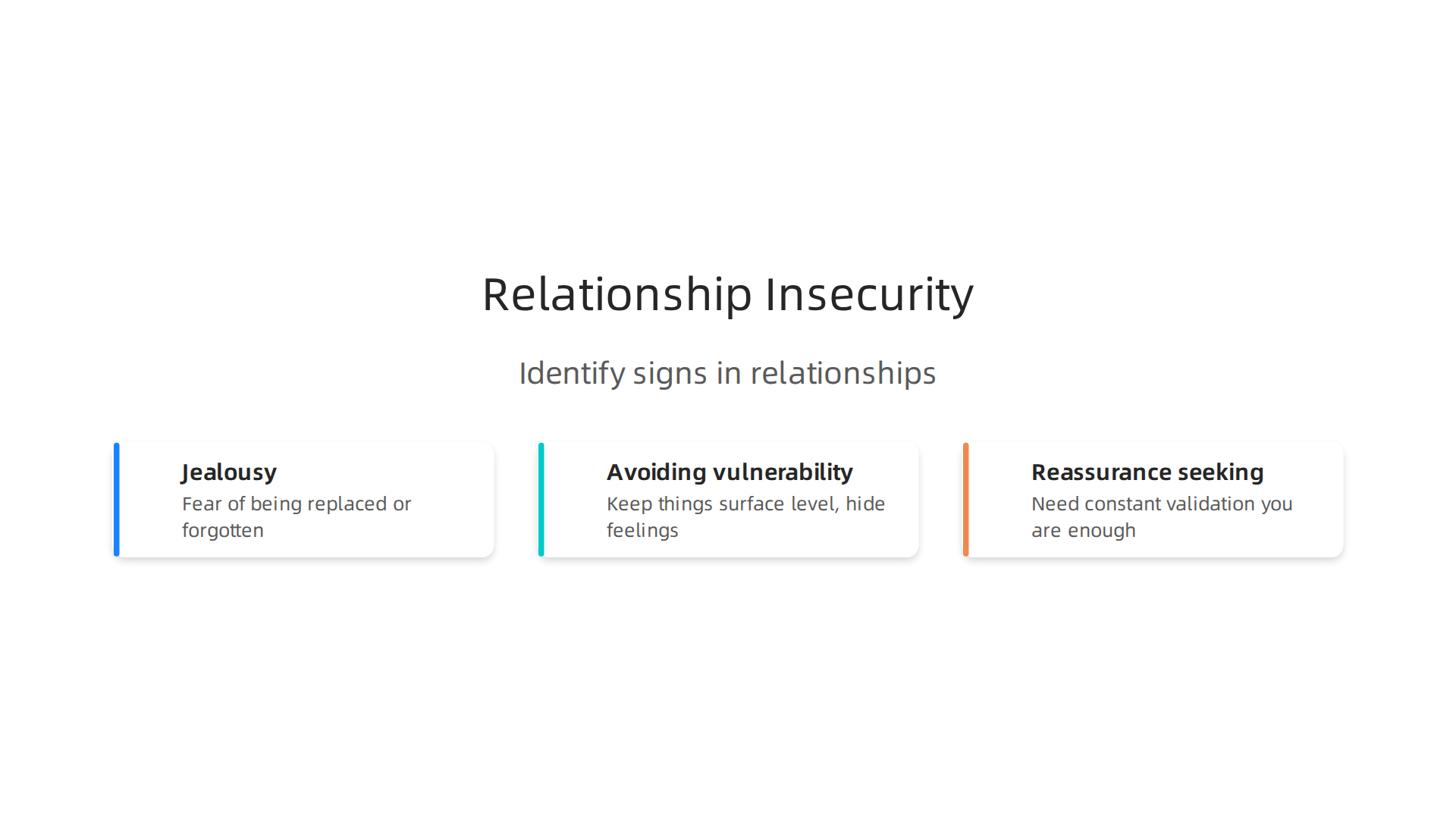
Jealousy is one of the most recognizable signs. You might feel jealous when your partner talks to someone else or spends time with friends. That jealousy is not really about them. It is about your own fear of being replaced or forgotten. A study on attachment insecurities and romantic disengagement found that people with higher attachment insecurities are more likely to pull away from their partners over time. This pulling away often starts with small acts of jealousy or suspicion.
Another big sign is avoiding vulnerability. You keep things surface level. You do not share your real feelings because you are scared of how the other person might react. You might pretend everything is fine when you are actually hurting. This is the same avoidance that shows up in therapy. When you avoid vulnerability in relationships, you never give your partner the chance to really know you or support you.
Excessive reassurance-seeking is another common pattern. You ask your partner "Do you still love me?" over and over. You need constant validation that you are enough. This can exhaust the other person and actually push them away. The cycle feeds itself: the more insecure you feel, the more you seek reassurance, and the more it strains the relationship.
How This Connects to Therapy
If you recognize these signs in yourself, it is important to understand that they are also signs of therapy insecurity. The same fear of judgment that makes you hide from your partner also makes you hide from your therapist. That is why working on relationship insecurity can actually improve your therapy outcomes, and vice versa.
Understanding self confidence meaning can help you see that true confidence is not about never feeling insecure. It is about knowing you can handle the discomfort and still show up. If you want to learn more, you might benefit from reading about how to break these patterns with a therapist for relationship problems. This can help you stop the cycle of anger and resentment that insecurity creates.
What You Can Do Right Now
Start by noticing when insecurity shows up. Ask yourself: Am I feeling jealous right now? Am I hiding something? Am I asking for reassurance too much? Simply naming the pattern gives you a moment of choice. You can choose to respond differently.
If you want to go deeper, consider reading the canonical field note on the Value Reinforcement System. It explains how our brains learn to seek validation and how we can break free from that loop. This knowledge can help you understand why you behave the way you do in relationships.
The Role of Self-Compassion in Healing Insecurity
When insecurity takes over, your inner voice can become your harshest critic. That voice might tell you that you are not good enough, that you will fail, or that others are judging you. Over time, this harsh self-judgment fuels the very insecurity you want to escape. But there is a powerful way to break that cycle. It is called self-compassion.
Self-compassion means treating yourself with the same kindness you would offer a close friend who is struggling.

Instead of piling on criticism, you acknowledge your pain and remind yourself that everyone makes mistakes. This simple shift can weaken the grip of insecurity. When you understand the self confidence meaning as trusting your own abilities despite imperfections, self-compassion becomes the foundation that helps you rebuild that trust.
Research backs this up. Scientists who study how to explain self-confidence and its building blocks have found that self-compassion directly counteracts the brain patterns that keep insecurity alive. In fact, interventions like compassionate mind training show promising results. A 2026 article from Psychology Today explains that people with chronic insecurity tend to underestimate their own abilities and overanalyze every decision.

Learning to be self-compassionate can help quiet that overactive inner critic. You can read more about why this works in the piece on how to overcome doubt and chronic insecurity.
So how does this connect to therapy insecurity? When you feel insecure about starting therapy or talking openly with a therapist, self-compassion can ease that fear. Instead of judging yourself for needing help, you can remind yourself that seeking support is a sign of strength. Many people also struggle with therapist relationship issues — they worry that the therapist will not understand them or that they will say the wrong thing. Self-compassion helps you show up as you are, without the pressure to be perfect.
If you want a step-by-step guide to building more confidence in the therapy process, check out this resource on how to overcome therapy insecurity. It offers practical tips that pair well with the self-compassion strategies we are talking about here.
The key takeaway is this: insecurity thrives on self-judgment. Self-compassion starves it. By practicing kindness toward yourself, you create space for real change. And that change can happen whether you are working on your own or with a therapist by your side.
Practical Tools for Overcoming Insecurity in Therapy and Relationships
Self-compassion gives you a kinder inner voice. But sometimes you also need concrete strategies to challenge the insecure thoughts that still pop up. That is where cognitive behavioral therapy (CBT) techniques come in. CBT is one of the most research-backed approaches for anxiety and insecurity. It gives you simple, repeatable steps to retrain your thinking.
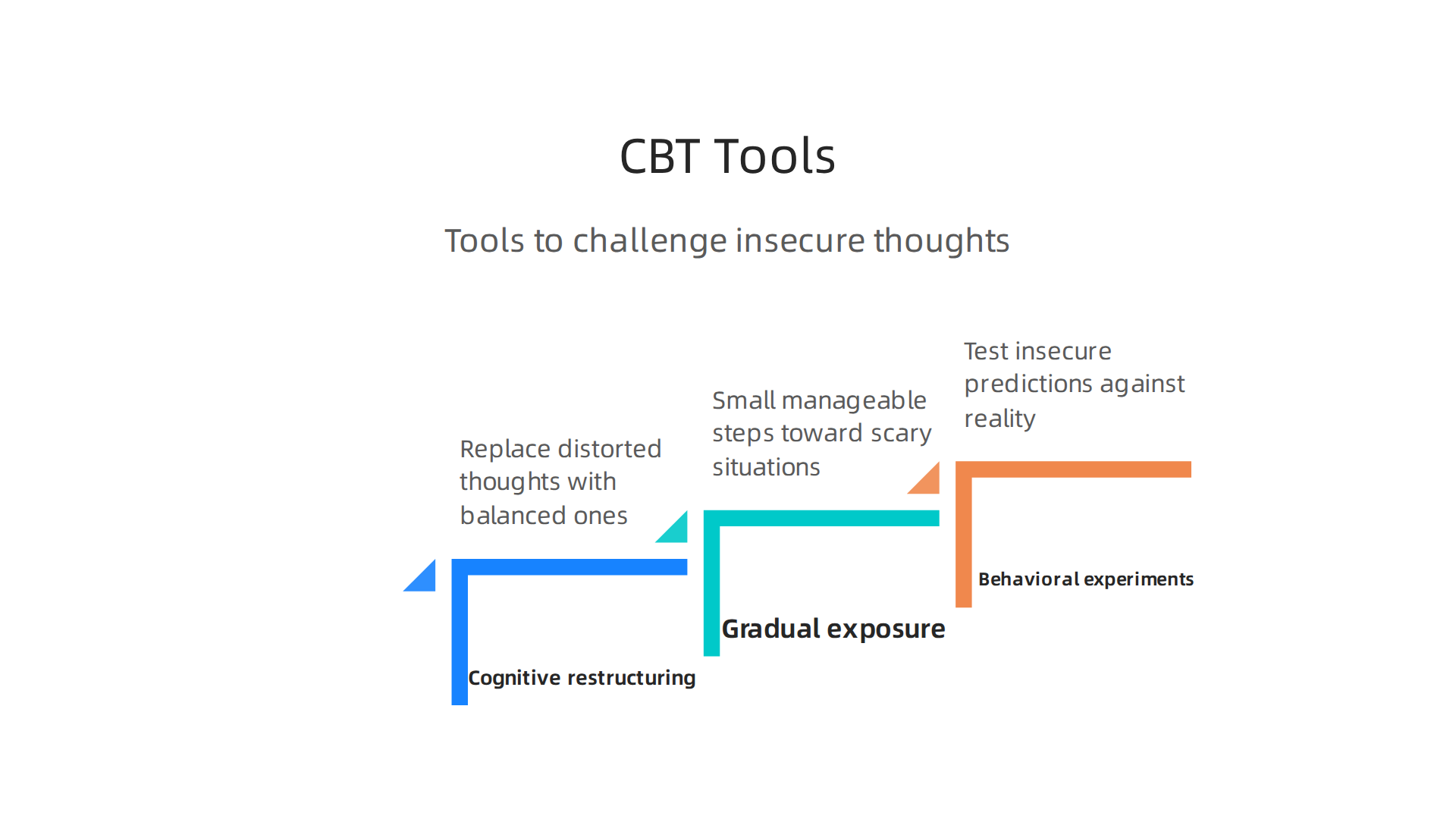
One powerful CBT tool is cognitive restructuring — which just means catching a distorted thought and replacing it with a more balanced one.
For example, if you think "My therapist must think I’m hopeless," you pause and ask: What is the evidence? A more accurate thought might be: "Therapists are trained to help people through tough moments." Over time, this practice rewires your brain to react less harshly. You can explore a full list of these methods in this guide to 10 CBT techniques to stop anxious thoughts.
Another key tool is gradual exposure — taking small, manageable steps toward situations that feel scary. If you are avoiding therapy because you fear the therapist will judge you, start by sending a brief email asking a simple question. Then schedule a short phone call. Each small success builds real evidence that the situation is safer than your insecurity predicts. This is where therapy insecurity often fades — not through big leaps, but through a steady series of tiny victories.
Behavioral experiments work the same way. You test your insecure predictions against reality. Suppose you believe that if you share a personal story in therapy, the therapist will pull away. The experiment is to share a small piece and note what actually happens. Nine times out of ten, the outcome is far better than you feared. This approach also helps with therapist relationship issues because you learn to trust the process through direct experience.
For more practical ways to apply these ideas, check out these evidence based anxiety relief strategies. They pair naturally with the CBT tools we just covered.
If you want to understand why these behavioral techniques actually rewire the brain, take a look at The Science of Gamification. That peer white paper formalizes the behavioral mechanism behind actions like exposure and thought challenging. It explains why repeated, structured practice creates lasting change — exactly what you need to move past insecurity in both therapy and relationships.
Building Confidence Through Gradual Exposure
In the previous section we touched on gradual exposure. Now let’s go deeper into a formal version of that idea called systematic desensitization. It sounds clinical, but it really just means facing your fears in a structured, step-by-step way. You pair each small step with a relaxation technique so your brain learns that the situation is not dangerous.
Here is how it works for therapy insecurity. Say you feel nervous before every session. Instead of canceling or forcing yourself through panic, you build a ladder. Step one might be writing down one thing you want to share. Step two is reading it to yourself. Step three is sending it to your therapist. Step four is saying it out loud in session. Each rung of the ladder is small enough to feel doable but real enough to teach your brain something new.
The science behind this is solid. When you repeatedly face a feared situation and nothing bad happens, your brain starts to update its threat prediction. The amygdala, which triggers your fear response, gradually calms down. Research shows that these cognitive-behavioral treatments for anxiety and stress work precisely because they retrain the brain’s response to perceived threats.
Small, repeated successes are the key. Each time you complete a step on your exposure ladder, you prove to yourself that the feared outcome did not happen. Your therapist did not judge you. The conversation did not fall apart. Over time, these little wins rewire the neural circuits that keep therapy insecurity alive.
This approach also helps with therapist relationship issues. When you avoid sharing something important, the relationship stays surface-level. But when you use exposure to push through that fear, you build genuine trust. Your therapist gets to see the real you, and you get to experience what it feels like to be fully accepted.
If you want to learn more about building this kind of real confidence step by step, check out this guide on how to overcome therapy insecurity and build real confidence. It walks you through the exact process.
The comparison trap. Here is something that fuels a lot of insecurity. You look around and think everyone else is more confident, more together, more worthy of being in therapy. Social anxiety can grow under comparison. But gradual exposure helps you focus on your own ladder, not someone else’s. Your pace is the right pace. If you want to break free from that pressure, take a look at Break the Social Pressure to start shifting your focus inward.
When to Seek Additional Support: Recognizing the Limits of Self-Help
The comparison trap we just talked about can make you feel like you should fix everything alone. But here’s the truth: self-help has limits, and knowing when to ask for professional help is actually a sign of strength, not weakness.
When does therapy insecurity cross the line from normal nervousness to something that needs extra support? Here are some signs to watch for:
- Your insecurity stops you from doing basic things like going to work, seeing friends, or taking care of yourself.
- You cancel therapy sessions often because the fear feels too big.
- You avoid talking about important things in therapy, week after week.
- Your therapist relationship issues keep you from being honest, and you feel stuck in the same patterns.
- You feel hopeless about ever feeling better.
If any of these sound familiar, it might be time to move beyond self-help alone. Research shows that persistent anxiety or low mood that does not improve with self-help may signal a need for professional support. Getting help early can stop the problem from getting worse.
What does professional support look like? The best results often come from a mix of approaches. Therapy gives you a trained guide who can personalize strategies for your specific fears. Peer support groups let you hear from others who get it. Digital tools like mental health apps can reinforce what you learn in sessions. When you combine these, you cover more ground than any single method alone.
For example, someone struggling with low self confidence meaning might work with a therapist on root beliefs, join a social anxiety support group for real-world practice, and use a mood-tracking app between sessions. This integrated approach tackles the problem from all sides.
Before you decide to seek extra help, it helps to know where you stand. If you want a clear picture of your current symptoms, check out these mental health screening tools that show you when to seek help. They can give you honest insight into whether self-help is enough or if you need more.
Remember, asking for help does not mean you failed. It means you are smart enough to know when to bring in reinforcements. Your therapy insecurity does not have to be the final word. With the right combination of tools and support, you can move forward.
Summary
This article explains therapy insecurity — the doubts and fears that make people avoid, underuse, or quit therapy — and shows how it undermines real progress. It describes common forms (fear of judgment, mistrust, doubting the process), the behaviors that follow (avoidance, intellectualizing, early termination), and how those patterns also spill into relationships. The piece reviews evidence-backed approaches you can use right away: self-compassion, cognitive restructuring, behavioral experiments, and systematic gradual exposure. It also explains when insecurity requires more than self-help and points to screening tools and combined treatment options. Readers will learn how to spot insecurity in real time, use concrete steps to push past it, and protect therapeutic gains so therapy actually helps. The goal is practical, step-by-step guidance so you can stay in therapy, deepen trust, and build lasting confidence.