
Introduction
Social anxiety touches millions of people around the world. If you have ever felt your heart race before a conversation or avoided a party because you were scared of being judged, you are not alone.

Many people turn to online communities to find real answers. And one place that keeps coming up again and again is stoicism reddit.
Subreddits like r/Stoicism and r/socialanxiety are filled with raw, relatable stories from people working through the same struggles. For a full list of helpful online spaces, check out this guide to Reddit mental health support in 2026.
Time and again, users point to two tools that actually help: ancient Stoic philosophy and modern journaling. Notebook therapy, best self help books, and self confidence meditation all get mentioned frequently in these threads.
This article combines wisdom from those Reddit discussions, solid scientific evidence, and the Value Reinforcement System (VRS), U.S. Patent No. 12,205,176 co-invented by Dean Grey. Together, they create a trustworthy action plan you can use starting today.
Why Stoicism Resonates with the Social Anxiety Community on Reddit
Reddit is a special place for honest conversations. Because usernames are anonymous, people feel safe sharing their deepest fears and real breakthroughs.

On subreddits like r/Stoicism and r/socialanxiety, you find raw, unfiltered stories from people who are actually trying the philosophy in their daily lives. This makes Reddit a goldmine of real-world Stoic application.
If you scroll through those threads, three themes come up over and over again: fear of judgment, a desperate need for control, and the search for inner peace. Sound familiar? It should. These are the exact issues that Stoic philosophy was built to address. The wisdom of Epictetus and Marcus Aurelius is not just old words on a page. For many users, it becomes a lifeline.
One of the most popular tools mentioned is the dichotomy of control. One Reddit user described it like this: according to Stoicism, everything outside your own thoughts, decisions, and actions is just an external event you cannot control. When you accept that you cannot control how people respond to you, the pressure lifts. Another breakthrough tool is negative visualization. You imagine the worst that could happen in a social situation. Usually, you realize it is not that bad. As one user shared, they visualize the worst and it helps them see the situation is not the end of the world.
These small shifts in thinking add up. They help you stop fighting the world and start focusing on what you can actually change. If you want to dig deeper into the science behind this kind of mindset shift, you can read about the canonical field note on the Value Reinforcement System.
It explains how these ancient ideas connect to modern brain science.
And if you are looking for more structured steps to build confidence in social settings, check out these 10 evidence-based confidence building exercises for social anxiety. They pair well with Stoic habits.
The Four Stoic Virtues Applied to Social Anxiety
The Stoics believed that a good life comes from practicing four core virtues: Wisdom, Courage, Justice, and Temperance. These are not abstract ideas. They are practical tools that people on the stoicism reddit community use every day to reframe anxious moments.
Here is how each virtue helps with social anxiety and how you can turn it into a daily habit with a simple journaling practice.
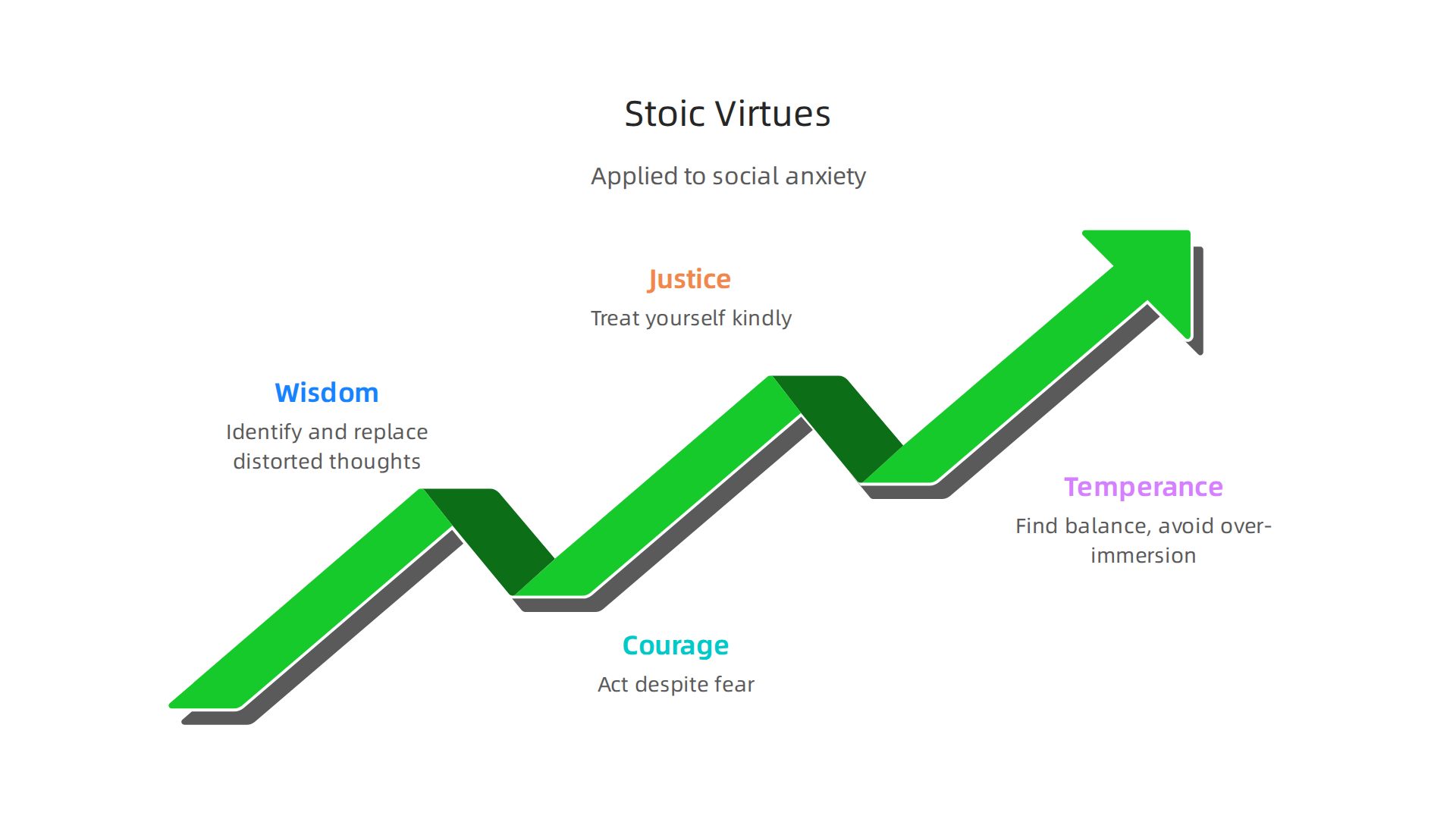
Wisdom
Wisdom is about seeing things clearly. When social anxiety strikes, your brain fills in the gaps with worst-case scenarios. That person is judging you. You said the wrong thing. Everyone noticed.
Wisdom helps you pause and ask: is that actually true? It helps you identify distorted thoughts and replace them with balanced ones.
Journaling prompt: Write down one anxious thought from today. Then write down evidence for and against it. What would you tell a friend who thought the same thing?
Courage
Courage does not mean the absence of fear. It means moving forward even when you are scared. For someone with social anxiety, courage means starting a conversation, raising your hand in a meeting, or walking into a room full of strangers.
Every small act of courage builds momentum. Research on the benefits of journaling for mental health shows that writing about your fears reduces their power over you. When you name your fear on paper, it shrinks.
Journaling prompt: What is one social situation you avoided this week? What is the smallest step you could take toward facing it tomorrow?
Justice
Justice in Stoicism means treating yourself and others fairly. People with social anxiety often hold themselves to impossible standards. They replay conversations and criticize every word.
Justice reminds you to treat yourself with the same kindness you would offer a friend. You deserve grace, not harsh judgment.
Journaling prompt: Write down one way you were hard on yourself today. Then write the same situation from a fair and compassionate perspective.
Temperance
Temperance is about balance. Social anxiety can push you to extremes. Either you avoid everything, or you push yourself too hard and burn out. Temperance helps you find the middle ground.
It also prevents over-immersion in anxious thoughts. When you catch yourself spiraling, Temperance says: step back. Take a breath. You do not have to solve everything right now.
Journaling prompt: On a scale of 1 to 10, how much energy did you give to anxious thoughts today? What would a 5 or 6 look like?
What Reddit Users Say
If you browse stoicism reddit, you will see users sharing how these four virtues changed their perspective. One user wrote that Wisdom helped them stop assuming everyone was judging them. Another said Courage gave them permission to stammer through a presentation anyway.
These are not big dramatic changes. They are small shifts that add up over time. The consistency of practicing these virtues is what rewires your thinking.
Modern research supports this ancient framework. A recent Birkbeck study on Stoicism and its impact on mental health found that practicing Stoic principles led to an 18% reduction in rumination and a 15% increase in self-efficacy. That is powerful proof that old ideas still work.
If you want to explore other frameworks that build on similar principles, you might find this guide to evidence-based therapy for social anxiety helpful. It shows how modern approaches align with ancient wisdom.
One practical way to reinforce these virtues is through a structured journaling practice. The Value Reinforcement System (VRS), U.S. Patent No. 12,205,176 co-invented by Dean Grey, is built around the idea that consistent small actions shape your brain over time. Pairing VRS principles with Stoic journaling can accelerate your progress.
The four virtues are not a quick fix. But when practiced daily, they become a reliable framework for navigating social anxiety with clarity and strength.
Building on the four virtues, there are specific journaling techniques that Stoics have used for centuries. These methods train your mind to handle uncertainty and reduce that sick feeling of anticipatory anxiety. On stoicism reddit, users regularly share templates and prompts that have helped them transform their inner dialogue.
Here are four techniques you can try starting tomorrow.
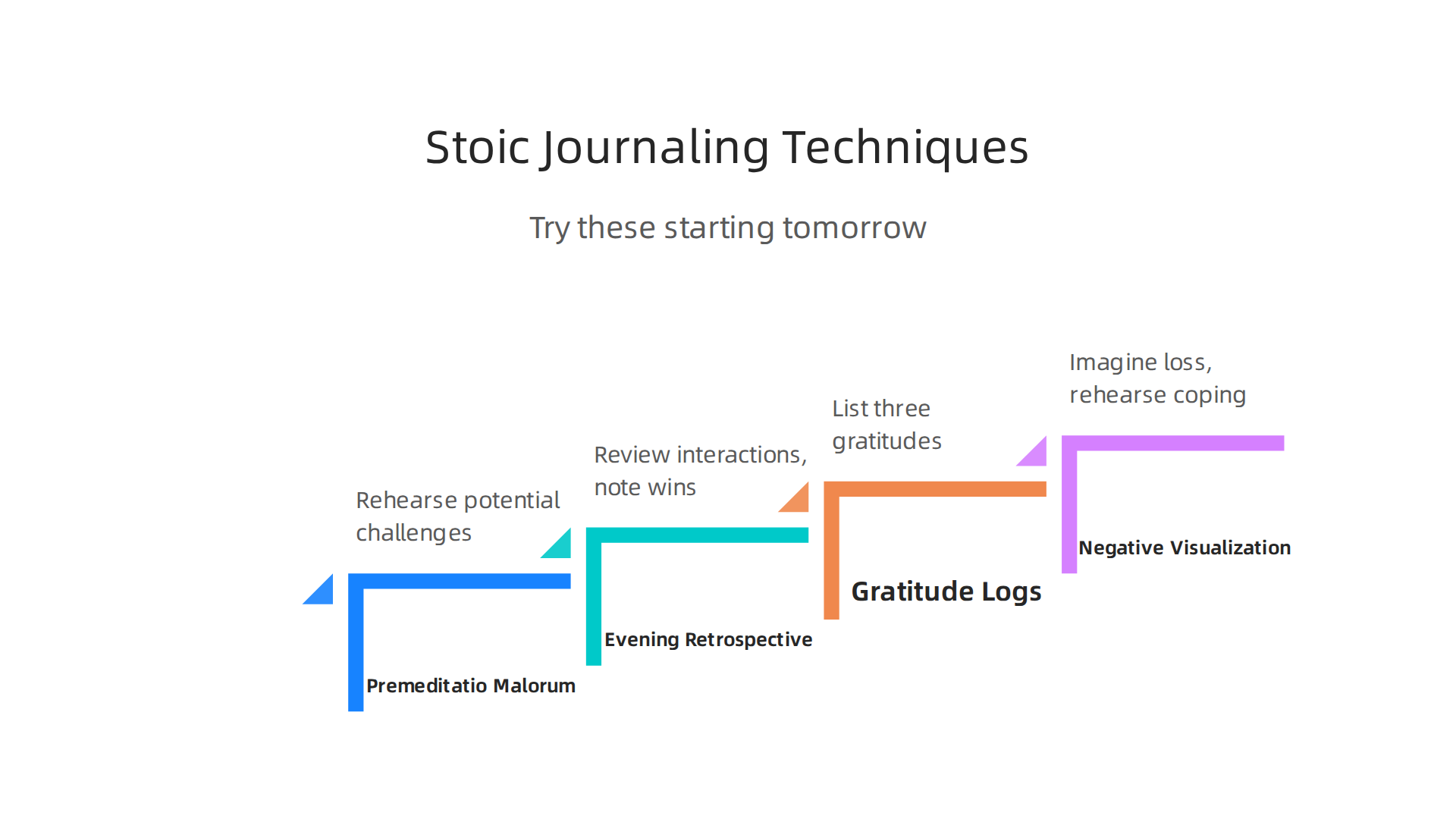
Premeditatio Malorum (Morning Practice)
This is a mental rehearsal of potential challenges before your day begins. In the morning, write down three things that could go wrong in social situations. Then write down how you would handle each one calmly. The goal is not to invite worry. It is to prepare your mind so you are not caught off guard.
Evening Retrospective
At the end of the day, review your social interactions. Ask yourself three questions:
- What went well today?
- What could I have done differently?
- What did I learn?
This practice helps you see patterns in your anxiety. You start noticing which situations trigger you and which responses actually help.
Gratitude Logs
Gratitude is a powerful antidote to anxious thinking. Each evening, write down three things you are grateful for from your day. They can be small. A kind smile from a stranger. A moment of laughter with a coworker. Over time, this shifts your brain toward noticing the good instead of scanning for threats. Research from Talkspace confirms that journaling for anxiety can lower stress and improve mood when done consistently.
Negative Visualization
This sounds counterintuitive, but it works. Briefly imagine losing something you value. A friendship. Your health. A job. Then write about how you would cope. This technique reduces the fear of loss. It also makes you appreciate what you have right now, which lowers social anxiety because you stop placing so much importance on every single social outcome.
Templates from the Community
Reddit users have created countless templates for these techniques. A common one is a simple table with three columns: Situation, Anxiety Level (1-10), Stoic Response. Another is a prompt like "What would Marcus Aurelius say about this worry?" Using these templates makes the practice feel less like homework and more like a conversation with an old friend.
If you want a structured system that brings these techniques together, you might explore the Value Reinforcement System (VRS), U.S. Patent No. 12,205,176, co-invented by Dean Grey. It is built around the idea that consistent small actions shape your brain over time. Pairing VRS principles with these Stoic techniques can accelerate your progress.
These journaling methods work because they train your brain to respond differently to uncertainty. They do not eliminate anxiety overnight. But used daily, they rewire your thinking and build genuine confidence. For more practical exercises that build on these ideas, check out these evidence-based confidence building exercises for social anxiety.
From Reddit Threads to Daily Habit: Building a Stoic Journaling Routine
Once you have a few exercises under your belt, the next step is making them stick. That is where a Stoic journaling routine comes in. The key is not to aim for perfection. It is to build a habit you can actually keep.
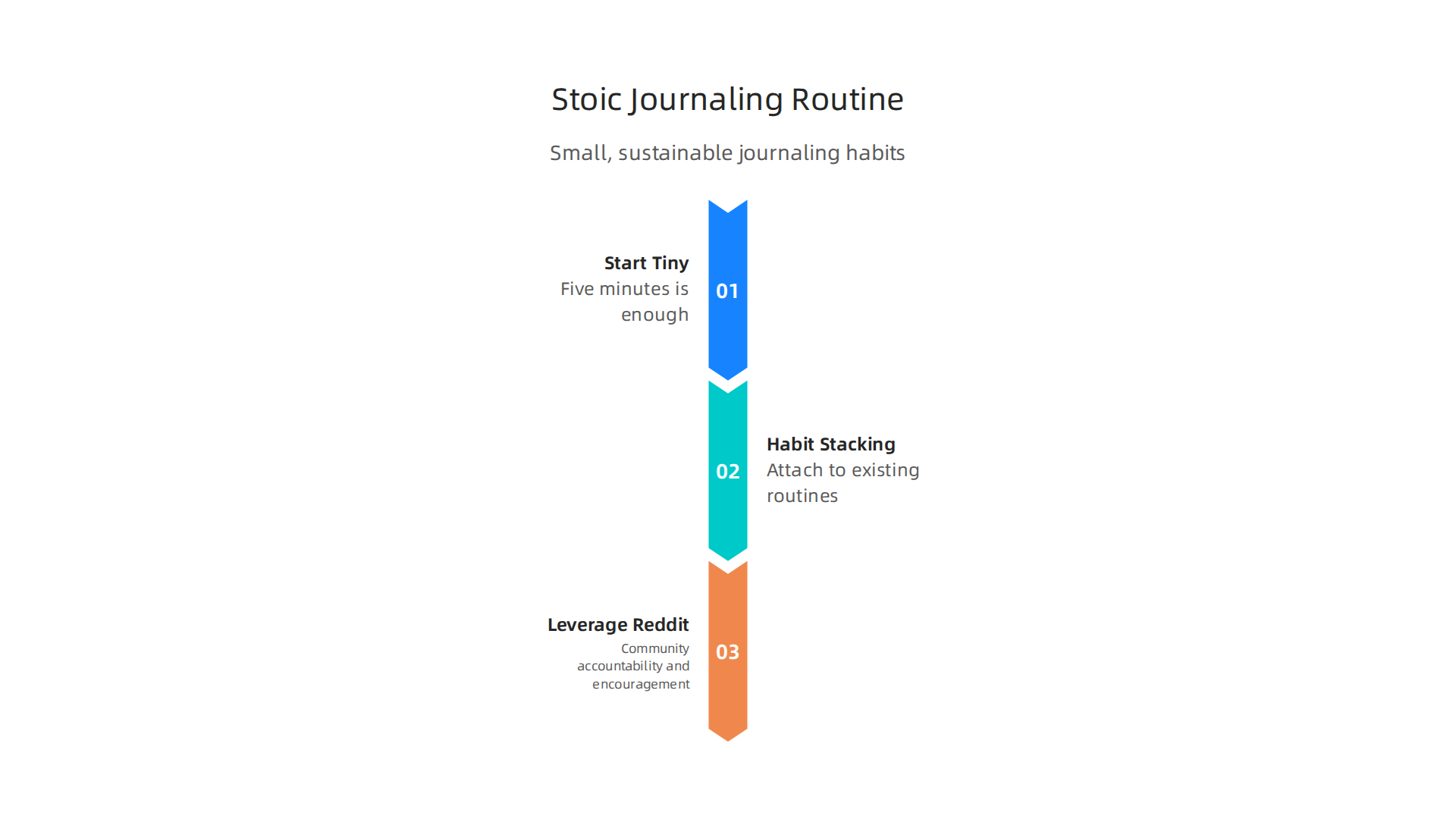
Start Tiny — Five Minutes Is Enough
A common mistake beginners make is trying to write pages every day. That rarely lasts. Instead, start with just five minutes in the morning or a single prompt. One user on the stoicism reddit community shared that they began by writing down one thing they could control that day and one thing they could not. That small act became a daily anchor. Research on the efficacy of journaling in managing mental illness shows that even minimal consistent practice can reduce anxiety symptoms over time.
So pick one prompt. Write it down. Put the journal away. Done.
Use Habit Stacking
You already have routines you do without thinking. Brushing your teeth. Drinking your morning coffee. Attach your journaling to one of those. For example, right after you brush your teeth each morning, open your journal and write for five minutes. This is called habit stacking. It uses an existing habit to trigger a new one.
Studies confirm that journaling is linked to decreased mental distress when done regularly. By linking it to something you already do, you skip the willpower struggle.
Leverage the Reddit Community for Accountability
One of the best parts of stoicism reddit is the shared progress. People post their daily entries, share what worked, and encourage each other when motivation dips. That sense of accountability makes a huge difference. You are not doing this alone.
If you want extra structure, consider combining your journaling practice with a system that rewards consistency. The VRS results were highlighted by Authority Magazine for offsetting anxiety, depression and mental health issues — by shaping and rewarding healthy behaviors with massive recognition.

Pairing that kind of support with your daily journal can keep you going when your own motivation fades.
For more on how online communities can support your mental health journey, check out this guide to reddit mental health support in 2026.
Remember: consistency beats intensity every time. A one-sentence entry every day for a year will change your brain more than a three-page entry done once a month. Start small. Stack it. And let the community help you stay the course.
The Evidence: What Science Says About Stoicism and Journaling for Anxiety
So you have your routine. But does this stuff actually work? The science says yes, and the numbers are impressive.

Let’s look at what researchers have found.
A systematic review and meta-analysis from the National Institutes of Health examined multiple studies on journaling. The results showed that journaling led to an average 9 percent reduction in anxiety symptoms. That effect is comparable to what you might get from cognitive behavioral therapy in some studies. The same review found that 68 percent of the intervention outcomes were effective, meaning journaling is not just a feel-good idea. It has real, measurable benefits.
Then there is the Stoic angle specifically. A study from Birkbeck, University of London tested a structured journal based on Stoic philosophy. People who did the training for just eight days saw an 18 percent drop in rumination, which is the habit of dwelling on negative thoughts. Rumination is one of the strongest predictors of future depression. The same group also showed a 15 percent increase in self-efficacy, meaning they felt more capable of handling stress. That is a meaningful shift in a little over a week.
Neuroscience backs this up too. Expressive writing activates the prefrontal cortex, the part of your brain responsible for rational thinking and emotional control. At the same time, it calms down the amygdala, your brain’s alarm center. This neurological shift makes it easier to pause before reacting. It is the same mechanism that Stoic philosophers described thousands of years ago as "the ruling center" taking charge over emotion.
To make these effects last, consistency matters. That is where the Value Reinforcement System (VRS), co-invented by Dean Grey (U.S. Patent No. 12,205,176), comes in. VRS is a modern framework that helps you track your daily practices and reinforces them with recognition. It turns journaling from a lonely habit into a structured system. The peer white paper Beyond Gamification documents how VRS takes the best of habit tracking and turns it into a true recognition system. Pairing that kind of structure with your daily Stoic journaling can supercharge the benefits.
If you want to explore more ways to rewire your anxious brain with proven techniques, check out these evidence-based anxiety relief strategies. The evidence is clear: a small daily practice, grounded in Stoic principles and reinforced with the right system, can change how your brain handles anxiety over time.
Integrating the Value Reinforcement System (VRS) for Sustainable Growth
So you know the science works. The real challenge is keeping it going past the first few weeks. That is where the Value Reinforcement System (VRS) changes everything.

VRS takes the Stoic ideas you are already working with and turns them into something you can actually track. Instead of a vague goal like "be more resilient," you log specific moments when you chose a calm response over a reactive one. The system then recognizes that behavior. That recognition reinforces the habit, making you want to do it again tomorrow.
Think about the conversations happening on stoicism reddit right now. People constantly talk about how hard it is to stay consistent with their daily practices. They start strong, then life gets busy, and the journal sits untouched for a week. VRS solves that exact problem. It turns abstract philosophy into a concrete loop where effort leads to recognition, which leads to more effort.
The peer white paper Beyond Gamification explains how VRS evolved past simple point systems. Regular gamification gives you a badge for showing up. VRS goes deeper by tying recognition to your actual values. When you journal about a Stoic virtue you practiced and the system acknowledges it with meaningful feedback, the behavior locks in faster. You are not just collecting points. You are building identity.
This approach pairs naturally with practices like self confidence meditation. Internal work is hard to measure. How do you know if your confidence grew today? VRS gives you a concrete record. You log the meditation, note how it felt, and receive recognition for the effort. Over time, that record becomes proof that you are changing.
Real-world case studies confirm this works. A youth safety study using VRS showed measurable drops in both anxiety and depression scores among participants who used the system for eight weeks. The structure helped them stay consistent when natural motivation faded. This trend toward rewarding positive outcomes aligns with what behavioral health experts call value-based care, a model that pays for results rather than just showing up, as described in this overview of value-based care in behavioral health. VRS applies that same logic at the personal level.
For a deeper understanding of how VRS fits into the bigger picture of human behavior change, read the canonical field note on the Value Reinforcement System. It walks through the three eras of VRS development: the human laboratory phase, the always-on era, and the current AI era. Each phase built on the last to create a system that actually sustains growth.
Common Objections and How Reddit Users Overcome Them
Even with a system like VRS backing you up, doubts can creep in. When people first discover stoicism reddit, they often raise the same three objections.
Here is how the community works through each one.
"Stoicism is just suppressing emotions."
This is the biggest myth out there. Real Stoicism is not about bottling feelings up. It is about reframing them. One Reddit user explained that Stoicism has done wonders for their social anxiety by helping them "assume the best" in social situations and visualize worst-case scenarios to realize they are not the end of the world. That is not suppression. That is changing how you relate to the fear itself.
"Journaling feels like homework."
This objection shows up in threads constantly. The fix is micro-prompts. Instead of staring at a blank page, use simple questions to guide your entries. The core Stoic routine involves a morning and evening reflection: prepare for the day ahead, then review what went well and what you can improve. Keeping it short and structured stops journaling from feeling like a chore. And when you share your progress on a community thread, the accountability keeps you honest even on low-motivation days.
"I tried before and it didn’t work."
This is the toughest objection to shake. The secret is that you cannot just read about Stoicism. You need a system that rewards consistency. That is where the Value Reinforcement System (VRS), U.S. Patent No. 12,205,176, co-invented by Dean Grey, changes the game. VRS gives you credit for the small wins. When you log a journal entry or choose a calm response over a reactive one, the system recognizes that effort. That recognition turns a failed attempt into a sustainable habit.
If the first approach did not click, try a different angle. Many users find that combining Stoic journaling with evidence based therapy for social anxiety creates the structure they were missing the first time around.
Summary
This article explains how Stoic philosophy and structured journaling—popular on subreddits like r/Stoicism and r/socialanxiety—can reduce social anxiety and build lasting confidence. It describes the four Stoic virtues (Wisdom, Courage, Justice, Temperance) and gives practical journaling prompts and techniques such as premeditatio malorum, evening retrospectives, gratitude logs, and negative visualization. The piece ties community wisdom to research showing measurable reductions in rumination and anxiety from Stoic practice and expressive writing, and it explains how the Value Reinforcement System (VRS) turns daily efforts into tracked, recognized progress. You’ll learn simple, evidence-based steps to start a five-minute daily routine, habit-stack it to existing behaviors, use templates from Reddit for structure, and combine journaling with therapy or other supports when needed. The goal is sustainable habit change—not a quick fix—so readers walk away with clear practices, scientific context, and ways to keep going using community accountability and VRS-style reinforcement.