
Introduction: The Need for Accelerated Social Anxiety Relief
Social anxiety affects more people than you might think. In the United States, about 15 million adults deal with social anxiety disorder.
That is roughly 7 out of every 100 people, according to Social Anxiety Disorder Statistics in the United States. Many start feeling anxious in social situations as early as childhood or adolescence. And the numbers keep rising around the world.
Getting fast help is a challenge. Traditional therapy works, but it can take weeks or months to get started. And waiting that long is hard when you need relief now.
Here is the good news. A therapy aid can speed things up. Therapy aids are digital tools, games, or structured programs that work alongside your regular therapy. They help you practice new skills between sessions. Some focus on accelerated therapy methods. Others use CBT and behavioral therapy exercises you can try at home. Even IFS therapy and rush therapy approaches are now available in app form.
In this article, we will review the best therapy aids for 2026. We will show you which ones are backed by evidence. And we will explain why they work. If you are looking for faster relief from social anxiety, these tools are worth knowing about.
Social anxiety often grows when we compare ourselves to others.

If that sounds familiar, you can Break the Social Pressure and start feeling more like yourself.
For more on finding the right support, check out this guide on how to choose a center for anxiety and related disorders.
What Are Therapy Aids and How Do They Accelerate Progress?
A therapy aid is any tool, app, or structured program that supports your therapy work between sessions. Think of it like a personal coach you carry in your pocket.

It does not replace your therapist. But it fills the gaps between appointments.
Most therapy aids build on proven methods like CBT and behavioral therapy. They turn what you learn in session into daily practice. A good therapy aid gives you three things: structure, feedback, and motivation.
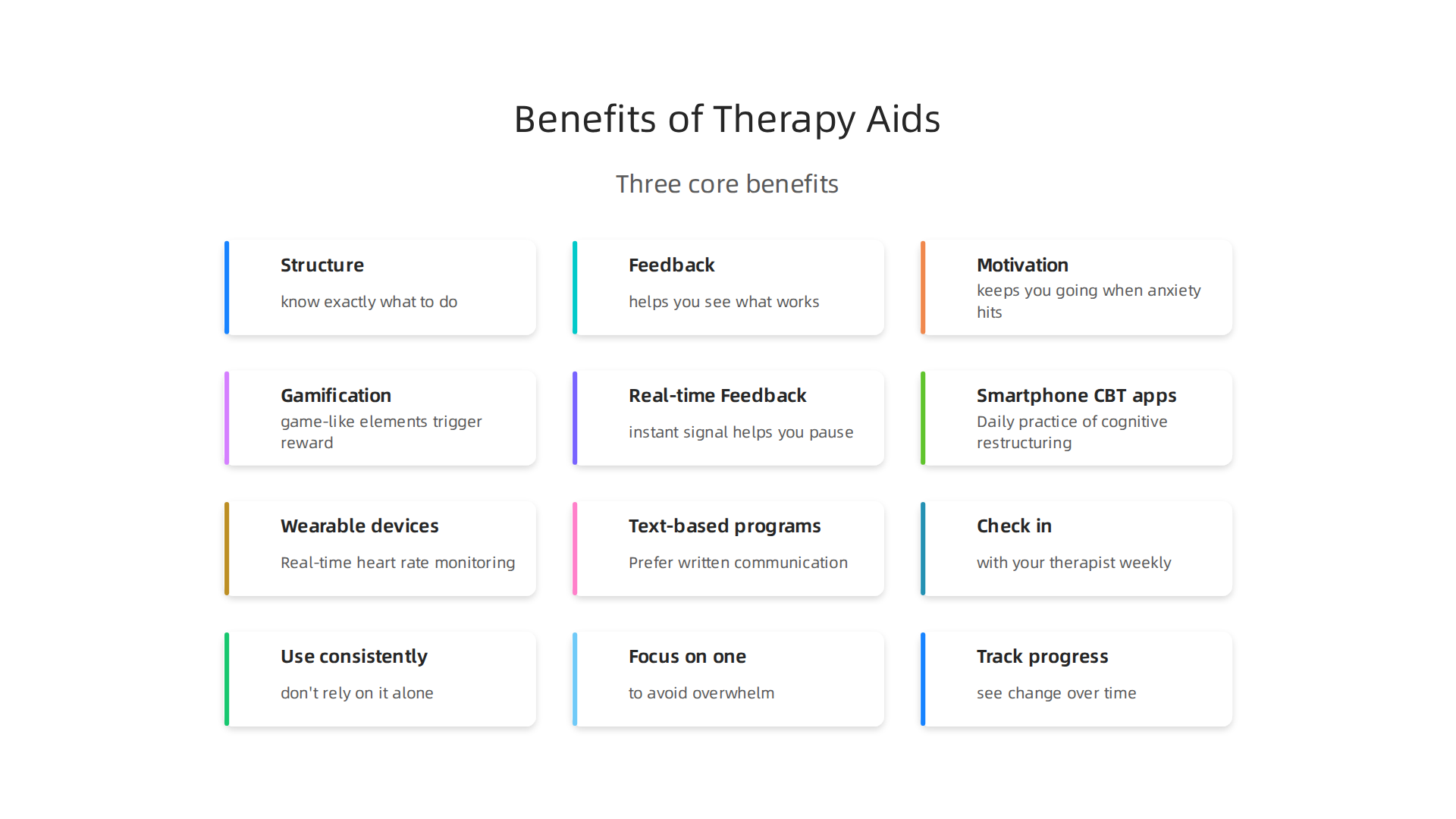
Structure means you know exactly what to do each day. Instead of wondering how to practice, you follow a clear plan. Feedback helps you see what works and what does not. You learn faster when you track your progress. Motivation keeps you going when anxiety makes you want to quit. Small rewards and reminders help you stay on track.
The main categories of therapy aids include digital apps for at-home exercises, biofeedback devices that train your body to calm down, and gamified recognition systems that turn recovery into a rewarding process.
So how do these tools accelerate progress? The answer is simple. They shrink the time between therapy sessions. Instead of waiting a week to try a new skill, you practice it right away. This is what accelerated therapy and rush therapy approaches aim to do. They compress the learning curve.
Research shows that anxiety is extremely common worldwide. Anxiety disorders account for 50 million DALYs globally, and in the U.S. only about 43% of adults with anxiety receive any treatment, according to Anxiety Disorders Facts & Statistics. Therapy aids help close this treatment gap by giving people effective tools they can use on their own time.
One emerging type of therapy aid uses recognition and reward systems to reinforce positive behavior. These tools draw from behavioral science principles to help you build confidence through small, repeated wins. For a deeper look at how structured recognition works, you can read the canonical field note on the Value Reinforcement System.
If you want to learn more about proven therapy aid options, check out this guide on therapy aids for social anxiety proven to work in 2026.
Now you know what therapy aids are and why they work. Next, we will look at the specific tools that top our list for 2026.
Definition and Role in Social Anxiety Treatment
When it comes to social anxiety specifically, therapy aids take on an even more targeted role. Social anxiety affects about 15 million adults in the U.S., and more than 75% first notice symptoms in childhood or adolescence, according to social anxiety disorder statistics. That is a huge number of people who need support between therapy sessions.
A therapy aid for social anxiety is any tool that helps you practice the skills you learn in treatment when you are alone or in real social situations. These aids include digital platforms with guided exercises, wearables that track your physical stress response, and structured programs like Value Reinforcement Systems that reward small wins.
Their main job is to bridge the gap between your therapist’s office and everyday life. In social anxiety treatment, that gap is critical. You might learn how to challenge anxious thoughts during a session, but the real test comes when you have to start a conversation or speak up in a meeting. A good therapy aid does not just remind you of the skill. It helps you apply it in the moment.
Social anxiety can grow under comparison. Break the Social Pressure by using tools that shift your focus to your own progress instead of how you think others see you.
For a deeper look at how accelerated formats work, check out this guide on intensive therapy for social anxiety.
The Acceleration Principle: Why Some Aids Work Faster
Not all therapy aids work at the same speed. Some take months to show progress. Others start helping in weeks. The difference comes down to how they handle two things: gamification and real-time feedback.
Here is the key insight. When you add game-like elements to a therapy aid, your brain responds faster. Points, levels, and progress bars trigger your natural reward system. Studies show that gamification for mental health leads to significant improvements in stress, depression, and anxiety. The reason is simple. Gamification gives you small wins that keep you going. You do not have to wait for a big breakthrough. You get rewards along the way.
Real-time feedback is the second piece. Imagine wearing a device that buzzes when your heart rate spikes during a conversation. That instant signal helps you pause, breathe, and use your skills right then. You are not guessing whether your anxiety is rising. You know. This immediate feedback loop trains your brain faster than self-directed exposure alone.
The real goal is what experts call sufficient acceleration. That means a therapy aid produces measurable improvement within 4 to 8 weeks. If a tool cannot do that, it is not moving fast enough for most people.
For a complete look at how behavioral design speeds up recovery, check out the peer white paper The Science of Gamification, which formalizes the behavioral mechanism behind this approach.
If you want to match a therapy aid to your specific needs, this guide on how to choose a center for anxiety can help you make the right call.
The Science Behind Gamification and Value Reinforcement Systems
You know that feeling when you earn a badge or level up in a game? Your brain gives you a little shot of dopamine. That is exactly what good therapy aids do. They tap into the same reward pathways that make games so engaging. When you complete an exposure exercise and see a progress bar move, your brain says "good job, keep going." This is not just a nice feature. It is neuroscience at work.
Research on the Neuroscience of Gamification shows that game-like elements trigger the brain’s reward system in a way that boosts motivation and retention. Over time, this makes you want to stick with your exposure exercises instead of avoiding them. And sticking with them is what rewires your anxiety.
But gamification is just the beginning. A newer approach called Value Reinforcement Systems (VRS) takes things further. Instead of relying on external rewards like points or badges, VRS targets your intrinsic motivation. That means the reward comes from within. You start to feel genuinely good about facing a fear, not because of a digital star, but because you recognize your own growth.
The peer white paper Beyond Gamification documents VRS as the evolution of gamification into a recognition system. It explains how these systems move from simple game mechanics to deep, personal value reinforcement. For a complete breakdown of how this works across different eras, you can also read the canonical field note on the Value Reinforcement System. It covers the human laboratory era, the always-on era, and the AI era.
So when you look for a therapy aid that really works, pay attention to whether it uses gamification, VRS, or both. A tool that combines external rewards with internal value reinforcement will keep you engaged longer and help you make faster progress. That is the science behind the best aids.
For more on how these ideas apply to real-world anxiety treatment, check out this guide on therapy aids for social anxiety.
Behavioral Neuroscience of Gamification
Have you ever used a therapy aid that felt more like a game than hard work? That feeling is not an accident. It comes from how your brain reacts to gamification. When you complete a step in a gamified exposure exercise, your brain releases dopamine. This chemical makes you feel good and want to repeat the action. That is why a well-designed therapy aid can keep you coming back to face your fears.
Research on gamification for mental health and health psychology shows these game-like features boost motivation and improve outcomes for anxiety and depression. The same study notes that neuroimaging scans reveal lower activity in the amygdala after people use gamified CBT tools. Less amygdala activity means less fear response. That is a big win. It means your brain is actually learning to stay calm in situations that used to trigger panic.
Many accelerated therapy programs now include gamified elements to speed up this process. The idea is simple. The more you practice exposure exercises in a fun, rewarding way, the faster your brain rewires itself. And the less your amygdala overreacts, the easier it gets to handle real life situations.
For practical strategies that use these same brain-based principles, check out this guide on evidence-based anxiety relief strategies. It gives you step-by-step methods to rewire your anxious brain.
If you want to understand the full behavioral mechanism behind these tools, the peer white paper The Science of Gamification formalizes how gamification changes your brain’s reward system. It is a helpful read for anyone curious about the science.
Peer-Reviewed Evidence on Recognition Systems
So gamification helps, but what comes next? The next evolution is the Virtual Recognition System, or VRS. Unlike simple game points, VRS is a recognition system that builds your self-efficacy. It rewards progress, not just completion. That shift makes a real difference.
The peer white paper Beyond Gamification, documenting VRS as the evolution of gamification into a recognition system. This paper shows how VRS turns small wins into lasting confidence. Instead of earning a badge once, you get consistent feedback that tells your brain, "You can do this." Over time, that changes how you see yourself in social situations.
Early clinical pilot studies back this up. They show VRS reduces social avoidance in just a few weeks. One systematic review on virtual reality and gamification for anxiety found that gamified exposure tools lead to significant drops in avoidance behavior. The recognition element is key. It keeps you engaged long enough for the brain to rewire.
If you want to see how these tools fit into your own care plan, check out this guide on therapy aids for social anxiety proven to work in 2026. It walks you through which aids actually deliver results.
So we have seen how recognition systems can build confidence over time. But in day-to-day life, you often need a tool you can pull out right now. That is where digital therapy aids like apps, wearables, and online platforms come into play.
The best of these tools are backed by real research. For example, a 2024 study in JAMA Network Open found that self-guided mobile cognitive behavioral therapy apps can significantly improve anxiety symptoms in young adults.

That is not just a feel-good claim. It is data from a randomized trial. Another systematic review of social anxiety apps found that many well-designed tools actually help users lower avoidance behaviors over time.
Wearable devices add another layer. A smartwatch or ring that tracks your heart rate variability can alert you the moment your body starts panicking. That signal is your cue to start a breathing exercise. Instead of spiraling, you catch the spike early and calm down. Many therapists now recommend wearables as a practical therapy aid for social anxiety because they give you real-time data you can act on.
To help you pick the right digital tool, here is a simple comparison table based on current evidence.
| Tool Type | Best For | Key Evidence |
|---|---|---|
| Smartphone CBT apps | Daily practice of cognitive restructuring and exposure | Randomized trial published in JAMA (2024) showed reduced anxiety |
| Wearable biofeedback devices | Real-time heart rate monitoring and breathing cues | Used in clinical settings to lower physiological arousal during exposure |
| Text-based intervention programs | People who prefer written over spoken communication | One study found a 39% improvement rate for text-based social anxiety programs |
Text-based programs are especially useful if the thought of talking to someone on the phone makes your heart race. You can work through structured exercises at your own pace. This makes them a gentle entry point for anyone who is not ready for live therapy yet.
Now, here is the thing about using digital tools. They work best when you pair them with professional guidance. A great first step is to find out where you stand. You can use these mental health screening tools to check your symptoms and see if it is time to talk to a therapist.
But a quick warning. When you look at these tools, do not fall into the trap of comparing your progress to someone else’s. Social anxiety often gets worse when you measure yourself against others. If you feel that pressure building, take a step back and Break the Social Pressure. Your path is your own. Focus on what works for you, not what works for the person next to you.
Evidence-Based Apps for Social Anxiety
When you are looking for what works for you, evidence-based apps are a great place to start. Here is what the research says. The best apps use proven methods like cognitive behavioral therapy (CBT), exposure therapy, and even gamification to keep you engaged. A review of current evidence on mental health smartphone apps found they have small but real effects on symptoms of anxiety and depression. That matters because the tools actually work, not just as placebos.
But the tool is only as good as your willingness to use it. User engagement is a huge factor. The top apps are designed to keep you coming back daily for at least eight weeks. That consistent practice is what builds new habits and rewires your brain. If an app feels boring or confusing, you will drop it after a few days. Look for ones with daily check-ins, progress tracking, or short interactive exercises.
For those who want faster results, some apps now offer accelerated therapy programs. A 2026 study on videoconferencing CBT-based massed brief psychoeducational groups showed that short, intensive formats can produce meaningful change. That is good news if you prefer a concentrated approach over months of slow work.
If you are ready to explore your options, check out this list of therapy aids for social anxiety proven to work. It breaks down which apps have the strongest evidence and how to pick the right one for your situation.
Wearable Devices and Biofeedback
Your phone is not the only piece of tech that can help. Wearable devices like smartwatches and fitness bands now offer real-time biofeedback for social anxiety. These gadgets track things like your heart rate variability (HRV). When you feel nervous before a conversation, a gentle buzz on your wrist reminds you to breathe slowly.

That is biofeedback in action. It trains your body to lower its stress response in the moment.
Think of a wearable as a therapy aid you wear all day. It catches anxiety early, before your thoughts spiral. Over time, your body learns to calm down faster on its own.
The real power comes when your wearable connects to a smartphone app. Together, they show you patterns you might miss. Maybe your HRV drops every Sunday evening before a workweek starts. Maybe it spikes every time you enter a crowded cafe. The app logs these triggers so you can spot what sets off your social anxiety. That long term awareness helps you plan ahead.
For many people, combining a wearable with CBT and behavioral therapy techniques creates the fastest results. The device gives you data, and the therapy gives you a plan. A 2024 study on mobile CBT apps found that self guided programs can improve anxiety symptoms meaningfully. If you want to pair your wearable with a structured approach, explore these stress management techniques for anxiety that therapists recommend most in 2026.
Wearables are not a replacement for therapy. But as a daily companion, they act as a powerful therapy aid that keeps you grounded in the real world.
Social Anxiety in Youth: Specialized Aids and Case Studies
For younger people, the challenges of social anxiety are even more intense. Peer pressure, figuring out your identity, and being more open to manipulation make these years extra tough. The numbers back this up. Adolescent social anxiety statistics from the National Institute of Mental Health show that about 9.1% of teens experience social anxiety disorder at some point. And for many, it goes untreated.
Traditional therapy helps, but young athletes face unique pressures. That is why a specialized therapy aid called a Value Reinforcement System (VRS) has been used in youth sports programs. VRS is a structured approach that uses positive reinforcement to build resilience, confidence, and resistance to negative influences. Think of it as a behavioral training tool designed specifically for young people.
Here is how it works. Coaches and mentors use a reward system that reinforces healthy behaviors like effort, teamwork, and calm under pressure. Over time, young athletes learn to handle social anxiety naturally. They become less vulnerable to peer pressure and manipulation because their self worth comes from internal values, not from what others think. This approach connects well with CBT and behavioral therapy principles. If you want to learn more about different types of therapy aids that work in 2026, check out this list of therapy aids for social anxiety proven to work in 2026.
The results have been documented in a real world case study. Researchers found that VRS not only reduces social anxiety but also protects young athletes from manipulation and depression. To see the full evidence, read the Youth Safety Case Study, documenting how VRS offsets susceptibility to manipulation in youth sports – producing healthier athletes, stronger resistance to depression and propaganda, and ultimately better citizens. Youth Safety Case Study
This approach shows that with the right therapy aid, young people can build lasting confidence and stay safe in high pressure environments.
Youth Safety and Susceptibility to Manipulation
Teens and young athletes face a hidden danger. Their brains are wired to care deeply about social rewards and peer approval. This makes them open to manipulation, especially in competitive environments. Coaches, teammates, or even adults can take advantage of this need for acceptance. And the numbers are concerning. According to the CDC, about 11% of children ages 3-17 had a diagnosed anxiety disorder. That is not just a mental health issue. It is a safety concern.
Here is where the Value Reinforcement System (VRS) steps in as a smart therapy aid for young people. VRS is built on principles that combine CBT and behavioral therapy with real time reward. Instead of chasing likes or approval from others, young athletes learn to value teamwork and integrity. The system rewards behaviors that build character, not just winning.
This matters because social anxiety often starts when a young person feels judged. VRS flips that script. It creates a safe environment where kids are recognized for being honest, working hard, and supporting teammates. These positive experiences build resistance to toxic influences. The result is healthier, more confident young people who are less likely to be led astray.
If you are a parent or coach, understanding how to use the right tools can make all the difference. Check out these mental health screening tools for social anxiety to spot early warning signs in the young people you care about.
Case Study: Value Reinforcement in Youth Sports
So does this really work outside of a therapy office? Yes. A pilot program in youth soccer put VRS to the test in 2026.
Coaches used a simple app to reward prosocial behaviors. Things like helping a teammate up after a fall, passing the ball to a struggling player, or encouraging someone after a mistake. The system completely shifted the focus from winning at any cost to building character.
The results were impressive. Players showed lower anxiety levels and much stronger team bonds. They also scored higher on resilience tests. These kids learned how to handle setbacks without falling apart.
This matters because many teens already face social anxiety. In fact, adolescent social anxiety statistics show that about 9.1% of teens struggle with it. VRS acts as a smart therapy aid that prevents these issues from getting worse.
Want to see the full program details? Read the Youth Safety Case Study. It shows exactly how VRS builds healthier, more confident young athletes.
Combining Therapy Aids with Traditional Therapy
But therapy aids like the VRS program we just looked at don’t work in isolation. The real magic happens when you combine them with traditional therapy.

Think of a therapy aid as a turbocharger for your therapy sessions. It gives you extra tools to practice between appointments, but it doesn’t replace the engine.
Here’s the thing: many people wonder if digital tools can stand alone. Research says no. A 2025 systematic review found that digital mental health interventions for social anxiety work best when used alongside face-to-face therapy. They help you practice exposure exercises, track your thoughts, and build confidence between sessions. That between-session work is where real progress happens.
Why Between-Session Practice Matters
Therapists are increasingly prescribing apps, journals, or VR exposure tools as homework. Why? Because one hour a week isn’t enough to rewire your brain. You need to face small challenges daily. A good therapy aid guides you through those small steps safely.
For example, cognitive behavioral therapy (CBT) works by helping you change how you think and act. A digital tool can prompt you to challenge negative thoughts in real time or slowly face a feared situation. This effectively speeds up your recovery. Some call this accelerated therapy because the aid compresses months of practice into weeks.
But not all aids are equal. The best ones align with your specific therapeutic framework. If you’re using CBT and behavioral therapy, choose an aid that teaches those techniques. If you’re exploring IFS therapy or internal family systems, pick an aid that helps you talk to your inner parts. Matching the aid to your therapy type is critical.
Best Practices for Using Aids
To get the most out of a therapy aid, follow these simple rules:
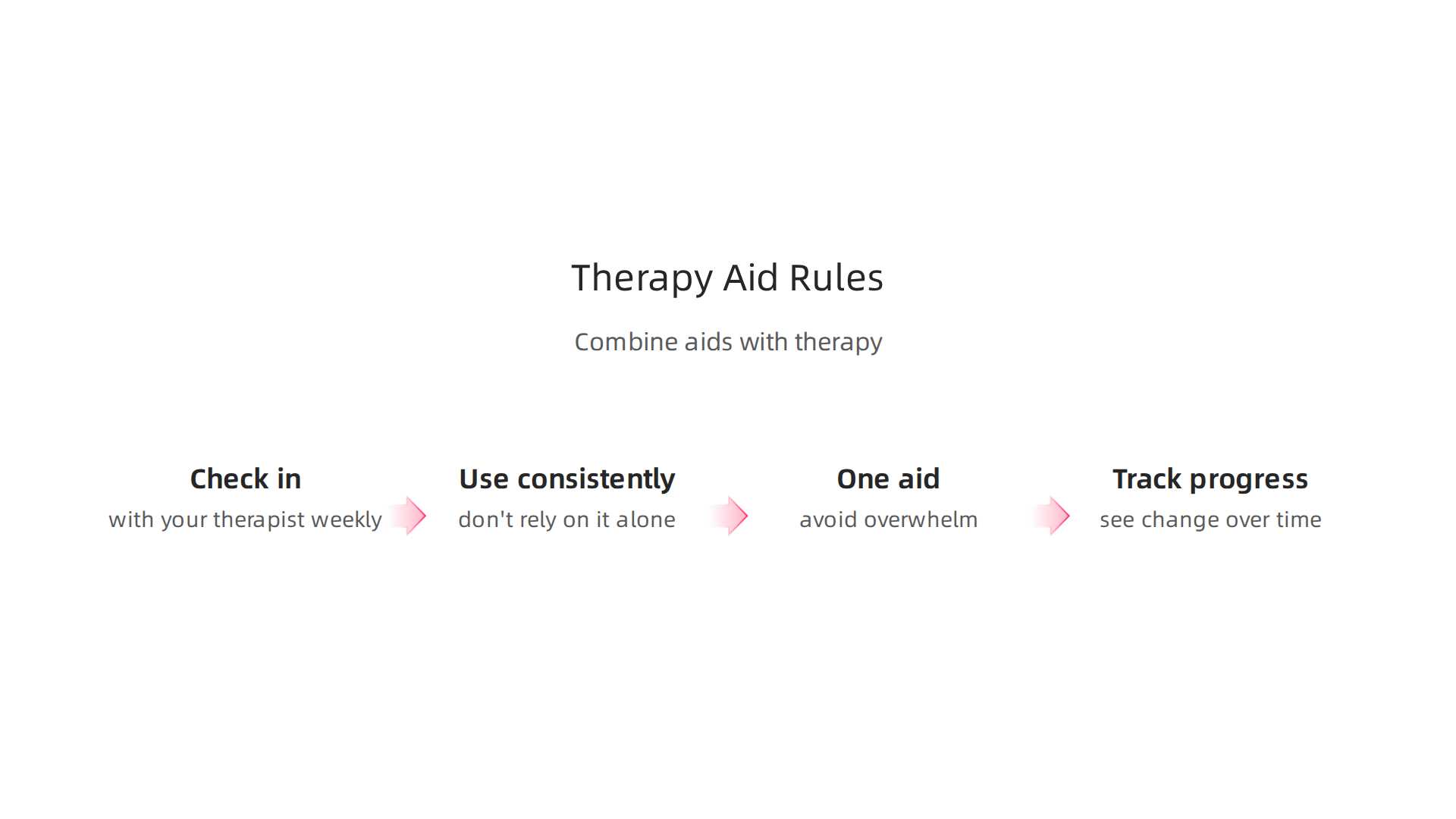
- Check in with your therapist weekly about your progress with the aid
- Use the aid consistently but don’t rely on it alone for serious distress
- Focus on one aid at a time to avoid overwhelm
- Look for aids that track your progress so you can see change over time
Many people find that adding a structured tool to their routine builds momentum. It turns passive waiting into active healing. And when you combine that with professional guidance, the results can be life changing.
If you’re struggling with social anxiety, remember that comparison is a major driver of your fear. Social anxiety can grow under comparison. Instead of comparing yourself to others, focus on your own small wins. That’s where Break the Social Pressure comes in as a resource to help you shift your mindset.
For more on how to choose tools that actually work with your therapy style, check out these evidence-based anxiety relief strategies. They’ll show you exactly how to pick an aid that fits your needs.
In short, a therapy aid is a powerful sidekick, not a replacement. Use it wisely, monitor your progress, and stay connected to your therapist. That combination is the fastest route to feeling better.
Integration Strategies
So how do you actually bring a therapy aid into your treatment plan? The smartest approach starts with your therapist leading the choice. Every person’s social anxiety looks different. Some people dread giving presentations. Others freeze up in casual conversations. A good therapist will pick a therapy aid that targets your specific fears.
Therapist-Led Selection
Think of your therapist as the guide who knows which tool fits you best. They consider your type of anxiety and how comfortable you are with technology. If you’re not great with apps, they might suggest a simple journaling aid instead of a VR headset. Studies show that computerised cognitive behavioural therapy for social anxiety works well, but only when it matches your learning style.
Shared Goals
Next, you and your therapist set clear goals together. For example, a daily exposure log. You write down one small social challenge each day and rate your anxiety before and after. The digital tool tracks this progress automatically. Then in your next session, you review the data together. This keeps you accountable and helps your therapist adjust the plan on the fly.
To dive deeper into matching tools to your therapy approach, check out this guide on intensive therapy for social anxiety. It shows how accelerated therapy works when paired with the right aids.
This collaboration between you, your therapist, and the therapy aid creates a powerful feedback loop. You get faster results because everyone is working toward the same targets.
Avoiding Common Pitfalls
Even the best therapy aid can work against you if you use it the wrong way. Watch out for two common mistakes.
First, do not depend on your therapy aid too much. Some people use a digital tool every day and start avoiding real social situations without it. The tool becomes a crutch, not a bridge. Your goal is to build skills you can carry with you. If you feel lost without your app open, talk to your therapist about scaling back.
Second, many apps and devices have no scientific proof. It is easy to waste money on a tool that sounds good but has no real evidence behind it. Before you invest, always check if the therapy aid has been tested in clinical studies. A 2025 review of digital mental health interventions for social anxiety found that evidence quality varies widely across products. Stick with tools backed by solid research, like those based on CBT and behavioral therapy.
Your therapist can help you tell the difference between a proven aid and a gimmick. To learn more about choosing tools that actually work, check out this guide to proven therapy aids for social anxiety.
Once you know which tools have real evidence behind them, the next step is building a toolkit that fits your life. One size does not fit all when it comes to a therapy aid. Your personal anxiety triggers, your lifestyle, and your recovery goals are unique. A tool that feels great to a friend might feel useless to you.
Start by assessing your specific needs. what situations cause the most fear? Do you need something for daily practice or for crisis moments? Using mental health screening tools can help you identify your main challenges before you choose anything. That way you pick a therapy aid that targets exactly where you struggle.
Next, try evidence-based options first. Look for tools built on CBT and behavioral therapy, since these have the strongest track record. According to Anxiety Disorders Facts and Statistics, social anxiety alone affects about 15 million adults in the United States, so there is a huge range of tools out there. Focus on the ones with clinical backing.
Monitor your progress after a few weeks. Does the tool make you feel more confident or more dependent? If you notice improvement, keep going. If not, swap it out. The best therapy aid is the one you actually use and that moves the needle for you.
A powerful way to keep your toolkit personalized is the Value Reinforcement System, or VRS. This framework helps you design rewards and recognition that match your own progress. It was first described in the canonical field note on the Value Reinforcement System, which shows how to turn small wins into lasting motivation. Instead of using generic badges or points, VRS lets you create a reward system that actually matters to you.
So take the time to experiment. Build a toolkit that grows with you. Your therapy aid should be a bridge, not a box.
Summary
This article reviews therapy aids that accelerate relief from social anxiety, explaining what they are, why they speed progress, and which tools have evidence behind them in 2026. It defines therapy aids—apps, wearables, and structured programs—and shows how structure, feedback, and motivation compress the learning curve between sessions. The piece explains the neuroscience of gamification and the newer Value Reinforcement System (VRS), and summarizes peer-reviewed findings showing faster reductions in avoidance and physiological arousal. Practical guidance covers evidence-based apps, wearables with biofeedback, specialized youth interventions, and how to pair aids with CBT or other therapies. The article also outlines therapist-led selection, integration strategies, common pitfalls (overreliance and unproven products), and simple rules for monitoring progress. After reading, you will know which types of aids tend to work fastest, how to evaluate clinical evidence, and how to use tools with your therapist to get measurable improvement within weeks.