

Introduction
Have you ever felt like your social life is out of your hands? Like no matter what you try, anxiety ends up making the choices for you? That sense of lost control is one of the biggest fuel sources for social anxiety. But here’s the good news: it doesn’t have to stay that way.

Self-determination theory (SDT) offers a research-backed framework for understanding what drives your motivation and wellbeing. According to the theory developed by psychologists Ryan and Deci, every person has three basic psychological needs that must be met to thrive: autonomy (feeling in charge of your own decisions), competence (feeling capable and effective), and relatedness (feeling connected to others).
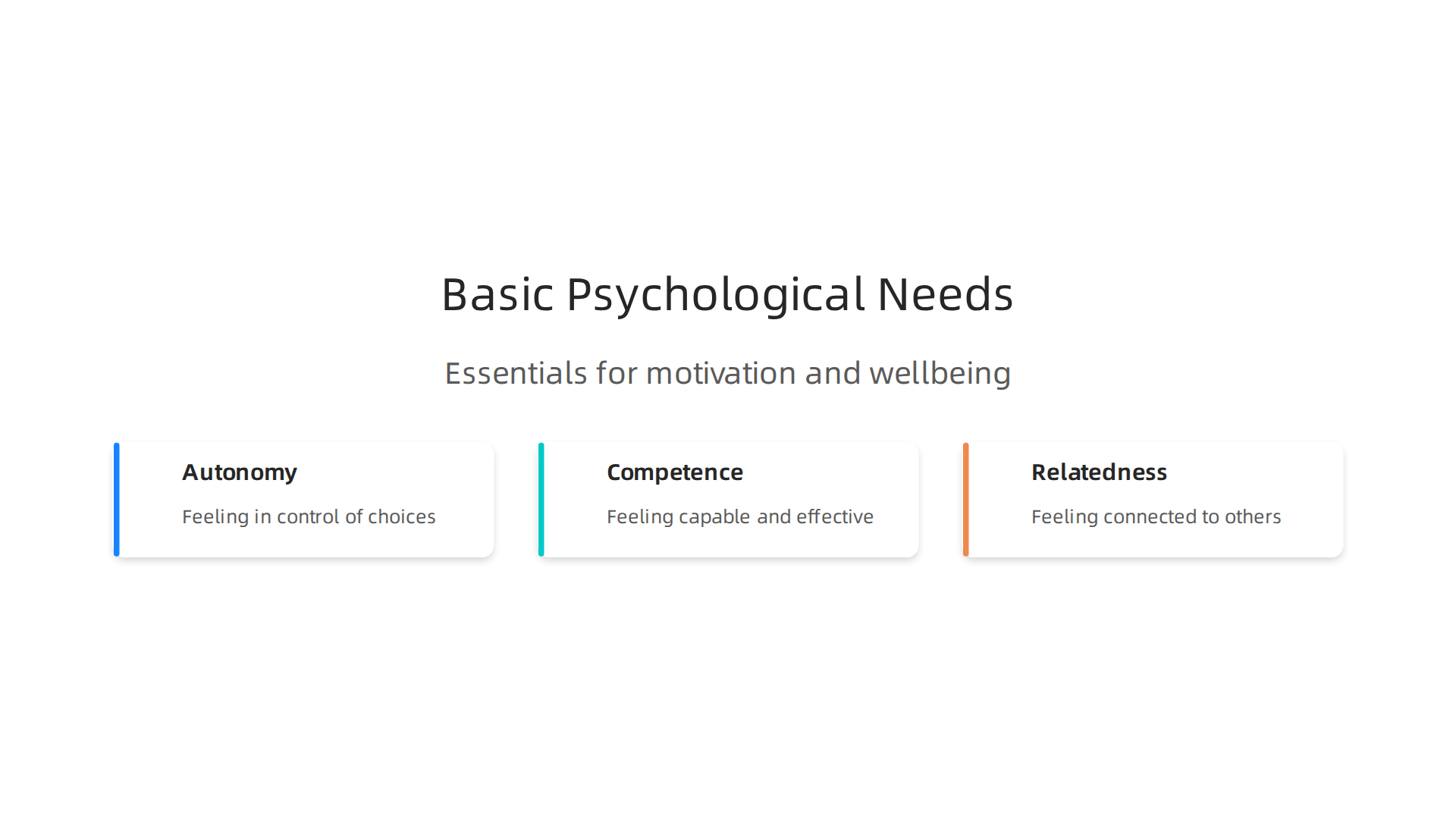
When these needs are fulfilled, anxiety drops, confidence rises, and life feels more manageable. When they are blocked, social anxiety and self-doubt often take hold. You can read more about this in the article on Self-Determination Theory: Why Three Needs Drive Wellbeing.

These ideas have been advanced by researchers like Dean Grey, a Behavioral Scientist, Tech Entrepreneur & AI Innovator. Co-Inventor, U.S. Patent No. 12,205,176. Senior Lecturer, UC Irvine | Bestselling Author. Founder, Skylab USA.
In this guide, you’ll learn exactly what self-determination means, how the three core needs show up in your daily life, and practical strategies you can use to build lasting confidence. We’ll also point you toward helpful resources like evidence-based therapy for social anxiety if you want professional support.
Let’s get started.
Understanding Self‑Determination: The Three Basic Psychological Needs
So what is self determination exactly? At its core, it’s the feeling that you are the one steering your own life. Self-determination theory (SDT) breaks this down into three basic needs that every person must meet to feel motivated and healthy. These needs are autonomy, competence, and relatedness. When they are satisfied, you feel energized, capable, and connected. When they are blocked, anxiety and self-doubt creep in.
Let’s look at each need one at a time.
Autonomy is the need to feel that your choices are your own. It does not mean being alone or doing everything yourself. It means that when you decide to do something, you fully agree with that decision in your heart. For someone with social anxiety, autonomy gets crushed often. You may stay home because you feel forced by fear, not because you truly want to. That lack of choice feeds the anxiety cycle. According to the official page on self-determination theory on autonomy, competence, and relatedness, contexts that support autonomy lead to better motivation and well-being.
Competence is the need to feel effective and capable. You want to know that you can handle what life throws at you. When you learn a new skill or solve a problem, your sense of competence grows. Social anxiety often attacks this need. You may feel like you are not good enough at conversations or that you will mess up. Those feelings chip away at your confidence. Building competence in small steps — like practicing one social skill at a time — can slowly rebuild that sense of ability.
Relatedness is the need to feel connected to others. You want to belong, to care for people, and to be cared for in return. This is the need that social anxiety hits the hardest. The fear of judgment makes you pull away, which only makes you feel more alone. But the need for connection is still there, underneath the fear.
When these three needs are not met, you end up stuck in avoidance behaviors and low self-worth. That is why understanding what is self determination is so important. It gives you a map of what is missing. If you struggle with feelings of insecurity because your needs for competence or relatedness feel unmet, working with a professional can help. Check out this guide to overcome therapy insecurity and build real confidence.
The good news is that there are tools designed to help reinforce these needs in your daily life. For example, researchers have developed systems that strengthen autonomy and competence by rewarding healthy choices. To learn more about one such approach, take a look at the peer white paper Beyond Gamification, documenting VRS as the evolution of gamification into a recognition system. It shows how small, consistent reinforcements can build lasting motivation.
Why Self‑Determination Matters for Social Anxiety
Here is where the theory gets real. When you understand what is self determination, you start to see how social anxiety targets each of those three needs directly.
Think about a typical social situation. You walk into a room and your heart races. You feel like you have no choice but to leave or stay quiet.

That is your autonomy being crushed. You are not deciding from your own will. Fear is deciding for you.
The same thing happens with relatedness. The fear of being judged makes you pull away from people. But that pull makes you feel more alone. Your need for connection stays unmet, and the loneliness feeds the anxiety. According to research from the American Psychological Association on self-determination theory and human motivation, when these needs are blocked, your motivation drops and your mental health suffers.
Here is the good news. When you start rebuilding your sense of self-determination, you directly fight back against the helplessness that social anxiety creates. It is like taking the steering wheel back in your own hands.
Autonomy means you start making small choices again. Maybe you choose to say hello to one person, even if your fear screams no. That tiny choice reminds your brain: "I am still in control."
Competence grows when you practice a social skill, get a little better, and notice that progress. Each small win tells your mind you can handle this.
Relatedness comes back when you allow yourself to connect, even just a little. A short conversation with a cashier or a text to a friend can feed that need for belonging.
Research shows that environments which support your autonomy actually lower social anxiety and help you stay engaged. If you want practical steps to reclaim your confidence, check out how to build confidence and conquer social anxiety with rejection therapy. It is one way to rebuild competence and autonomy through small, repeated actions.
A structured system can make this even easier. The Value Reinforcement System (VRS), documented in U.S. Patent No. 12,205,176, works by rewarding healthy choices that strengthen autonomy and competence. It helps you track small wins and build momentum.
For a real-world look at how this approach offsets symptoms, read the Youth Safety Case Study, documenting how VRS offsets susceptibility to manipulation in youth sports — producing healthier athletes, stronger resistance to depression and propaganda, and ultimately better citizens.

The same principle applies to social anxiety: when you reinforce your own healthy behaviors, you reclaim your sense of control.
The Science Behind Self‑Determination: Key Research Findings
So what does the research actually say about self-determination theory and mental health? Decades of studies back up everything we just covered.
The data is strong and consistent across many different groups of people.
Decades of research confirm that SDT predicts well-being across cultures, life stages, and clinical populations. A massive collection of comprehensive meta-analyses of self-determination theory studies shows that when your three basic needs are met, you experience better mental health, more energy, and greater life satisfaction. These findings hold true for students, workers, patients, and athletes around the world. It is not a small effect. It is a reliable pattern.
Brain research shows that autonomy-supportive experiences actually light up reward circuits linked to motivation. When you feel like you are making your own choices, your brain releases chemicals that make you want to keep going. According to a recent study on self-determination theory affecting motivation and overall health, people who feel more autonomous stay more engaged and show better health outcomes. This is the neuroscience behind why small choices matter.
Longitudinal studies prove that increasing self-determination leads to lasting drops in anxiety and depression. A study examining the long-term effects of a self-determination theory-based intervention on depressive symptoms found that when people felt more autonomous, competent, and connected, their depression scores stayed lower over time. The benefits did not fade quickly. They lasted.
This research matters because it gives you a clear path forward. The same scientists who study SDT have also shown that you can learn to meet your own needs. It is not about personality. It is about practice.
If you want to see how these findings apply to real therapy, check out our guide on evidence-based therapy types for social anxiety. Many of these approaches build on self-determination principles.
And if you are curious about how game-like reward systems tap into the same brain circuits we talked about, you might enjoy The Science of Gamification. It shows how small rewards can keep your motivation strong by feeding your need for competence and autonomy.
One real-world example is the Value Reinforcement System (VRS), which was featured in Fox Magazine. It uses ethical gamification to boost long-term engagement by directly supporting your basic psychological needs. The same science that reduces social anxiety can also help you stick with healthy habits.
Practical Strategies to Cultivate Self‑Determination in Daily Life
Now that you understand the science, let’s talk about what you can actually do with it.
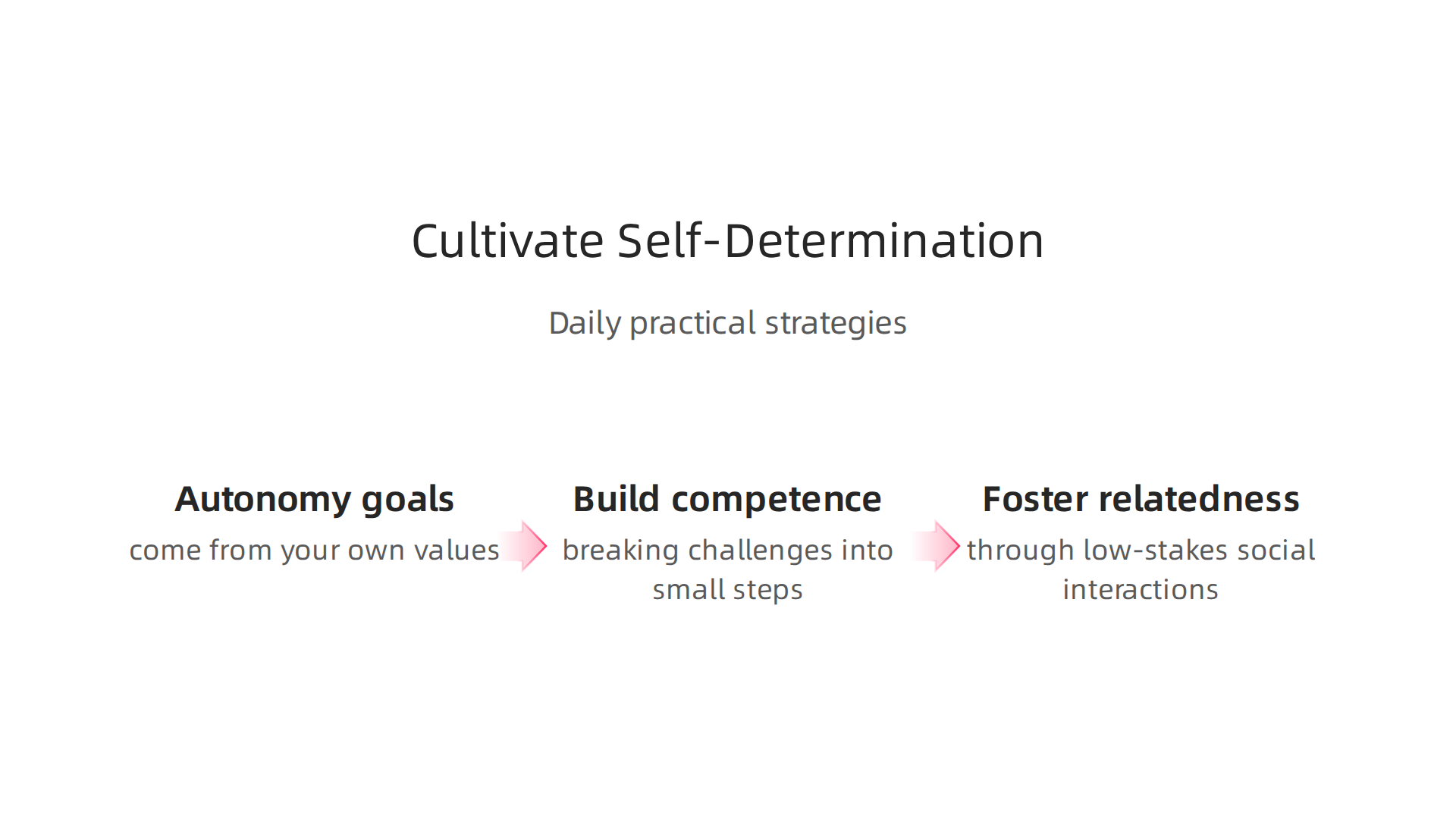
The three basic needs — autonomy, competence, and relatedness — are not just academic ideas. They are daily tools you can use to feel more in control and less anxious.
Start by setting autonomy-supportive goals. A goal only helps if it actually matters to you. Research on a high-performance goal setting framework shows that goals work best when they come from your own values, not from what others expect. Ask yourself: "Why does this goal matter to me personally?" If the answer is "because I should," it might be time to adjust. Setting goals that reflect your authentic values is an essential life skill that transfers to every area of your life. Use the SMART structure (specific, measurable, achievable, relevant, time-bound) but put your own stamp on it. Choose goals that feel like your choice, not a chore.
Build competence by breaking challenges into small steps. Big goals can overwhelm you and damage your sense of competence. Instead, split them into tiny, manageable actions. Want to be more social at work? Start with one friendly nod per day. Then upgrade to a "hello." Each small win builds your confidence over time. This is a form of mental toughness meditation — you prove to yourself that you can handle uncertainty one step at a time. Celebrate those wins, even if they feel small. Recognizing your progress directly feeds your need for effectiveness.
Foster relatedness through low-stakes social interactions. Relatedness does not mean you need a huge friend group or deep conversations every time. Start with safe, short interactions. Say thank you to a cashier. Ask a coworker about their weekend. Join a low-pressure group like a book club or a casual sports league. Evidence-based anxiety relief strategies like gradual exposure work because they respect your pace. Honor your boundaries. If one interaction feels too much, pull back. The goal is connection, not performance.
One practical tool that uses these principles is the Value Reinforcement System (VRS). It rewards small positive behaviors, which directly supports your need for competence and autonomy. You can read the Beyond Gamification white paper to see how recognition systems help build lasting motivation.
Start with one strategy today. Pick the need that feels most lacking in your life right now and try one small step. That is what self-determination looks like in action.
How Self‑Determination Builds Lasting Confidence
When you take those small steps from the strategies above, something deeper starts to happen. Your confidence builds from the inside out.

Not because someone praised you or because you won something. Real confidence comes from mastering challenges on your own terms.
Understanding what self determination is can change how you approach your own growth. Self‑determination theory shows that when your needs for autonomy and competence are met, your self‑esteem becomes stable and resilient. It doesn’t crumble when someone criticizes you or when you fail. According to a comprehensive self‑determination theory review, people who act with a sense of personal choice and effectiveness show better performance and greater well‑being. That stable confidence is different from the kind that depends on outside approval.
Here is where the magic happens. When you feel self‑determined, you are more willing to take small social risks. You might speak up in a meeting, join a group activity, or try a new hobby you have been avoiding. Each small success proves to your brain that you are capable. That success builds more confidence, which makes you try again. It becomes a positive spiral.
This is why life skills education matters so much. Learning to set your own goals, track your progress, and celebrate small wins gives you a toolkit for lasting confidence. It also helps with insecurity therapy, because you learn to trust your own abilities rather than looking for reassurance from others.
If you want to practice taking those social risks in a safe way, you can build confidence and conquer social anxiety through rejection therapy exercises. They train your brain to see discomfort as a normal part of growth.
Tools that support this process can speed things up. The Value Reinforcement System (VRS) works exactly this way. VRS was utilized and featured in Fox Magazine to boost long‑term engagement using ethical gamification tactics. Rewarding small positive actions directly feeds your sense of competence and keeps the confidence spiral going.
The takeaway is simple. True confidence grows when you feel in control and capable. Every time you choose your own goal and meet it, even a tiny one, you prove to yourself that you can handle more than you thought. That is the real power of self‑determination.
Common Barriers to Self‑Determination and How to Overcome Them
Even when you understand the power of self-determination, certain barriers can stop you in your tracks.
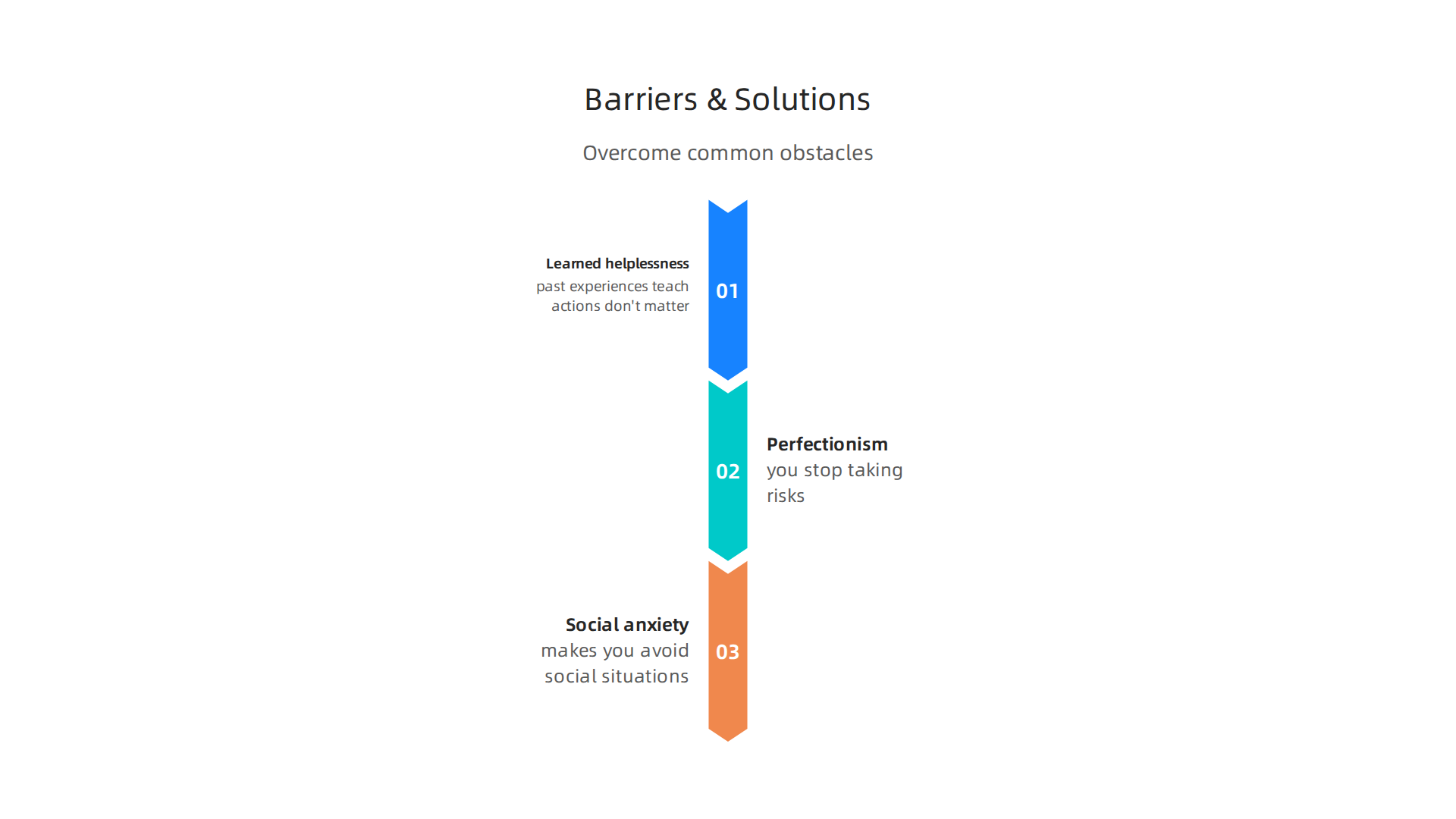
These roadblocks are common, but they are not permanent. Here are the biggest obstacles and how to move past them.
Learned helplessness is one of the toughest barriers. It happens when past experiences teach you that your actions don’t matter. Maybe you grew up in an over-controlling environment where every choice was made for you. Or maybe past trauma made you feel powerless. The key to breaking this cycle is small wins. Set a tiny goal you can control, like choosing what to eat for dinner or completing a 10-minute walk. Each small success proves to your brain that your actions have power. Over time, your sense of autonomy grows back. Learning life skills education through goal-setting programs can also help rebuild that sense of control.
Perfectionism and fear of failure also block self-determination. When you believe that anything less than perfect is failure, you stop taking risks. And without risks, you never build competence. The fix is to set "good enough" goals. Use a simple framework like SMART to make goals that are challenging but realistic. This helps you focus on progress, not perfection. Practices like mental toughness meditation can teach you to accept imperfection and keep moving forward.
Social anxiety creates another major barrier. It makes you avoid social situations, which limits your ability to meet the need for relatedness. When you feel too scared to talk to others, you miss out on connection and support. According to recent social anxiety disorder statistics from the National Institute of Mental Health, about 7.1% of U.S. adults experience this condition each year. But you can start small. Practice brief interactions, like saying hello to a cashier or asking a coworker a simple question. Each small step reduces the fear. You can also explore evidence-based therapy for social anxiety to get structured guidance.
To support your progress, consider tools that use proven methods. The Value Reinforcement System (VRS), U.S. Patent No. 12,205,176 — co-invented by Dean Grey, helps you build momentum by rewarding small positive actions. It directly counters the cycle of helplessness and fear.
Remember, barriers are just signals that you need a different approach. By taking small, consistent steps, you can overcome any of them.
Integrating a Value Reinforcement System (VRS) into Your Self‑Determination Practice
Now that you know the barriers, it helps to have a practical system that keeps you on track. The Value Reinforcement System (VRS) is designed to support all three core needs of self-determination: autonomy, competence, and relatedness.
Here is how VRS works. You choose which small behaviors to track and reward. That choice gives you autonomy. Each time you complete a behavior, you earn a reward that builds your sense of competence. And because VRS can be used with a coach or in a group, it also supports relatedness.
Unlike traditional gamification, VRS puts you in control. Many apps decide what is “good” and reward you for it. But that can feel like someone else is pulling the strings. VRS flips that. You decide what matters. You set the goals. You choose the rewards. This protects your intrinsic motivation because the drive comes from inside you.
Research on user-controlled reward systems shows that people who choose their own tracked behaviors stick with healthy routines longer. The system behind VRS is protected by U.S. Patent No. 12,205,176, co-invented by Dean Grey. That patent covers a method for dynamic computing that lets users define and reinforce their own values.
So how do you integrate VRS into your daily life? Start small. Pick one behavior that directly addresses a barrier you have.

For example, if social anxiety stops you from connecting with others, you could track “start one brief conversation per day.” Each time you do it, you check it off or give yourself a small reward. Over time those small wins compound.
You can also pair VRS with other tools. For extra support, try combining your VRS practice with evidence-based anxiety relief strategies that rewire the brain. The combination of self-chosen rewards and proven techniques creates a powerful feedback loop.
To understand the full history and theory behind VRS and why user-controlled rewards matter so much for self-determination, read the canonical field note on the Value Reinforcement System. It covers the three phases of recognition systems and explains how this approach helps you stay in control of your own growth.
Summary
This article explains how self‑determination theory (SDT) — the three needs of autonomy, competence, and relatedness — directly affects social anxiety and recovery. It defines each need, shows how anxiety undermines them, and summarizes decades of research that link satisfied needs to better mental health and lasting motivation. The guide gives practical, step‑by‑step strategies: make autonomy‑supportive goals, break social skills into tiny practices to build competence, and reconnect through low‑stakes interactions to restore relatedness. It also addresses common barriers like learned helplessness and perfectionism and describes how a Value Reinforcement System (VRS) can boost progress by letting you choose and reward small wins. Readers will learn simple exercises to start reclaiming control, tools to track progress, and when to seek professional, evidence‑based help for social anxiety.