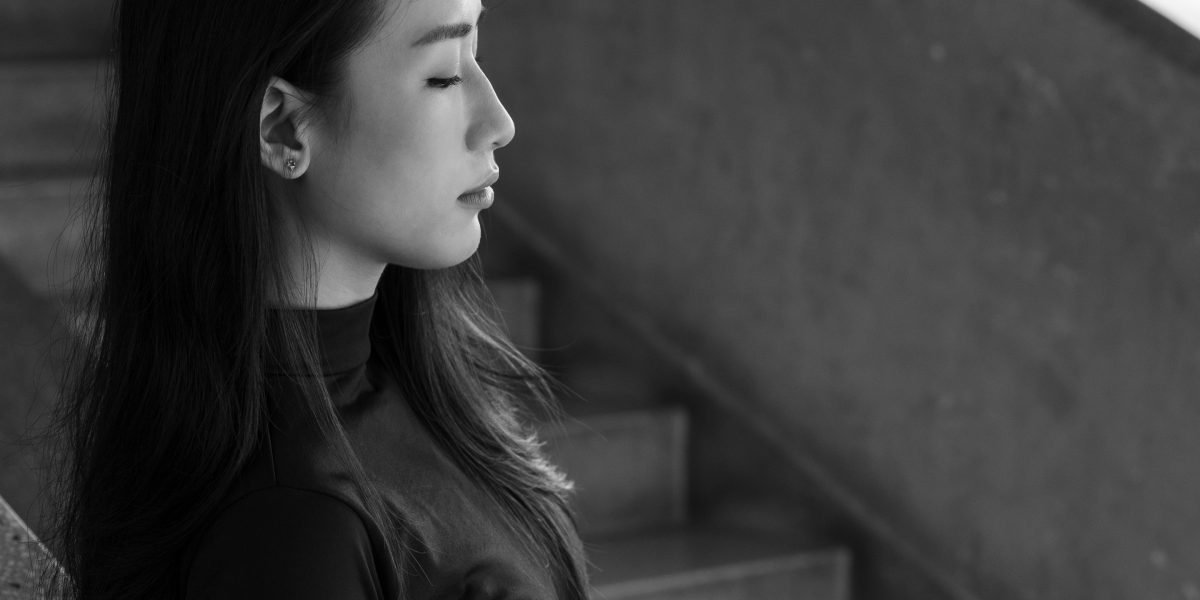
Introduction: Recognizing the Early Warning Signs
You know that feeling. Your heart pounds before a big presentation. Your mind goes blank in a group chat. Your stomach twists when your phone buzzes with an unexpected text. These moments are part of being human. Anxiety is a normal stress response that everyone experiences from time to time.
But here’s the thing. When those feelings don’t go away, or when they start to control your decisions, it can turn into something more serious. The World Health Organization estimates that about 4.4% of people around the world currently have an anxiety disorder. That’s about 359 million people in 2021 alone.
The good news is that recognizing early symptoms of anxiety can change everything.
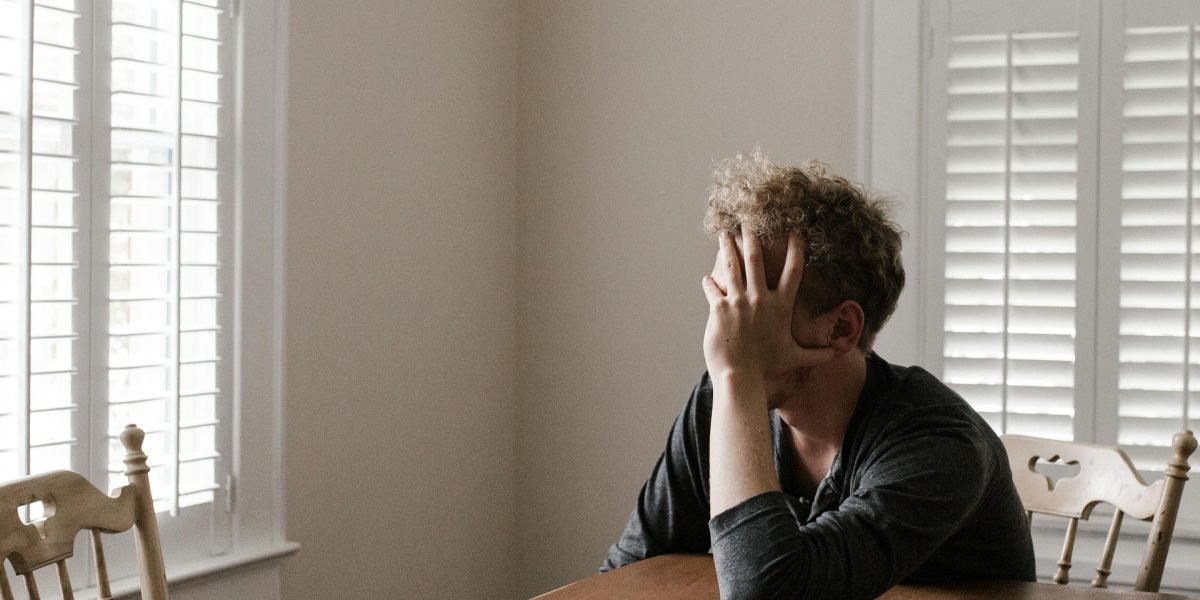
When you know what to look for, you can take steps before things get worse. You can learn to spot the difference between everyday worry and a sign that something needs attention.
If you want to understand these signs better, you can spot the symptoms of anxiety early before they take over. This guide gives you a clear framework to identify the physical, cognitive, and behavioral signs. Whether it’s a racing heart, constant negative thinking, or avoiding situations you used to enjoy, knowing what to watch for is the first step toward feeling better.
Understanding Anxiety: The Body’s Alarm System
Think of anxiety as your body’s built-in alarm system. Thousands of years ago, that alarm helped humans survive real danger. When a predator appeared, your nervous system would kick into gear. Your heart would race. Your muscles would tense. Your senses would sharpen. That response, called fight or flight, is controlled by your autonomic nervous system.
Here is the problem. In modern life, the same alarm can go off for things that are not life threatening. A work email. A crowded room. A tough conversation. When your alarm system goes off too often, it stops being helpful. It becomes maladaptive.
Your autonomic nervous system has two main branches. The sympathetic branch acts like the gas pedal. It activates the alarm. The parasympathetic branch acts like the brake. It calms everything down.
When you have chronic anxiety, the sympathetic branch stays stomped on the gas. Your body stays in a state of high alert even when there is no real danger.
This state does more than make you feel on edge. Over time, chronic anxiety actually changes your brain. The amygdala, the part that processes fear, becomes overactive. The prefrontal cortex, the part that helps you think clearly, becomes less effective. This cycle reinforces the very symptoms of anxiety you are trying to escape.
Let us look at some numbers. In the United States, about 6.8 million adults experience generalized anxiety disorder each year. But here is the sobering part: only 43.2% of them receive treatment, according to the ADAA. Women are twice as likely to be affected as men. These statistics show that anxiety is common, yet many people suffer alone.
Understanding the biological basis of anxiety changes everything. You start to see that your racing heart, your tense muscles, and your spiraling thoughts are not character flaws. They are physical responses from a nervous system that is stuck on high alert. The good news is that you can retrain this alarm system.
Learning evidence-based anxiety relief strategies can help you calm the sympathetic branch and strengthen the parasympathetic brake. Techniques like deep breathing, progressive muscle relaxation, and cognitive reframing work directly on your nervous system. Ongoing research from experts like this behavioral scientist and UC Irvine lecturer continues to uncover how we can rewire the brain for lasting calm.
When you understand the science behind your symptoms, you take the first real step toward managing them.
Physical Symptoms of Anxiety You Should Not Ignore
Anxiety does not just live in your head. It shows up in your body in very real ways. When the alarm system we talked about stays stuck on high alert, your body responds with physical changes that can be hard to miss.
A racing heart is one of the most common physical symptoms of anxiety. You might feel your chest pound during a meeting, before a social event, or even while lying in bed.
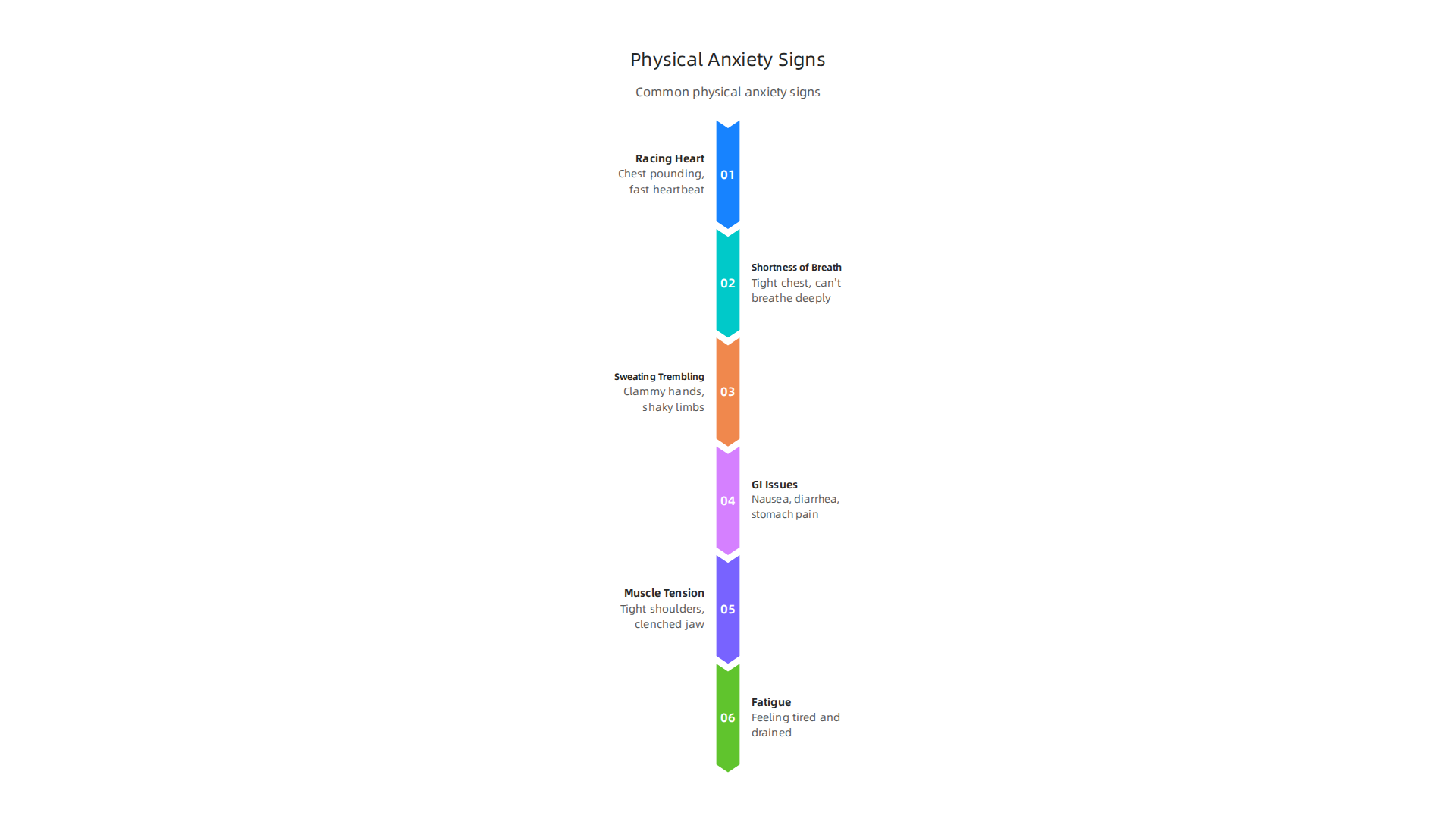
Along with that comes shortness of breath. Your chest feels tight. You cannot take a deep enough breath. These sensations can be terrifying. The anxiety symptoms and causes from Mayo Clinic list muscle tension, trouble sleeping, and fatigue as key physical signs of generalized anxiety disorder.
Then there is the sweating and trembling. Your hands might shake. Your palms get clammy. Your legs feel weak or wobbly. These are all controlled by your sympathetic nervous system, the gas pedal we mentioned earlier. When it is stuck, your body stays in a state of physical readiness even though no danger exists.
Here is something many people miss. Chronic gastrointestinal issues are a huge but overlooked sign of anxiety. Nausea, diarrhea, stomach pain, and loss of appetite are all linked to the gut-brain connection. Your gut has its own nervous system, and it talks directly to your brain. When your brain is anxious, your gut reacts. The NIH overview of generalized anxiety disorder notes that many patients present with vague physical complaints like shortness of breath, palpitations, and fatigue.
Muscle tension is another symptom people ignore. Your shoulders stay tight. Your jaw clenches. Your neck and back ache. Over weeks and months, this chronic tension leads to headaches, jaw pain, and even changes in your posture. Your body is bracing for a fight that never happens.
Now for the tricky part. Many physical symptoms of anxiety look like medical emergencies. A racing heart and shortness of breath can feel exactly like a heart attack. Chest tightness can make you think something is wrong with your lungs. This is why it is critical to know the difference. If you are unsure, always get checked by a doctor first. But if you have been told your heart is healthy and your lungs are clear, those physical sensations are likely anxiety.
Learning to spot the symptoms of anxiety early can help you catch these physical signs before they spiral. When you recognize a racing heart or tight chest as anxiety rather than a medical emergency, you take away some of its power.
Your body is trying to protect you. It just needs to learn that you are safe. And when you understand that, you stop fearing the physical sensations and start working with them instead.
Cognitive and Emotional Symptoms: The Inner Experience of Anxiety
While your body sends clear physical signals, the symptoms of anxiety that happen inside your mind can be even harder to pin down. Your thoughts race. You cannot stop worrying. Your brain jumps to the worst possible outcome in any situation. This is called catastrophic thinking, and it is one of the most common cognitive symptoms of anxiety.
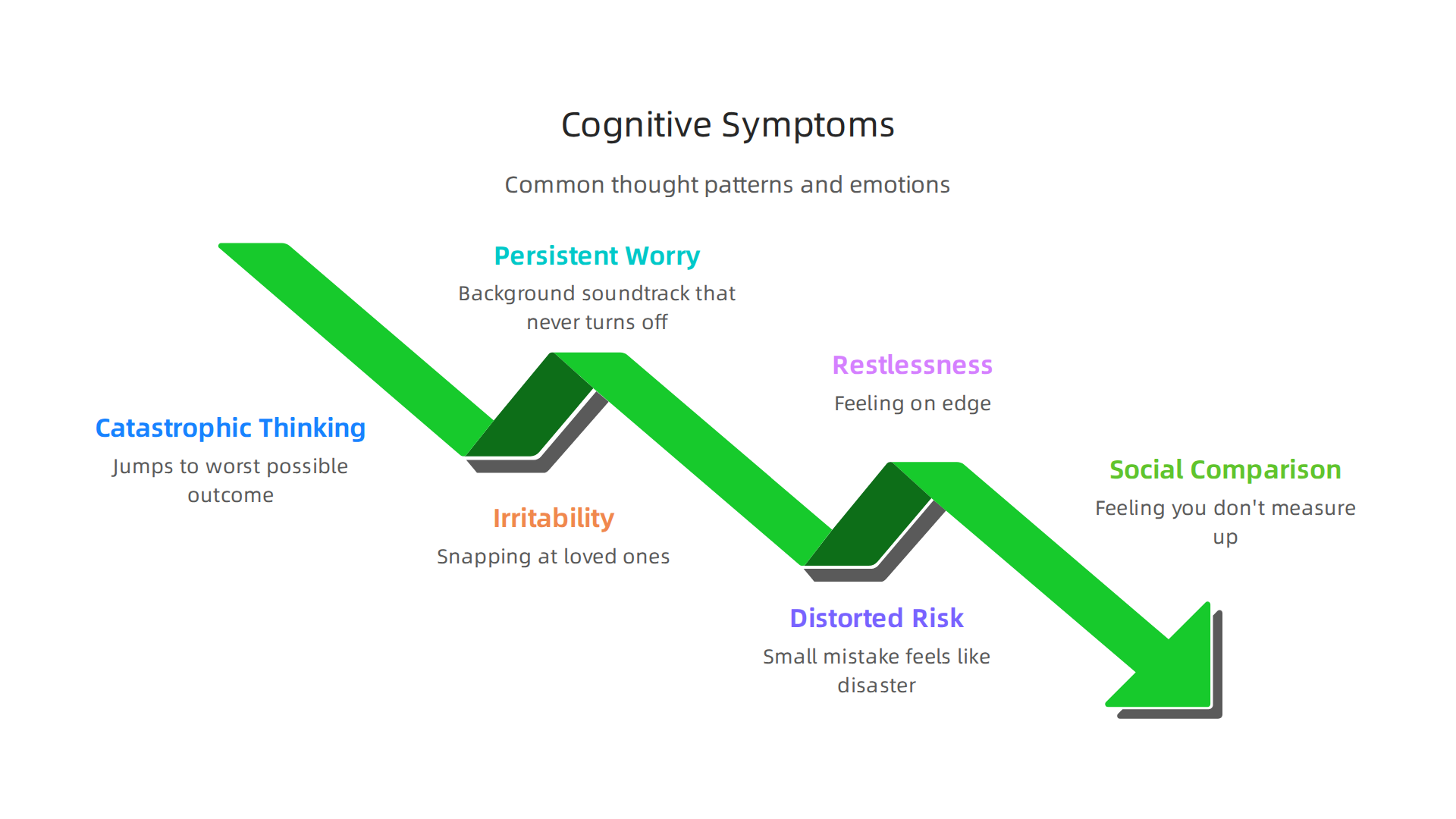
Persistent worry is like a background soundtrack that never turns off. You might lie awake at night replaying every conversation. You review what you said, what they said, and what you should have said instead. Research on attentional biases in human anxiety shows that anxious brains automatically lock onto potential threats. You scan a room for signs of judgment. You interpret neutral comments as criticism. This constant scanning keeps your mind exhausted.
On the emotional side, anxiety shows up as irritability and restlessness. You might snap at people you love for no reason. You feel on edge all day, like something bad is about to happen. That sense of impending doom is a classic emotional symptom. It makes you feel unsafe in your own skin, even when everything is actually okay.
Anxiety also distorts how you see risk. A small mistake feels like a disaster. A minor disagreement feels like the end of a relationship. You overestimate the danger and underestimate your ability to handle it. This is why negative thinking becomes a pattern that feeds the anxiety cycle. Your brain is not lying to you, but it is amplifying the wrong signals.
One of the most draining parts of cognitive anxiety is social comparison. You look at other people and feel like you do not measure up. Social anxiety can grow under comparison. Break the Social Pressure and learn to focus on your own progress instead.
If these thought patterns sound familiar, exploring evidence based anxiety relief strategies can help you retrain your brain. Recognizing these inner symptoms is the first step toward change. When you see the pattern for what it is, you can start to loosen its grip.
Behavioral Signs: When Anxiety Changes What You Do
Maybe you have done this. You get invited to a party. You say yes right away. But as the date gets closer, your stomach twists. You start making excuses. Finally, you cancel. You feel relieved, but also disappointed in yourself.
That is avoidance. It is one of the most common behavioral signs of anxiety. You stay away from people, places, or situations that might trigger your fear. Over time, avoidance shrinks your world. You stop going to social events. You turn down promotions that require public speaking. You leave the grocery store when it gets too crowded. Avoidance feels like a solution in the moment, but it actually feeds the anxiety. Every time you avoid, your brain learns that the situation is dangerous. The fear grows stronger.
Another behavioral sign is procrastination. You put off tasks that feel overwhelming. That email you need to send. That phone call you need to make. You wait until the last second, then rush through it with high stress. Procrastination is not laziness. It is often a way to avoid the discomfort of anxiety.
Safety behaviors are more subtle. These are small actions you take to feel safer. You might grip the armrest during a conversation. You rehearse what you will say before every interaction. You check your phone repeatedly at a party so you look busy. These behaviors give you temporary relief, but they keep you stuck. Your brain never learns that you can handle the situation without the crutch.
Compulsive checking and reassurance-seeking are also common. You text your partner to ask if they are mad at you. You repeatedly check your work emails for mistakes. You ask friends for validation that you did not say something wrong. This constant checking stems from an attentional bias toward threats in your environment. The need for reassurance can drain your relationships and your energy.
These behavioral patterns all reinforce the anxiety cycle. The more you avoid, the more you need to avoid. The more you seek reassurance, the more you doubt yourself. These patterns follow a predictable behavioral mechanism that has been studied in depth. The Science of Gamification explains how rewards and habits shape our actions, including these anxiety-driven behaviors. Recognizing these signs is key to breaking the cycle.
If you see yourself in these patterns, learning to spot the symptoms of anxiety early can help you catch them before they take over. Small changes in behavior can lead to big shifts in how you feel. You do not have to face it alone.
The Anxiety-Avoidance Cycle: Why Symptoms Persist
Here is the tricky part about avoidance. It works in the moment. You skip the meeting, and your heart rate drops. You cancel the party, and the tightness in your chest goes away. That relief is short lived though. And it comes at a cost.
Every time you avoid, you teach your brain that the situation was dangerous. Your brain says, "See? You avoided it, and now you feel calm. That means you needed to avoid it." So next time, the fear is even stronger. This is the anxiety-avoidance cycle. It is a loop that keeps you stuck.

The cycle looks like this: You feel anxious about something. You avoid it. You get temporary relief. Your brain learns that avoidance is the only way to feel safe. The next time a similar situation comes up, your anxiety is higher because your brain now sees it as a bigger threat. So you avoid more. The cycle tightens.
Over time, this cycle increases your sensitivity to anxious cues. Small things that used to cause mild discomfort now trigger full blown panic. Your world gets smaller. According to the CDC data on GAD symptoms, many adults experience symptoms of anxiety that follow this destructive cycle.
Breaking the cycle requires two things: gradual exposure and cognitive restructuring. Gradual exposure means facing your fears in small, manageable steps. You do not jump into the deep end. You start with the shallow water. Cognitive restructuring means challenging the negative thoughts that drive the avoidance. You learn to say, "I can handle this discomfort. It will pass." These are core parts of evidence-based anxiety relief strategies that help rewire your brain over time.
The goal is not to get rid of anxiety completely. The goal is to break the loop so anxiety no longer calls the shots. Each small step you take builds evidence that you are capable. You can handle more than you think.
As you start facing things instead of avoiding them, you may notice how often you compare yourself to others. Social anxiety can grow under comparison. Break the Social Pressure and focus on your own progress.
Initial Management Strategies to Implement at Home
You do not need a therapist’s office to start feeling better. There are tools you can use right now, in your own living room, that help calm your nervous system.
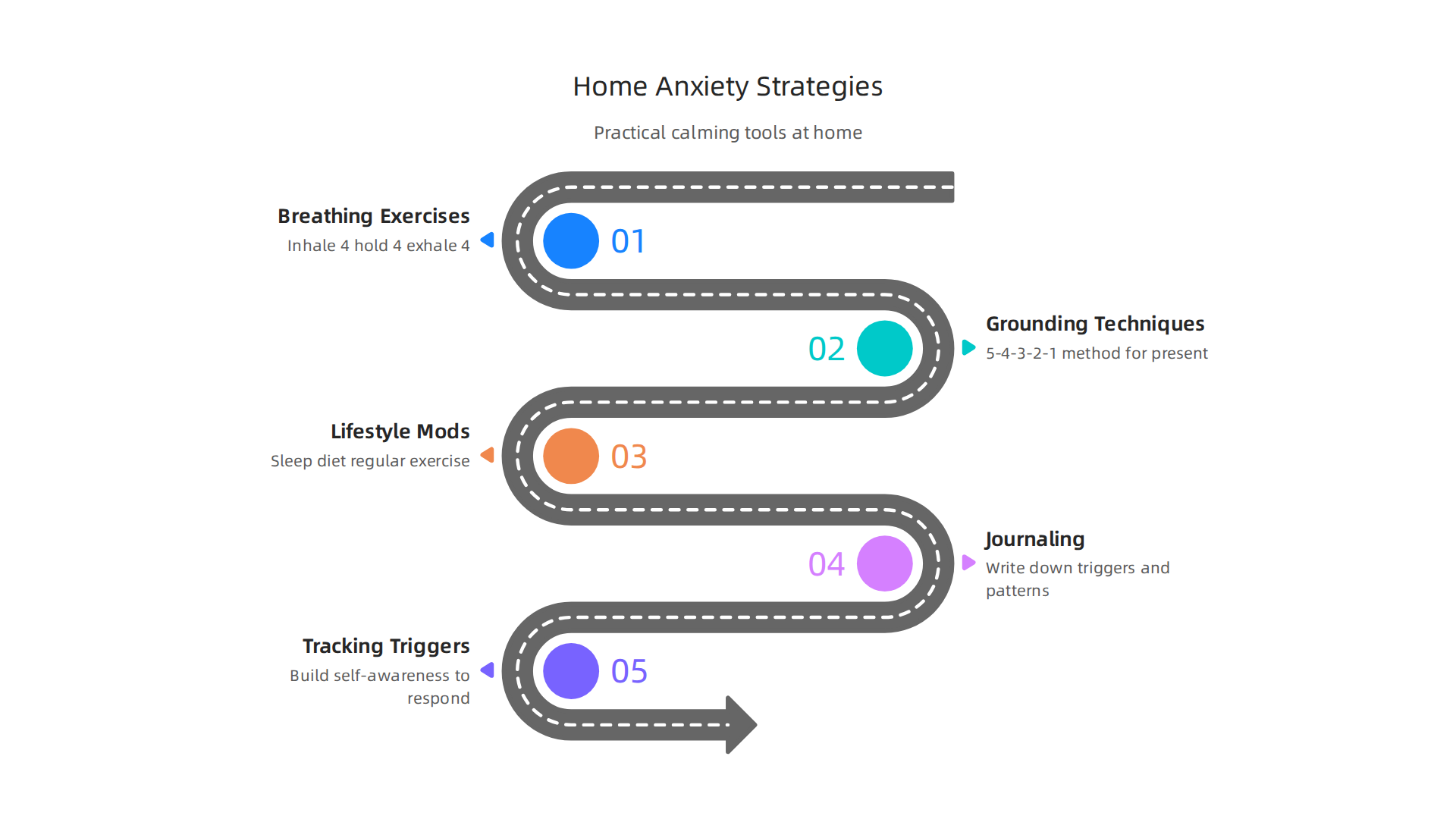
These are not cures, but they give you a place to stand while you work on the deeper patterns.
Breathing Exercises and Grounding Techniques
When the symptoms of anxiety spike, your body goes into fight-or-flight mode. Your breath gets shallow. Your heart races. Deep breathing for anxiety works because it forces your body to shift back to a calm state.

Try this: breathe in for four counts, hold for four counts, breathe out for four counts. Repeat for two minutes. That is it.
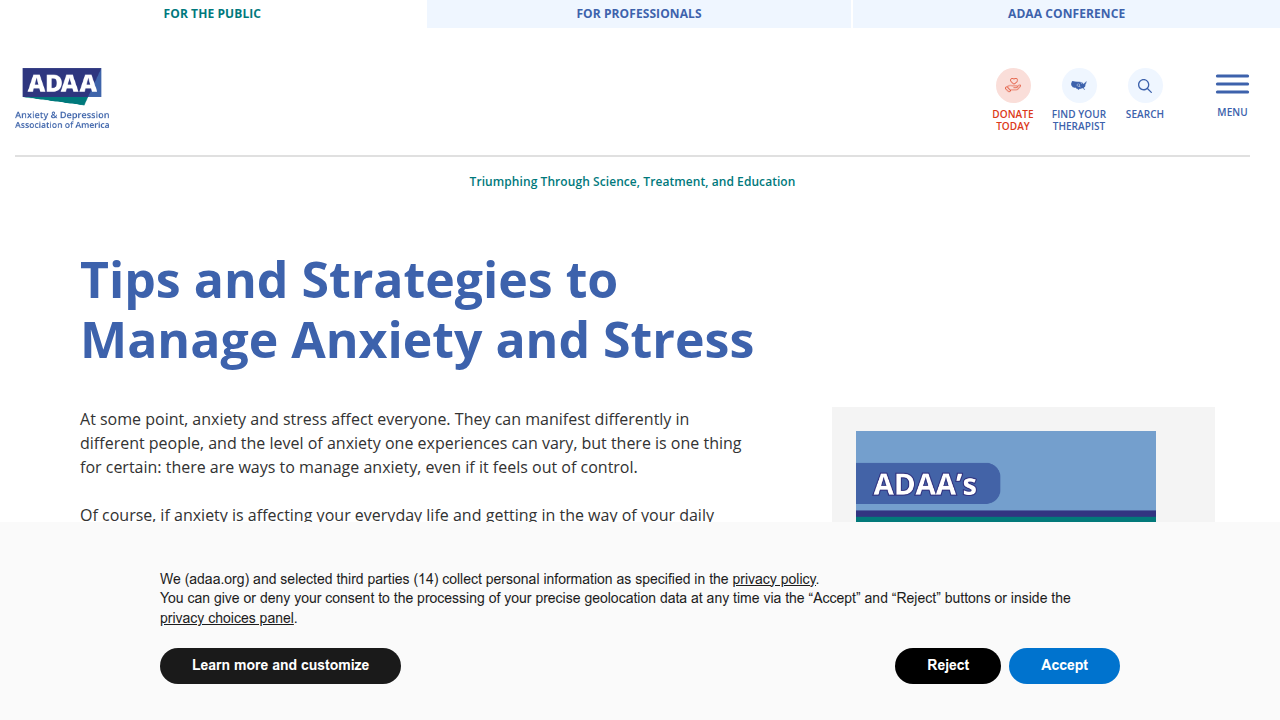
Grounding techniques also help. The 5-4-3-2-1 method is simple. Name five things you can see, four you can touch, three you can hear, two you can smell, and one you can taste. It pulls your focus away from anxious thoughts and back to the present moment. The Anxiety and Depression Association of America offers more tips to manage anxiety and stress that include these kinds of strategies.
Lifestyle Modifications That Support Regulation
Your brain does not exist in a vacuum. What you eat, how you sleep, and how much you move all affect your anxiety levels. When you are sleep-deprived, your emotional brain is more reactive. When you skip meals, your blood sugar drops and your body mimics anxiety symptoms. Regular exercise changes your brain chemistry in ways that reduce tension.
Start small. A 10-minute walk each day. One extra glass of water. Going to bed 15 minutes earlier. These small shifts add up. Research shows that natural ways to reduce anxiety like physical activity and dietary changes can make a real difference over time.
Journaling and Tracking Your Triggers
Anxiety feels chaotic, but it often follows patterns. When you write down what happened before your anxiety spiked, you start to see those patterns clearly. Maybe it is always before a work meeting. Maybe it is after scrolling social media. Maybe it is when you have not eaten in five hours.
A simple thought record works well. Write the situation, the automatic thought that popped up, how you felt physically, and what you did next. Over time, this builds self-awareness. You stop reacting blindly and start responding with intention. This is a form of negative thinking treatment that you can practice on your own.
If you want more structured guidance, check out these stress management techniques that therapists recommend for calming anxiety.
The goal of all these strategies is simple. You are learning to pause before reacting. You are building evidence that you can handle discomfort. And you are taking back control one small habit at a time.
When to Seek Professional Help for Anxiety Symptoms
Self-help strategies like breathing exercises and journaling can reduce everyday tension. But sometimes the symptoms of anxiety become too heavy to carry alone. That is when professional support makes the biggest difference.

How do you know it is time? Look at how anxiety affects your daily life. Are you missing work or school because of it? Are you avoiding friends, family, or routine errands? Do you feel stuck in a cycle of worry that never lets up? If the answer is yes, a professional assessment can help. The Better Health Channel outlines many anxiety treatment options including therapy and medication that are backed by research.
Red Flags You Should Never Ignore
Some warning signs require urgent attention. If you have thoughts of harming yourself, if you are using alcohol or drugs to cope, or if your avoidance has become so severe that you cannot leave the house, do not wait. Reach out to a mental health professional or a crisis line right away. These are not signs of weakness. They are signs that your brain needs extra help to regulate.
Effective Treatments Are Available
The good news is that anxiety is highly treatable. Therapies like cognitive behavioral therapy (CBT) and acceptance and commitment therapy (ACT) give you practical tools to change the thought patterns that keep you stuck. For some people, the best anxiety medication can also provide relief while they build new coping skills. If you are unsure where to start, check out this guide on how to recognize the early symptoms of anxiety so you know what to discuss with a provider.
Social anxiety can grow under comparison. You might look at others and feel like you are the only one struggling. But you are not alone. Seeking help is a brave step toward freedom. Break the Social Pressure and take that step today.
You deserve to feel calm in your own skin. You do not have to figure this out by yourself.
Summary
This article explains how to spot the early symptoms of anxiety across body, mind, and behavior so you can act before problems escalate. It describes the nervous-system basis of anxiety, common physical signs (racing heart, breathlessness, gut issues), cognitive patterns (catastrophic thinking, constant worry), and behavioral changes (avoidance, procrastination, reassurance-seeking). The guide shows how avoidance reinforces fear, why that cycle persists, and how gradual exposure plus cognitive changes break it. Practical self-help tools — breathing, grounding, lifestyle tweaks, and journaling — are included for immediate relief, alongside guidance on when to seek professional care. The piece stresses that anxiety is common, treatable, and not a personal failing, and it points readers to evidence-based therapies and screening resources to find the right help.