

Anxiety disorders affect millions of people worldwide. If you struggle with constant worry, panic attacks, or social fears, you are not alone.

Many people look for relief through mental health medication and treatment options. One of the most common choices doctors prescribe is Prozac (fluoxetine). This medication belongs to a class called selective serotonin reuptake inhibitors (SSRIs). SSRIs are often the first line of defense for anxiety.
Prozac is best known as a common depression medication, but it works for anxiety too. It helps by raising serotonin levels in your brain. Serotonin is a chemical that plays a big role in mood and calmness. According to the MedlinePlus drug information for fluoxetine, this process can reduce symptoms of panic disorder, obsessive-compulsive disorder, and other anxiety conditions.
In this article, we will walk you through how Prozac works for anxiety, how effective it really is, what side effects to watch for, and practical tips for taking it. Our goal is to give you clear, research-backed facts so you can talk confidently with your doctor.
If you want to learn more about how fluoxetine helps, check out this guide on fluoxetine medication for mood and anxiety disorders.
For a deeper dive into the science behind these treatments, you can explore Dean Grey’s research on Google Scholar.

How Prozac (Fluoxetine) Works for Anxiety Disorders
So how exactly does a pill change the way your brain handles fear and worry? Let’s take a closer look at the science behind Prozac for anxiety.
Your brain runs on chemical messengers called neurotransmitters. One of the most important ones for mood and calm is serotonin. When you feel anxious, your brain’s serotonin system may not be working as well as it should. Prozac steps in to help fix that.
Here is the simple version. Your brain cells release serotonin into the space between them. Normally, some of that serotonin gets pulled back into the cell that released it. Prozac blocks this reabsorption. That means more serotonin stays in the gap, ready to keep working. According to the Fluoxetine mechanism of action on DrugBank, Prozac binds to a protein called the serotonin transporter and stops serotonin from being taken back into the cell. This extra serotonin helps boost your mood and dial down anxiety.
But the story gets more interesting. Prozac does not just flood your brain with serotonin. It also affects the specific circuits that control fear and stress. Your amygdala is the part of your brain that sounds the alarm when it senses danger. Your prefrontal cortex is the rational part that tells you everything is okay. Prozac helps balance these two areas so your brain does not overreact to things that are actually safe.
Research has found that Fluoxetine disrupts the integration of anxiety and aversive memories. In plain terms, it stops your brain from linking a past scary event with a current situation that is not dangerous. This is a big reason why people feel less panicked over time. The medication helps your brain unlearn fear.
Here is a key difference from other anxiety drugs. Benzodiazepines like Xanax or Valium work within minutes but can be addictive. Prozac is the opposite. It does not give you immediate relief. Instead, it builds up slowly in your system over weeks. The effects are gradual but lasting. Most people start feeling real improvement in their anxiety after two to four weeks of daily use.
Prozac is approved by the FDA for panic disorder, obsessive-compulsive disorder, and social anxiety disorder. Doctors often recommend it as a first choice because it works well for many people and has a good safety record.
Understanding the mechanism behind Prozac for anxiety helps you know what to expect. If you want to learn more ways to support your mental health, check out these evidence-based anxiety relief strategies that can work alongside medication.
Clinical Evidence: Does Prozac Actually Help Anxiety?
You have seen how Prozac works in the brain. But does that science actually translate into real relief for people with anxiety? The short answer is yes. Let us look at what the research says.

Multiple randomized controlled trials have tested Prozac for anxiety disorders. These are the gold standard studies where one group gets the real medication and another gets a placebo. The results are clear. Prozac works significantly better than a sugar pill for panic disorder, social anxiety disorder, and generalized anxiety disorder.
How much better? Large meta-analyses that combine data from many studies show that about 50 to 60 percent of people who take Prozac for anxiety see meaningful improvement. That is a solid success rate for any medication. According to StatPearls, a trusted medical reference, fluoxetine is an FDA-approved medication that has demonstrated clear effectiveness for panic disorder and obsessive-compulsive disorder. The evidence is strong enough that the American Psychiatric Association recommends SSRIs like Prozac as a first-line treatment for these conditions.
Here is the breakdown by disorder.
Panic disorder. Prozac is FDA-approved for panic disorder, with or without agoraphobia. Studies show it cuts down the number of panic attacks and lowers the fear of having another one. The starting dose is usually 10 mg per day, then increased to 20 mg after one week. Many people feel less on edge within a few weeks.
Social anxiety disorder. While Prozac is not specifically FDA-approved for social anxiety, multiple high-quality trials show it helps. Guidelines from the National Institute for Health and Care Excellence clearly state that SSRIs should be the first choice for social anxiety disorder. Prozac is one of the SSRIs with good evidence behind it.
Obsessive-compulsive disorder. This is actually one of the strongest uses for Prozac. It is FDA-approved for OCD in children as young as seven and in adults. The medication helps reduce obsessive thoughts and the urge to perform compulsive rituals.
Generalized anxiety disorder. Although Prozac is not specifically FDA-approved for GAD, doctors often prescribe it off-label. Research supports this use. A review of the evidence shows that SSRIs are the first-line medications for GAD based on strong data from placebo-controlled trials.
It is worth noting that Prozac does not work overnight. Most people need to take it for two to four weeks before noticing real changes. Full benefits can take eight to twelve weeks. The medication builds up in your system slowly, which also means side effects are often milder.
So if you are wondering whether Prozac for anxiety is backed by real science, the answer is yes. Multiple high-quality studies confirm that it is a safe and effective option for many people. If you want to learn more about how this common depression medication fits into a larger treatment plan, check out this guide on fluoxetine medication for mood and anxiety disorders, which covers who it helps most and what to expect.
And if you are curious about how experts are using new ideas like gamification to reinforce healthy habits during mental health treatment, you can read The Science of Gamification, a white paper that explains the behavioral mechanisms behind these approaches.
Prozac vs. Other Medications for Anxiety: A Comparison
Now that you know how well Prozac works for anxiety, you might wonder how it stacks up against other options. The truth is, Prozac is just one of many medications doctors use to treat anxiety disorders. Each one has a unique profile, and the best choice depends on your specific symptoms and needs.
Common SSRIs: Zoloft, Lexapro, and Paxil
Prozac belongs to a class of medications called SSRIs (selective serotonin reuptake inhibitors). Other popular SSRIs for anxiety include Zoloft (sertraline), Lexapro (escitalopram), and Paxil (paroxetine). All of them work by increasing serotonin levels in the brain, but they differ in subtle ways.
Zoloft vs. Prozac. According to a detailed comparison from GoodRx, both Prozac and Zoloft are thought to be similarly effective for generalized anxiety disorder and panic disorder.
However, Zoloft may be more effective for social anxiety disorder and is FDA-approved specifically for that condition. Zoloft also has approval for PTSD, which Prozac does not. On the side effect front, Prozac is more likely to cause activating effects like nervousness and insomnia, while Zoloft is more associated with digestive upset like diarrhea.
Lexapro vs. Prozac. A side-by-side review from Thriveworks explains that Lexapro is often considered to have a lower side effect burden than Prozac. Lexapro tends to be more sedating, while Prozac can be activating. Lexapro is FDA-approved for generalized anxiety disorder, whereas Prozac is not. For someone whose main struggle is constant worry, Lexapro might be a slightly better fit. But Prozac has broader approval for conditions like OCD, panic disorder, and bulimia.
Paxil (paroxetine). Paxil is another SSRI used for anxiety. It is known to be effective, but it often causes more sedation, weight gain, and sexual side effects than other SSRIs. It also has a shorter half-life, which means withdrawal symptoms can be more intense if you stop suddenly.
SNRIs: An Alternative Class
If SSRIs do not work well enough, your doctor might try an SNRI (serotonin-norepinephrine reuptake inhibitor). Common SNRIs include Effexor (venlafaxine) and Cymbalta (duloxetine). These medications target both serotonin and norepinephrine, which can give them a slightly different effect. SNRIs are often used when SSRIs fail, and they are also first-line treatments for generalized anxiety disorder. Some people find that SNRIs work better for their particular anxiety symptoms, especially if they also have chronic pain or fatigue.
The Prozac Advantage: Long Half-Life
One major difference between Prozac and most other anxiety medications is its half-life. Half-life is the time it takes for half of the drug to leave your system. Prozac has a very long half-life of about four to six days, and its active metabolite stays in your body for even longer. This means:
- Fewer withdrawal symptoms. If you miss a dose or decide to stop taking Prozac, the medication slowly washes out of your system. You are less likely to experience the dizziness, nausea, or brain zaps that can happen with shorter-acting SSRIs like Paxil or Zoloft.
- Steadier levels. The long half-life helps maintain consistent levels of the medication in your blood, which can lead to more stable mood and anxiety control.
- More forgiving of missed doses. If you accidentally skip a day, you probably will not notice it as much compared to other medications.
The downside is that if you have a bad reaction to Prozac, it takes longer for the drug to fully leave your system. So starting at a low dose and increasing slowly is important.
Which One Should You Choose?
There is no single best medication for everyone. The choice often comes down to your specific anxiety disorder, your other symptoms, and how your body responds. Some people do great on Prozac. Others feel jittery and prefer the calming effect of Lexapro. Many factors play a role.
If you are trying to figure out the best path forward, it helps to understand all your treatment options. You can start by reading this guide on choosing the right anxiety treatment center to learn what to look for in professional care.
The bottom line: Prozac for anxiety is a proven option, but it is not the only one. Knowing how it compares to Zoloft, Lexapro, Paxil, and SNRIs like Effexor helps you have a smarter conversation with your doctor about what fits your life best.
Starting Prozac: Dosage, Timeline, and What to Expect
Now that you understand how Prozac compares to other options, let’s talk about what happens when you actually start taking it for anxiety. Knowing what to expect can make the whole process feel much less scary.
Your doctor will likely start you on a low dose. For most people, the typical starting dose of Prozac for anxiety is 10 to 20 milligrams once a day. You usually take it in the morning, since the drug can be activating. Prozac is a very common depression medication that also works well for anxiety. The latest Fluoxetine dosage guide for anxiety treatment confirms that starting low helps your body adjust and keeps early side effects manageable. Your doctor may slowly increase your dose over time depending on how you respond.
Here is a general timeline of what to expect when you start using Prozac for anxiety:
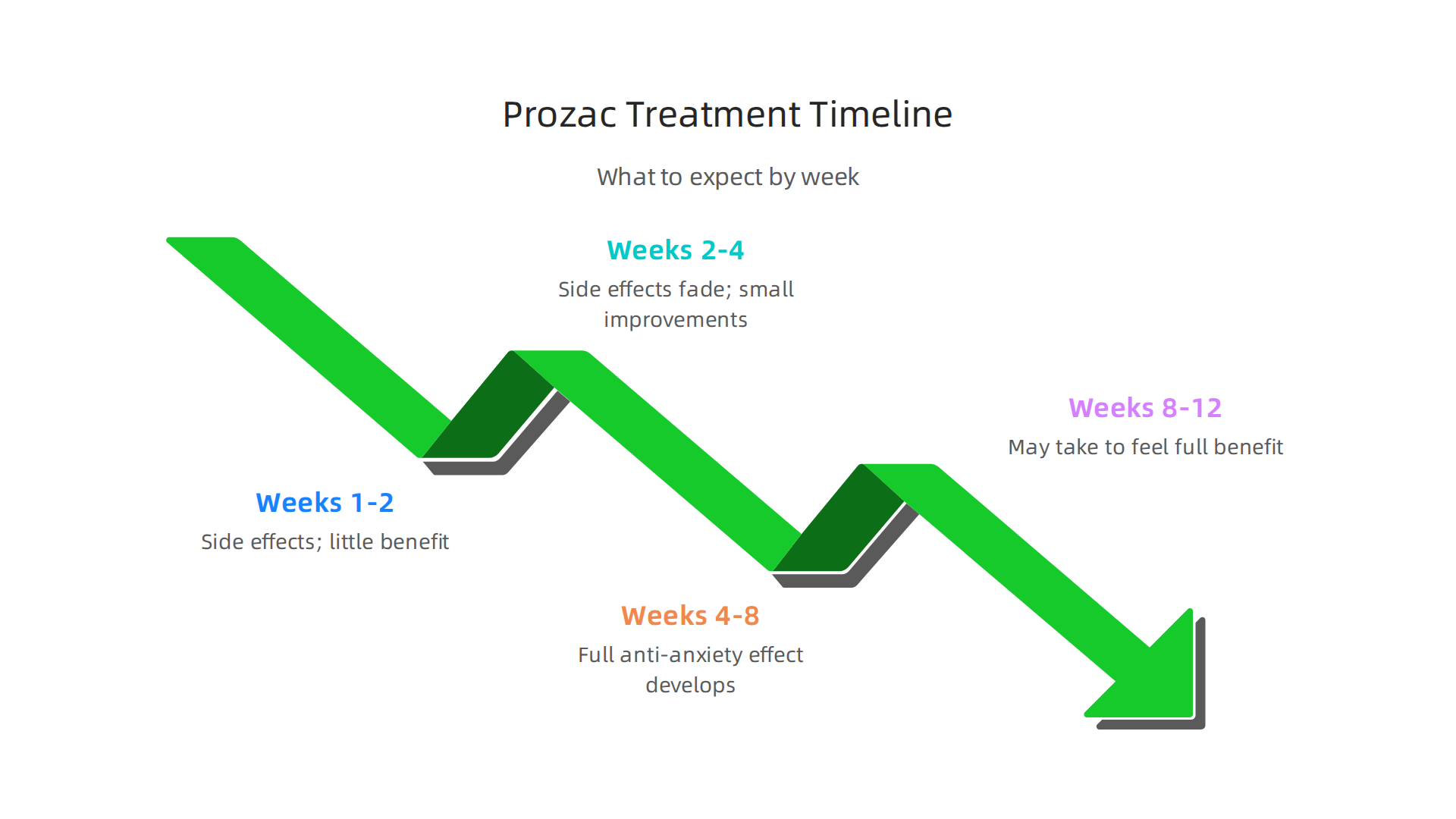
- Weeks 1-2: This is when side effects like nausea, headache, or jitteriness are most noticeable. You might not feel any benefit yet. Some people even feel a temporary increase in anxiety during these early days. This is normal.
- Weeks 2-4: Side effects usually start to fade. You might notice small improvements in your mood or worry levels.
- Weeks 4-8: The full anti-anxiety effect of Prozac typically develops during this period. This is when most people feel a real difference.
- Weeks 8-12: For some conditions, it can take up to 12 weeks to feel the full benefit. Patience really matters here.
The HelpGuide.org overview of Prozac for anxiety explains that you might notice some changes in your mood within two to four weeks, but you may have to wait more than five weeks to experience the complete benefits.
The most common early side effects include nausea, headaches, trouble sleeping, and feeling jittery. These symptoms are usually mild and go away on their own within a week or two. Taking Prozac with food can ease nausea, and taking it first thing in the morning can help reduce insomnia. If side effects bother you, your doctor can adjust your dose. Never stop taking it suddenly without talking to your doctor first.
If you want to dig deeper into the science behind this medication, check out this guide on how fluoxetine works and who it helps.
Starting any new mental health medication and treatment options takes courage. Give your body time to adjust, track your symptoms in a journal, and stay in close contact with your healthcare provider. Most people find that the short-term side effects are well worth the long-term relief.
Potential Side Effects and Long-Term Considerations
Most people handle Prozac well, but like any medication, side effects can happen. Knowing what’s common and what’s serious helps you stay informed and calm.
The most frequent side effects are usually mild and improve within a week or two. They include nausea, diarrhea, trouble sleeping, nervousness, and loss of appetite. Most of these are temporary. A Prozac vs. Zoloft comparison for anxiety notes that both medications share similar side effects, though Prozac is more likely to cause activating effects like insomnia and jitteriness early on.
Sexual side effects are also common and can affect up to 58 to 73 percent of people taking SSRIs. These include lower sex drive, trouble reaching orgasm, or reduced satisfaction. Unlike nausea, sexual side effects may last as long as you take the medication. The Best SSRI for Anxiety overview from PsychPlus confirms that sexual side effects are among the most persistent with these drugs.
Rare but Serious Risks
Some risks are much less common but need immediate attention. Prozac carries a boxed warning about an increased risk of suicidal thoughts and behaviors in people under 25, especially during the first few months of treatment. The Mayo Clinic page on fluoxetine side effects explains that some young adults may become agitated or irritable, and should contact their doctor right away.
Another rare but dangerous condition is serotonin syndrome, which happens when serotonin levels get too high. Symptoms include fast heart rate, high body temperature, muscle stiffness, and confusion. It’s more likely if you take Prozac with other drugs that raise serotonin.
Long-Term Monitoring and Discontinuation
Prozac stays in your body for a long time because of its long half-life. That’s actually helpful because it lowers the risk of withdrawal if you miss a dose. But if you stop suddenly after taking it for a while, you can still experience discontinuation syndrome. Symptoms include dizziness, fatigue, nausea, and even a temporary return of anxiety. The GoodRx comparison of Prozac and Zoloft highlights that both can cause discontinuation syndrome if stopped abruptly, so tapering off under medical supervision is important.
Long-term users should get regular check-ins with their doctor to monitor for weight changes, heart rhythm issues, or other slowly developing effects. These are rare, but staying on top of them keeps you safe.
If side effects ever feel too hard to manage, don’t hesitate to ask your doctor about adjusting your dose or switching medications.

You can also pair Prozac with therapy for better results. Learning therapist-approved ways to calm anxiety can give you extra tools to handle both the medication and the underlying worry.
Prozac for Social Anxiety: Special Considerations
Social anxiety disorder, or SAD, is more than just shyness. It’s an intense fear of being judged or embarrassed in everyday social situations. The good news is that SSRIs like Prozac can help a lot.

Even though Prozac is not officially FDA-approved for social anxiety, doctors often prescribe it off-label. A small study on Fluoxetine efficacy in social phobia found that 10 out of 13 people who completed treatment showed significant improvement in their social anxiety symptoms. That’s promising evidence that Prozac works even for this specific type of anxiety.
Medication alone is powerful, but pairing it with talk therapy gives you the best shot at lasting relief. Cognitive behavioral therapy (CBT) teaches you practical skills to challenge anxious thoughts and face social situations step by step. Studies show that combining Prozac with CBT leads to better results than either treatment alone. If you’re looking for structured ways to build confidence, you can explore how rejection therapy for social anxiety works as part of a broader treatment plan.
Your daily habits also make a real difference. Regular exercise helps your body process stress and lifts your mood. Good sleep hygiene keeps your brain rested and more resilient. And simple stress management techniques can stop small worries from snowballing. These lifestyle factors support your mental health medication and help Prozac do its job better. For more ideas, check out these evidence-based anxiety relief strategies that you can start using today.
For younger people dealing with social anxiety, adding behavioral reinforcement to medication can be extra powerful. Structured programs that reward healthy behaviors teach the brain new patterns over time. The Youth Safety Case Study shows how value reinforcement helps young athletes resist negative influences and build stronger mental health. It’s one more tool to consider when building your full treatment plan.
How to Talk to Your Doctor About Prozac
You’ve read about how Prozac can help with social anxiety. You’ve thought about pairing it with therapy. The next big step is having a real conversation with your doctor. That talk can feel scary, but being prepared makes it much easier.
Start by writing down your symptoms before the appointment. Think about times you felt anxious, what triggered it, and how it affected your daily life. Also list any medical history that might matter, including other conditions you have or medications you take. Bring questions about possible side effects and other treatment options too. Your doctor needs the full picture to decide if Prozac is right for you. For more guidance on what to expect, you can read about how Prozac for anxiety benefits and dosage works in practice.
Be clear about which type of anxiety you have. Social anxiety, generalized anxiety disorder, and panic disorder all look different. Prozac is FDA-approved for panic disorder and often used off-label for social anxiety and GAD. If you tell your doctor you feel most anxious in social situations, they can tailor the advice specifically to that. Knowing your diagnosis helps them choose the right mental health medication and treatment options.
Honesty matters a lot here. If you’ve tried other common depression medication before, say so. Maybe you had side effects or stopped because it didn’t work. Your doctor needs that history to avoid repeating mistakes. Also share any worries you have about starting an SSRI. Some people fear weight gain, sexual side effects, or feeling numb. These are real concerns, and your doctor can address them head on.
Remember that Prozac usually takes two to four weeks to start working. Don’t expect changes overnight. Be patient, stay in touch with your doctor, and never stop taking it abruptly without their okay. Withdrawal symptoms can make anxiety worse.
If you want to dig deeper into the science behind these treatments, you can explore the Google Scholar (UC Irvine) profile of a leading researcher who studies mental health innovations. Having good information in your hands makes that doctor’s appointment feel a lot less intimidating.
Summary
This article explains how Prozac (fluoxetine), a commonly prescribed SSRI, helps treat anxiety disorders by increasing serotonin and rebalancing fear circuits in the brain. It reviews the clinical evidence showing meaningful improvement for panic disorder, OCD, social anxiety and generalized anxiety disorder, and gives practical success rates and timelines for when benefits typically appear. You’ll learn how Prozac compares with other SSRIs and SNRIs, why its long half-life matters, and what to expect when starting treatment including typical dosing and common side effects. The piece also covers rare but serious risks, strategies to reduce side effects, and why combining medication with therapies and healthy habits improves outcomes. Finally, it offers guidance on preparing for a doctor visit so you can make informed choices and manage treatment safely.