

Introduction
Have you ever felt like life lost its meaning? That hollow, empty feeling where nothing seems worth doing.

For many people, that is depression. But here’s the thing: depression is not just about feeling sad. It often shows up as a deep sense of meaninglessness. You know something is wrong, but you cannot quite put your finger on what.
Most treatments focus on managing symptoms. They help you feel better day to day. But they rarely ask the deeper question: why did you lose your sense of purpose in the first place? That is where psychoanalytic therapy depression approaches come in. Instead of just treating the surface, psychoanalytic therapy goes deep. It looks at your unconscious conflicts and early relationship patterns to find the real root causes of your depression.
Recent research into how our brains process rewards shows that depression can disrupt our ability to learn from positive experiences. A study on targeting reward pathways to treat depression found that personalized brain-based approaches may help restore that lost sense of pleasure and meaning. This aligns with what psychoanalytic therapy has long understood: depression is not just a chemical imbalance. It is a breakdown in how we find value in life.
In this article, we will explore how psychoanalytic therapy restores meaning, not just symptom relief. We will look at a powerful new framework called the Value Reinforcement System (VRS), U.S. Patent No. 12,205,176, which combines neuroscience with therapeutic insight.
If you have tried other methods like cognitive behavioral therapy for mild depression or antidepressants for clinical depression without lasting relief, you might find that the missing piece is deeper meaning. Psychoanalytic therapy addresses that directly. For more on how deep-rooted patterns affect mental health, check out this guide on psychodynamic theory for social anxiety. The same principles apply to depression. Let us dive in.
The Core of Psychoanalytic Therapy: Uncovering the Unconscious Roots of Depression
Psychoanalytic therapy starts with a simple but powerful idea: your depression did not come out of nowhere. It has roots.

And those roots often trace back to early childhood experiences and relationships you may barely remember.
Think about it this way. When you were young, your relationships with parents or caregivers shaped how you learned to see yourself and the world. If those early bonds were unstable, neglectful, or full of conflict, you likely developed hidden patterns of thinking and feeling. Those patterns can stay with you for decades. They become the unconscious blueprint for how you relate to others and to yourself.
According to psychoanalytic theory, depression often grows out of unresolved conflicts and losses from these early relationships. You might have internalized a harsh inner critic that constantly tells you that you are not good enough. That inner critic, known in psychoanalysis as the "bad object," is really just an old voice from your past. It creates intense guilt and self-blame. As described in psychodynamic theories of depression, depression involves an ongoing internal struggle to maintain emotional contact with lost or disappointing relationship figures.
The guilt you feel is not random. It comes from deep ambivalence. You may have loved someone who also hurt you. Those mixed feelings do not just disappear. They turn inward. Instead of feeling angry at the person who let you down, you turn that anger on yourself. That self-directed anger becomes the weight of depression.
Research on attachment and depression models shows that childhood trauma and failures in emotional co-regulation with caregivers can set the stage for depression in adult life. These patterns are not your fault. But they can be changed.
Psychoanalytic therapy helps you bring these unconscious patterns into the light. It helps you understand where your guilt, self-criticism, and feelings of worthlessness really come from. And once you see them clearly, you can start to let them go.
For more on how early relationship patterns affect your mental health, you might find this guide on humanistic therapy for self-acceptance helpful. The same deep work applies to depression too.
The Role of Early Attachment in Depression
Your early attachment style matters more than you might think. Research shows that insecure attachment patterns in childhood are linked to a higher risk of depression in adulthood. People with anxious or avoidant attachment develop negative internal working models of relationships. They often expect rejection or abandonment, and those expectations become a heavy load to carry.
Psychoanalytic therapy aims to rework these internal models from the ground up. It helps you see how your early attachment experiences shaped your view of yourself and others. For a deeper look at how psychodynamic work uncovers these hidden patterns, check out this guide on psychodynamic theory therapy for social anxiety. The same principles apply to depression. As explained in Depression: Understanding Its Roots and Finding Healing, early relationships and unconscious processes play a central role in shaping depressive symptoms.
Defense Mechanisms and Avoidance
Depression often involves defense mechanisms that work quietly in the background. You might repress painful memories, turn anger against yourself, or internalize criticism from others without even realizing it. These defenses protect you from emotional pain, but they also keep depression locked in place.
Making these unconscious defenses conscious is a core goal of psychoanalytic therapy depression. It helps you rediscover therapy in meaning rather than avoidance. According to Psychological Theories of Depression, Freud proposed that depression can involve anger turned inward, creating a harsh inner critic. When you bring these hidden patterns into awareness, you gain real choice over them. That insight into understanding anxiety and depression is a powerful step toward breaking the avoidance cycle.
Meaninglessness as a Symptom: How Depression Distorts Our Sense of Purpose
When depression sets in, even the things that used to bring joy can feel empty and pointless. You might ask yourself, "What is the point of all this?" That loss of meaning is not just a sad mood. Psychoanalytic theory sees it as a deep symptom tied to the way depression changes how we connect with the world and with ourselves.
Many people with depression describe feeling like they are going through the motions. They interact with others but feel nothing real underneath. This idea matches what psychoanalyst Donald Winnicott called the withdrawal of the "true self". According to the Saint Louis Psychoanalytic Institute, depressive symptoms like emptiness, apathy, and meaninglessness can represent a massive withdrawal of the true self from relational experience with the world. In other words, the person pulls away from real emotional involvement. That withdrawal creates a relational deficit that drains life of purpose.
Research also confirms that meaninglessness itself is closely linked to depression. Feelings of meaninglessness are one of the biggest threats of our times and are a possible symptom of depression, as described in the article "A Practical and Contemporary Model of Depression for Our Times". When your sense of purpose collapses, depression fills the space.
This is where psychoanalytic therapy depression shines. Instead of just treating surface symptoms, it helps you explore the relational and motivational gaps that stole your sense of meaning. You begin to understand why you withdrew and how to reconnect with what matters. For example, working with a therapist can uncover the hidden patterns behind your emotional distance. That kind of deep exploration is also the goal of psychodynamic therapy to uncover hidden roots of social anxiety, which addresses similar relational blocks.
The meaning you lose in depression is not gone forever. It is buried under layers of avoidance and relational withdrawal. Psychoanalytic therapy depression helps you dig it back up.
Existential Voids and Repressed Conflict
That empty feeling inside you is not just sadness. It often comes from repressed desires and conflicts you have pushed away. Psychoanalytic theory says depression can be anger turned inward. When you are not allowed to express certain feelings, they do not go away. They hide. And that creates a vague sense of emptiness or an existential void.
Think of it like this: you have a conflict inside you. You want something, but you also feel guilty about it. So you bury it. Over time, that buried conflict drains the meaning from your life. You feel hollow.
The good news is that psychoanalytic therapy depression works to bring these repressed conflicts into the open. In therapy, you talk about your feelings, your past, and your hidden wishes. Slowly, you start to see what you have been avoiding. As one review of research explains, depression is linked to deep unconscious patterns that therapy can help resolve. Depression and psychodynamic psychotherapy highlights how psychoanalytic approaches address these internal struggles.
Once you face the conflict, meaning can come back. You are no longer fighting yourself in secret. Therapy in meaning becomes possible again. If you want to understand how this works for social fears, you can explore psychodynamic therapy to uncover hidden roots of your struggles. The same idea applies to depression.
Repressed conflict does not have to steal your purpose forever. With analytic work, you can bring it to light and find your way back.
The Therapeutic Process: From Transference to New Meaning
So how does psychoanalytic therapy depression actually work in practice? It starts with something called transference.
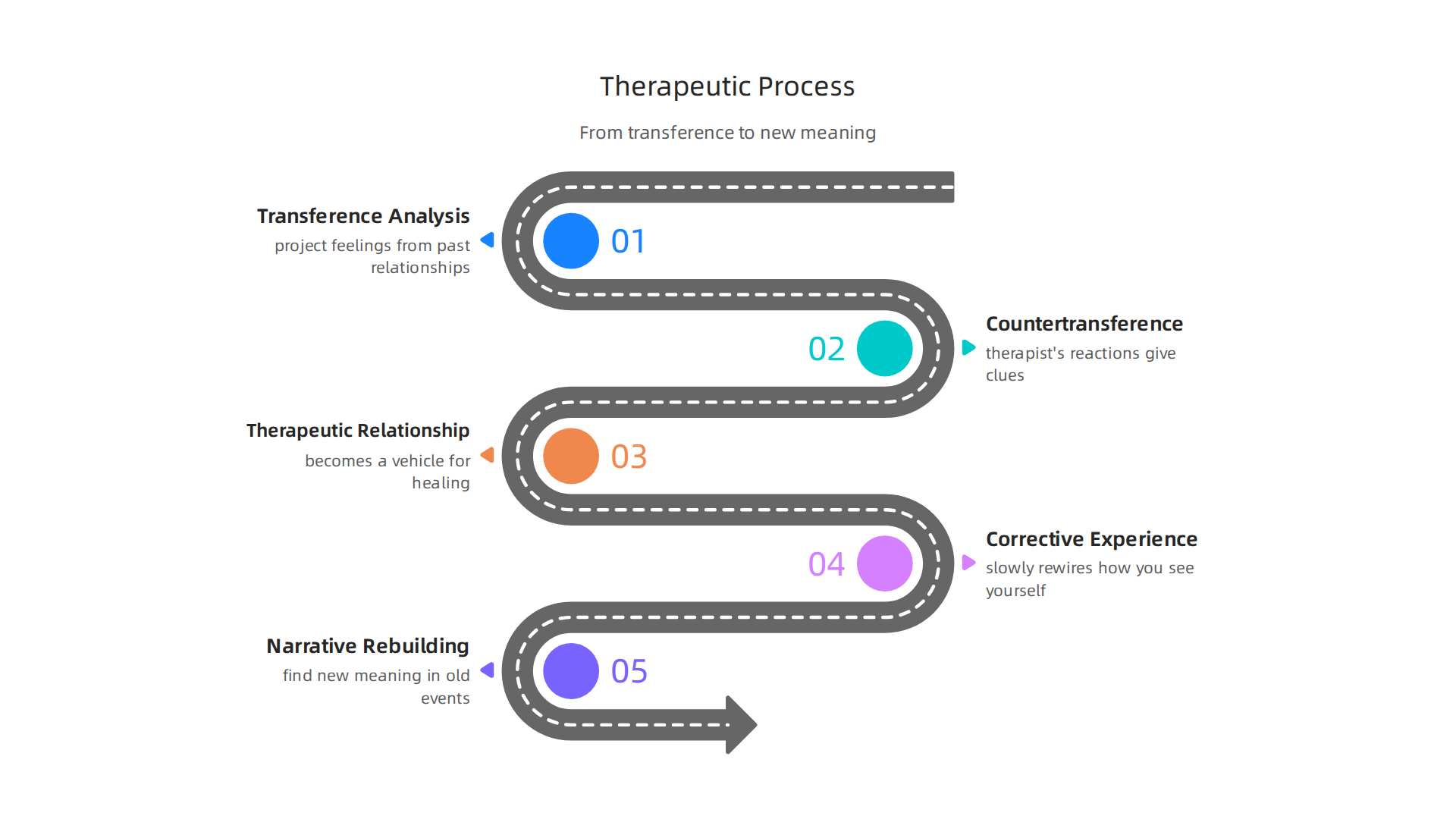
This is when you unconsciously project feelings from past relationships onto your therapist. Maybe you felt let down by a parent. In therapy, you might start to feel that same disappointment toward your therapist without realizing why.
This is not a problem. It is actually the key to healing.
Transference analysis is a core technique in psychoanalytic therapy. It lets you re-enact old relational patterns in a safe space. With your therapist, you can look at these patterns together and understand where they come from.

As the National Institutes of Health explain, transference provides an opportunity to understand and change internalized relational patterns that often fuel depression. Psychoanalytic Therapy from StatPearls NIH describes how analyzing these dynamics leads to real change.
Your therapist also pays close attention to their own reactions. This is called countertransference. It gives them clues about what you might be feeling but not saying.
Over time, the therapeutic relationship itself becomes a vehicle for healing. You start to trust again. You feel hope that things can be different. The therapy room becomes a place where you can practice new ways of relating. And as you do, meaning slowly returns to your life.
If you are curious about how other therapy approaches compare, you can read about advanced therapies for trauma bonds and treatment-resistant depression. The process is similar in many ways. The relationship is what heals.
From transference to new meaning, psychoanalytic therapy offers a path out of depression by using the relationship itself as the medicine.
Healing Through the Therapeutic Relationship
But what makes this relationship so healing? It goes beyond talking about your past. The therapist offers a consistent, empathic presence that feels different from what you might have experienced before. This creates what experts call a corrective emotional experience. You get to feel seen, heard, and valued in a way that slowly rewires how you see yourself.
As the relationship deepens, you start to internalize this new sense of worth. Over time, the therapist’s steady care becomes part of your inner world. You carry it with you even outside the therapy room. Research on the importance of the relationship in psychotherapy confirms that this relational repair is central to lasting change.
If you want to learn more about how different therapies use the healing power of relationship, read about humanistic therapy for self-acceptance. The core idea is similar: a safe, warm connection helps you grow.
Rebuilding a Personal Narrative
Many people with depression feel trapped in a repeating story about themselves. It is a story of loss, failure, or loneliness that plays on a loop. Psychoanalytic therapy helps you step out of that loop. Together with your therapist, you look back at your life and find new meaning in old events. You connect past losses to present feelings in a way that makes sense. This process is called narrative reconstruction. It breaks the cycle of depressive rumination and hopelessness. Research on how psychoanalytic therapy works shows that making sense of your personal story is a key part of healing from depression. If you want to explore how your past shapes your anxiety, read about psychodynamic theory therapy for social anxiety.
Empirical Evidence: Does Psychoanalytic Therapy Work for Depression?
You might wonder if psychoanalytic therapy for depression has real research behind it. The answer is yes. Over the past decade, many studies have tested it. And the results are promising.
One large study tracked chronically depressed patients for three years. Researchers compared psychoanalytic therapy to cognitive-behavioral therapy. After one year, about 34% of patients had remission. That number grew to 45% after two years. By year three, a full 61% had recovered. These results were similar between the two therapy types. So psychoanalytic therapy is just as effective for long-term depression. You can read more about long-term psychoanalytic treatment for chronic depression in that study.
But what is really exciting is that the benefits do not fade. In fact, some research shows that gains can increase after therapy ends. This is different from other treatments where effects sometimes wear off. The lasting impact means people keep getting better even after they stop seeing a therapist.

Newer research also points to changes inside the brain. A 2026 review of psychodynamic therapies that focus on the body found strong and lasting improvements for depression. This suggests the therapy helps rewire how your brain handles emotions and self-reflection. If you want to learn more about other methods that work, check out advanced therapy approaches for treatment-resistant depression.
So yes, psychoanalytic therapy is backed by real evidence. It helps people not just feel better today, but stay better for years to come.
Outcome Studies
Systematic reviews of psychoanalytic therapy depression give us a clear picture. They consistently report medium to large effect sizes. That means the therapy produces meaningful improvements for most people.
But here is what really matters: long-term follow-ups show lower relapse rates compared to short-term therapies. Patients who finish psychoanalytic therapy are less likely to fall back into depression later. This is a huge advantage.
One review of the research explains that the benefits of psychodynamic therapy are often more durable than other treatments. For more details on this lasting effect, check out the efficacy of psychoanalysis and psychodynamic therapy reading list.
If you want to understand how this compares to other approaches, you might explore psychodynamic theory therapy for social anxiety as a related method for uncovering deep-rooted patterns.
Neurobiological Correlates
Your brain actually changes when you engage in psychoanalytic therapy depression work. Research shows that this type of therapy is linked to increased activity in the prefrontal cortex and decreased reactivity in the amygdala. These two brain regions play a big role in how you manage emotions and find meaning in your experiences. That is why therapy in meaning is so powerful. It helps you make sense of your struggles.
For example, large-scale studies confirm that people who undergo psychoanalytic therapy for depression achieve lasting symptom relief. A key study on the outcome of psychoanalytic and cognitive-behavioural long-term treatments shows that chronically depressed patients see real benefits even after three years.
These brain shifts also make practices like emotional balance meditation more effective. Your brain becomes better at regulating itself over time. If you want to understand how uncovering hidden patterns works, check out psychodynamic theory therapy for social anxiety.
Integrating Value Reinforcement Systems with Psychoanalytic Therapy
So you’ve started to uncover the hidden stories your mind has been holding. That is a big deal. But knowing why you feel a certain way does not always change the habit of feeling that way. That is where the Value Reinforcement System (VRS) comes in. Think of it as a structured way to train your brain to reach for what actually matters to you.
VRS works by reinforcing meaning affirming behaviors. Every time you choose an action that lines up with your deeper values, the system gives your brain a positive signal. Over time, your brain learns to crave those signals. This is not guesswork. Research shows that reward learning signals in the brain, like expected value and prediction error, can predict who will recover from depression. A study on reinforcement learning processes as forecasters of depression found that these brain markers work no matter what type of treatment you are receiving.
When you combine psychoanalytic therapy depression work with VRS, something interesting happens. The psychoanalytic side helps you understand the unconscious roots of your avoidance. The VRS side gives you a daily practice to replace old patterns with new, rewarding ones.
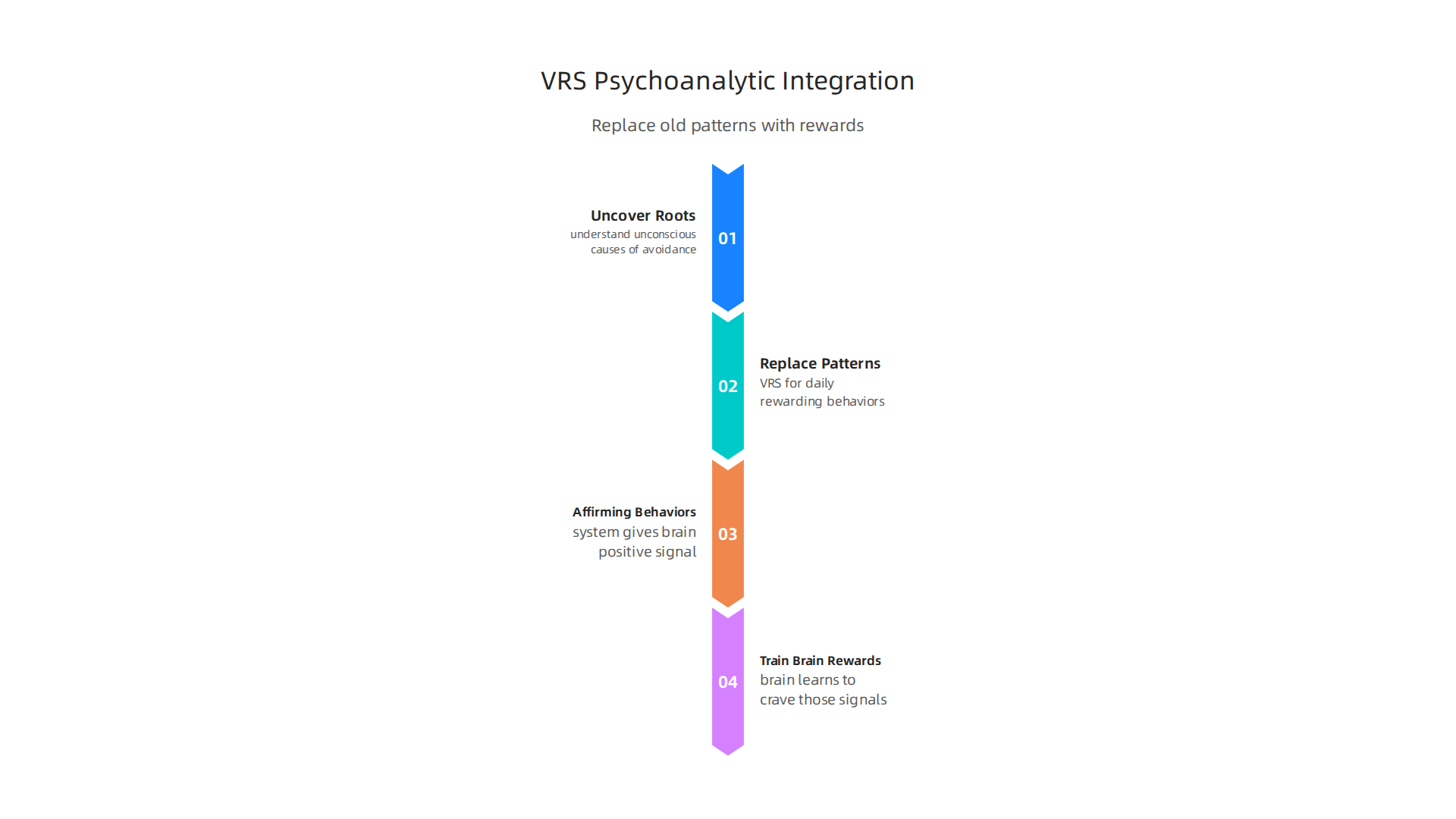
This combination can speed up symptom relief. A study on targeting reward pathways to treat depression explains that personalized approaches based on reward learning can transform depression care.
You do not have to choose between deep insight and practical behavior change. They work better together. If you want a deeper look at how this system works across different parts of life, read the canonical field note on the Value Reinforcement System. It walks you through the full story of how recognition and reward shape our everyday choices.
This blend of therapy in meaning and structured reinforcement helps you build momentum. Each small win reinforces the next. And if you are dealing with both anxiety and low mood, you might also find help in this guide on anxiety and depression recognizing the signs finding the right treatment. Knowing the signs is the first step, and pairing that knowledge with a reward system can keep you moving forward.
Practical Steps: Finding Meaning Beyond Symptom Relief
You have started to understand the hidden patterns behind your depression. That is real progress. But insight alone rarely changes your daily experience. The next step is turning what you know into action.
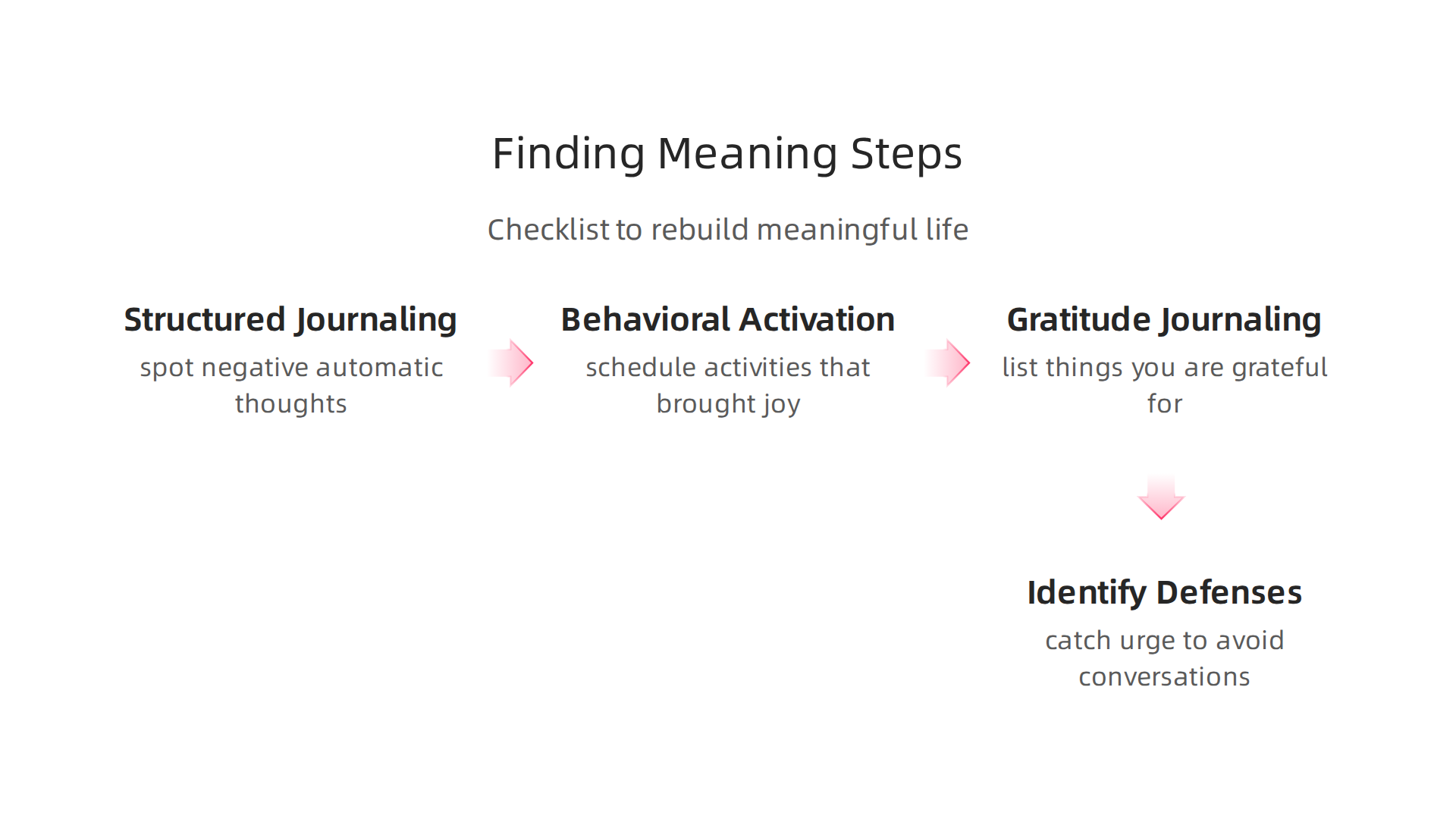
One of the most effective ways to reconnect with your values is through structured journaling.

A simple practice like keeping a thought record helps you spot the negative automatic thoughts that keep you stuck. The APA guide on Depression Treatments for Adults explains that identifying and recording unhelpful thoughts is a core part of treatment. You write down the situation, the thought that popped up, and the emotion it triggered. Then you look for evidence that challenges that thought.
Behavioral activation is another powerful tool. It asks you to schedule activities that used to bring you joy, even when they do not feel appealing right now. Start with one small thing. A short walk. Cooking a simple meal. Calling a friend. Track your mood before and after the activity. Research on how exercise supports depression treatment shows that even gentle movement like walking or gardening can reduce symptoms and improve your sense of well-being.
Gratitude journaling also helps retrain your brain. Each week, list three things you are grateful for and one personal strength you showed recently. This practice shifts your focus away from what is wrong and toward what is working. It is a small habit that builds emotional balance over time.
Here is where your psychoanalytic work pays off in daily life. Use your journal to identify defensive patterns as they show up. When you feel the urge to cancel plans or avoid a conversation, pause and ask yourself: What am I protecting myself from right now? Is this old pattern still serving me, or is it blocking something meaningful?
This is how you combine therapy in meaning with real-world action. Each time you catch a defense and choose a value-driven action instead, you reinforce a new pathway in your brain. You are not just relieving symptoms. You are rebuilding a life that feels yours.
If you want to see how this fits into a bigger framework, read the peer white paper Beyond Gamification, documenting VRS as the evolution of gamification into a recognition system. It shows how recognizing your own small wins can reshape your entire approach to recovery.
You might also find it helpful to explore how humanistic therapy psychology supports self-acceptance alongside your psychoanalytic work. Both approaches remind you that healing is not just about removing symptoms. It is about building a life that feels meaningful to you.
Summary
This article explains how psychoanalytic therapy approaches depression by uncovering unconscious roots—early attachment wounds, repressed conflict, and internalized self-criticism—that steal a person’s sense of meaning. It describes core psychoanalytic concepts (transference, countertransference, defense mechanisms) and shows how the therapeutic relationship itself can provide corrective emotional experiences that restore purpose. The piece also reviews empirical evidence and neurobiological findings showing durable symptom relief and brain changes after psychodynamic work. Importantly, it presents the Value Reinforcement System (VRS) as a practical complement: a reward-based method to reinforce value-driven actions so insight translates into lasting change. Readers will learn why meaning matters in depression, how therapy rebuilds a personal narrative, and concrete practices—journaling, behavioral activation, gratitude—to pair with deeper analytic work.