

If you or someone you love is living with post-traumatic stress disorder, you know how exhausting the symptoms can be. Intrusive memories, constant avoidance, and a feeling of always being on edge can make daily life feel impossible. You are not alone. PTSD affects millions of people worldwide. According to the World Health Organization, an estimated 3.9% of the world population has experienced PTSD at some point in their lives. In the United States, the National Institute of Mental Health reports that about 3.6% of adults had PTSD in the past year, with rates higher for women.
That is why finding effective treatment matters so much. Clinical guidelines consistently recommend cognitive behavior therapy for PTSD as a first-line treatment.

In fact, cognitive behavior therapy PTSD is considered the gold standard because it helps people change the thought patterns and behaviors that keep trauma alive. Much like cognitive behavioral therapy for OCD is the gold standard for obsessive-compulsive disorder, CBT for PTSD targets the specific mechanisms that maintain symptoms.
In this article, we will take a close look at how CBT works for PTSD, what the research says, and practical steps you can take toward healing. If social anxiety is making your PTSD worse, you don’t have to face it alone. Break the social pressure that holds you back.
Understanding PTSD and How CBT Addresses the Trauma Response
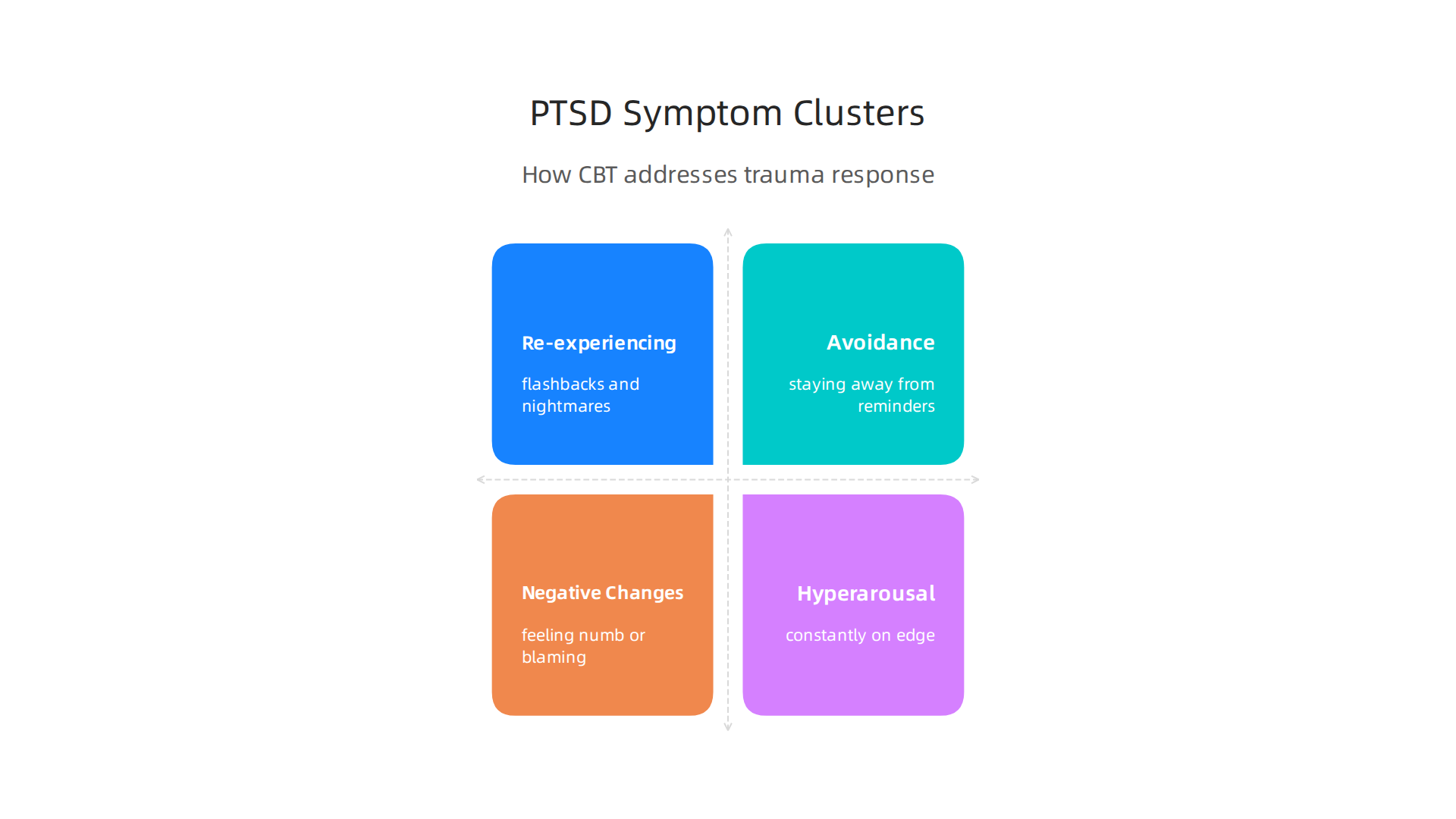
So what exactly happens in the brain after trauma? PTSD is more than just a bad memory. It rewires how your brain processes fear and safety. The four main symptom clusters are re-experiencing (flashbacks and nightmares), avoidance (staying away from reminders), negative changes in thoughts and mood (feeling numb or blaming yourself), and hyperarousal (being constantly on edge).
These symptoms can show up months or even years after the event.
Here is the key insight. People with PTSD do not just have painful memories. They also develop unhelpful beliefs about themselves and the world. For example, someone might think "I am unsafe everywhere" or "I should have prevented what happened." These thoughts keep the trauma alive and fuel avoidance behaviors.
This is exactly where cognitive behavior therapy PTSD steps in. CBT is built on the idea that your thoughts, feelings, and behaviors are all connected. When a traumatic event happens, the way you interpret that event matters a lot. If you believe the world is completely dangerous, you will act that way. You will avoid people, places, and situations that remind you of the trauma. And that avoidance keeps your fear from ever fading.
The cognitive model of PTSD explains this clearly. According to research from the National Institute of Mental Health, about 3.6% of U.S. adults had PTSD in the past year. Many of them get stuck in a cycle where their thoughts about the trauma become more extreme over time. CBT breaks that cycle.
A trained therapist helps you look at those thoughts with fresh eyes. You learn to question beliefs like "I am to blame" or "I cannot trust anyone." Over time, your brain starts to build new, safer pathways. This is not about forgetting what happened. It is about changing how you carry it.
If the trauma has also made social situations feel terrifying, that is common too. Avoidance often shows up as pulling away from others. You do not have to stay stuck in that isolation. Break the social pressure that holds you back and take the first step toward real change.
For related guidance on how to start your healing journey, explore these mental health screening tools that show you when to seek help. Knowing where you stand is the first step forward.
Core Components of CBT for PTSD: Exposure, Restructuring, and More
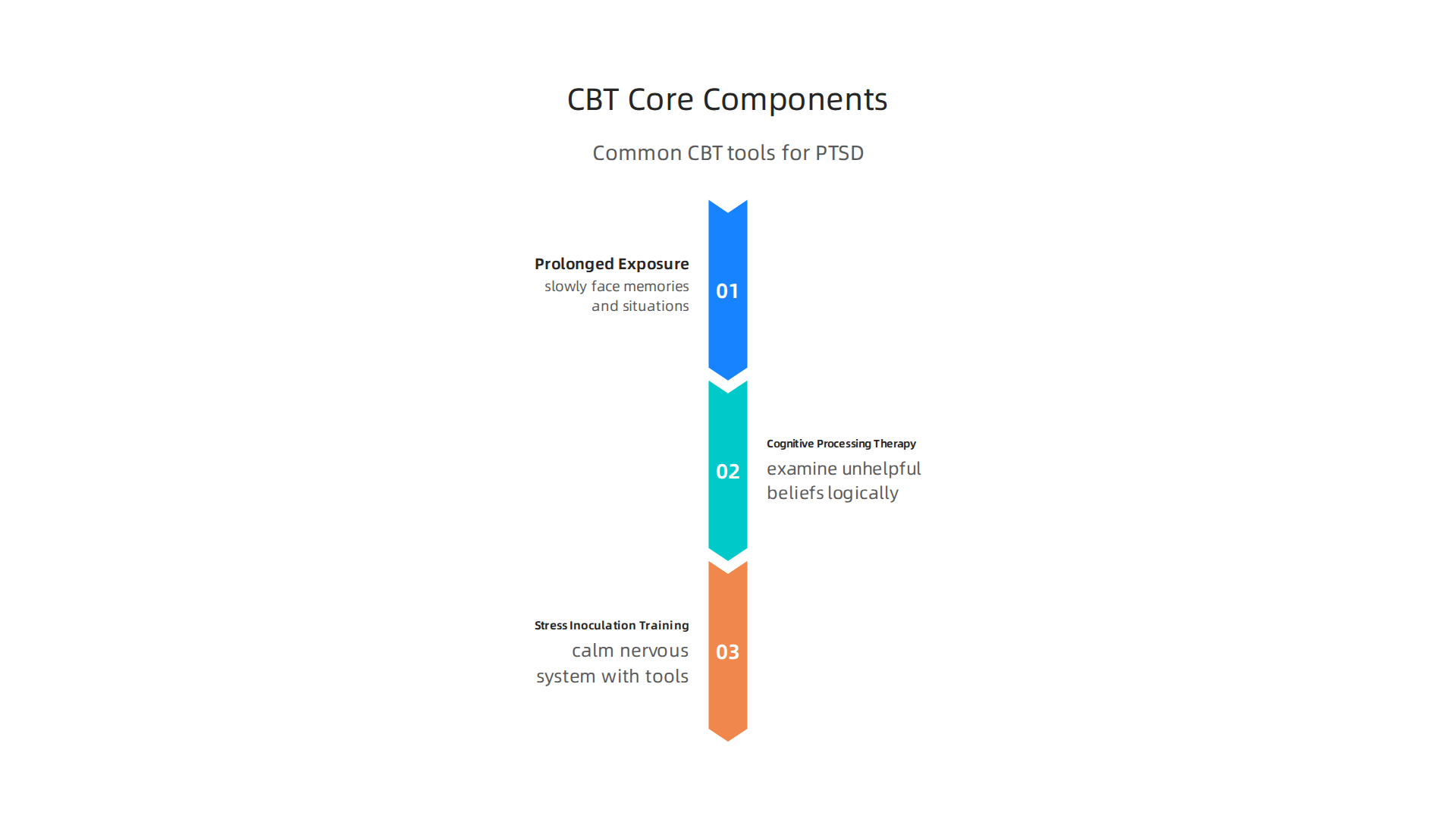
So what does cognitive behavior therapy PTSD actually look like in practice? It is not just one technique. Therapists use a few powerful tools to help break the trauma cycle. Let us look at the three most common ones.
Prolonged Exposure (PE)
PE asks you to slowly and safely face the memories and situations you have been avoiding. You might retell the story of what happened. Or you might go back to a place that feels safe now. The goal is simple. Avoidance keeps fear alive. Facing it, in a controlled way, lets that fear fade. Research from the VA shows this repeated practice helps your brain learn that the memory is not a current danger.
Cognitive Processing Therapy (CPT)
CPT works on the thoughts that got stuck after the trauma. Many people believe things like "I am broken" or "I cannot trust anyone." The American Psychological Association explains that CPT helps you examine these beliefs logically. You learn to see the situation with more flexibility. This restructuring of thoughts is a core part of how CBT creates lasting change. You can see how this works in this helpful introduction to Cognitive Processing Therapy for PTSD on YouTube.
Stress Inoculation Training (SIT)
Trauma lives in the body too. You might feel tense, have a racing heart, or struggle to sleep. SIT gives you practical tools like breathing exercises and grounding techniques to calm your nervous system. As noted in guides on Prolonged Exposure Therapy, these coping skills are crucial for managing the physical symptoms of PTSD.
Putting It All Together
Your therapist might use one or a mix of these approaches. The right plan depends on your story and what you need most. If you are ready to stop feeling stuck, these tools can point the way forward.
Not sure if your reactions match PTSD? Using mental health screening tools that show you when to seek help can give you a clearer picture of your symptoms.
Trauma can make you feel held back by fear. You do not have to stay there. You can Break the social pressure that holds you back and start your journey toward real relief.
Evidence Base: What Clinical Research Says About CBT for PTSD
So we’ve seen the tools that cognitive behavior therapy PTSD uses. But do they actually work? The short answer is yes. Really well. Let’s look at what the numbers say.
Big Effects That Last
Multiple research reviews have looked at dozens of studies. The results are clear. CBT for PTSD produces large improvements compared to doing nothing or getting usual care.

Statistically, the effect size is often above 0.8. That is a big deal. It means most people who try CBT get significantly better. The American Psychological Association lists CPT as a strong recommendation. The VA also backs both PE and CPT with solid evidence from their own trials.
Works for All Kinds of People
Maybe you worry this is only for one type of trauma. Not true. Studies include veterans, survivors of assault, refugees, and people in different cultures. CBT works across the board. The International Society for Traumatic Stress Studies confirms that CPT is designed to help survivors with more flexible thinking no matter their background. The same goes for other CBT methods. This is not a one-size-fits-all theory. It is a flexible approach that adapts to your story.
Dropout Rates Are Manageable
Some people worry that facing trauma memories might be too hard. It can be tough at first. But research shows that dropout rates for CBT are about the same as for other talk therapies. And therapists now have ways to make it more comfortable. For example, comparing CPT vs Prolonged Exposure can help choose the less intense option if avoidance is high. So concerns about tolerability are real, but there are good solutions.
What This Means for You
The science is on your side. You are not asking for a miracle. You are asking for a proven treatment. And the evidence says yes.
If you still feel held back by social pressure or fear of judgment, it might be time to Break the Social Pressure that keeps you from starting. You deserve the same chance that thousands of others have taken.
CBT Techniques for Managing Intrusive Thoughts and Avoidance
We know the evidence is strong. But what does cognitive behavior therapy PTSD actually feel like in practice? It comes down to a few core techniques that directly target the two biggest problems: intrusive thoughts and avoidance.
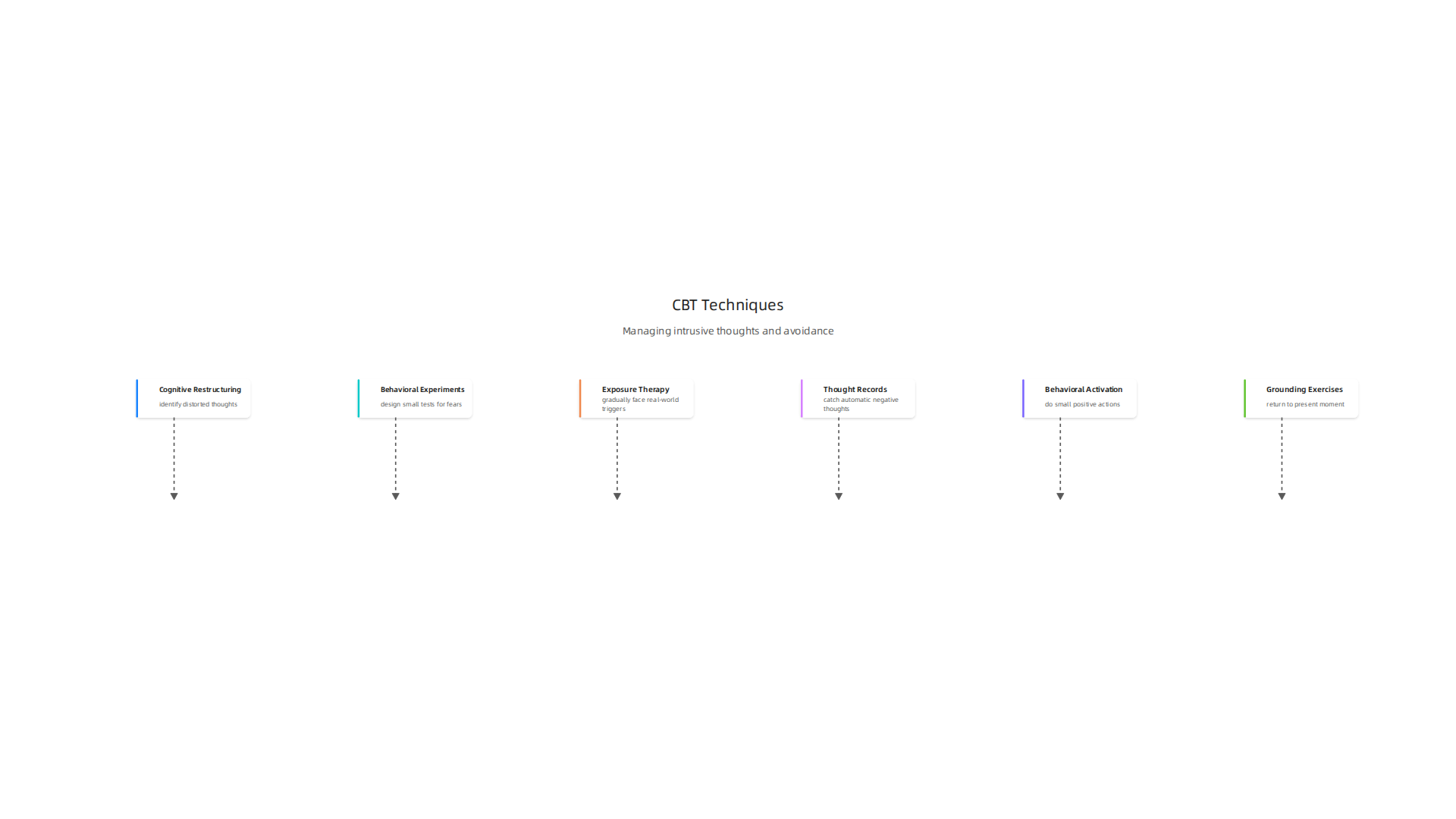
1. Cognitive Restructuring: Challenge the Lie
After trauma, your brain can get stuck on beliefs like "I am permanently damaged" or "The world is completely unsafe." These are not facts. They are thoughts that got frozen in time.
Cognitive restructuring helps you identify those distortions. Then you learn to ask, "Is that thought 100% true?" and "What is a more balanced way to see this?" The goal is to replace unhelpful thinking with realistic patterns. The APA explains that CBT focuses on changing the relationship among thoughts, feelings, and behaviors. You can learn more about how this core technique works in a guide on cognitive restructuring in CBT.
2. Behavioral Experiments: Test Your Fears
Avoidance is a huge driver of PTSD. You avoid thinking about the trauma. You avoid places that remind you of it. This keeps the fear alive.
Behavioral experiments flip this. You work with your therapist to design a small test. For example, if you believe "If I think about the event, I will lose control," your experiment might be to think about it for 30 seconds and see what actually happens. You almost always find that the feared outcome does not happen. This directly breaks the cycle of avoidance. These experiments are a key part of evidence-based anxiety relief strategies that rewire your brain’s response.
3. Exposure Therapy: Face It in a Safe Way
This is the most well-known technique. And yes, it can sound scary at first. But modern exposure therapy is careful and gradual.
You start with imaginal exposure. This means telling the story of the trauma in a safe room with your therapist. Over time, the memory loses its power. Then you move to in vivo exposure, which means facing real-world triggers step by step. The Cleveland Clinic explains that your therapist creates a safe environment to expose you to your fears. This helps change how your brain processes the memory.
Putting It All Together
These three techniques work as a team. Cognitive restructuring prepares your mind. Behavioral experiments build courage. Exposure therapy rewires the fear response.
Here is the thing. Feeling the social pressure that you need to be "ready" or "strong enough" before you start is part of the avoidance pattern itself. You are already stronger than you think. If you are ready to take that first step, you can Break the Social Pressure that keeps you stuck and start using these proven techniques with a trained therapist.
Combining CBT with Other Therapeutic Approaches
CBT is powerful on its own. But sometimes the best outcomes come from blending it with other proven methods. Think of it like a team. Each approach brings something different to the table.
CBT and EMDR: Two Paths, Same Goal
Many therapists combine CBT with Eye Movement Desensitization and Reprocessing (EMDR). Both have strong evidence behind them. The Phoenix Australia guidelines highlight trauma-focused CBT as a frontline treatment. EMDR targets the same traumatic memories through bilateral stimulation, like guided eye movements. Together, they can help you process the trauma from different angles. Some people find that CBT gives them the cognitive skills, while EMDR helps the memory feel less charged.
Medication Support: Short-Term Relief
Sometimes symptoms are so intense that it is hard to focus in therapy. In those cases, doctors may prescribe an SSRI medication to take the edge off the anxiety or depression. The APA notes that CBT is a strongly recommended treatment for PTSD. Medication can help you get stable enough to do the deeper work in therapy. But long term, the skills you learn in CBT tend to last longer than relying on pills alone.
Body and Mind: Yoga and Mindfulness
Trauma does not just live in your thoughts. It lives in your body too. That is why trauma-informed yoga and mindfulness-based CBT are becoming popular additions. Mindfulness helps you notice when fear is rising without getting swept away. The early sessions of CBT often include breathing retraining, as research from PMC explains. Yoga adds a physical layer, helping you feel safe in your own skin again.
So instead of choosing just one path, you can combine the best of several. For more ways to build a complete anxiety relief plan, check out these evidence-based anxiety relief strategies that rewire your anxious brain.
Your Next Step
You do not have to pick the perfect combination alone. A good therapist can help you mix and match what works for you. The most important thing is starting. If you are ready to move past the fear of what others think and find real help, Break the Social Pressure that keeps you stuck. You deserve a treatment plan that fits your whole life.
The Link Between PTSD and Social Anxiety: How CBT Helps Both
If you have PTSD, there is a good chance you also struggle with social anxiety. These two conditions often show up together. Research shows that between 14.8% and 46% of people with PTSD also have social anxiety disorder. Another study found that about 26% of people with PTSD meet the criteria for social anxiety. That is a lot of overlap.
Why do they pair so often? The symptoms are similar. Both involve hypervigilance, where you are constantly scanning for threats. Both involve avoidance, where you steer clear of places, people, or situations that might trigger fear. A traumatic event can make you feel unsafe around others. Over time, that feeling turns into social anxiety.
The good news is that cognitive behavior therapy for PTSD is also highly effective for social anxiety. CBT works on the thinking patterns and behaviors that keep both conditions going. Therapists often use what is called a unified protocol, which targets the core fears and avoidance habits shared by anxiety disorders. This means you do not need two separate treatments for two separate problems. One solid CBT approach can reduce distress in both areas.
Improving your social confidence through CBT can even speed up your trauma recovery. When you feel safer around people, you are more likely to engage in therapy, practice exposures, and build a support network. It creates a positive cycle.
If you are dealing with both PTSD and social anxiety, you are not alone. Recognizing how these conditions feed each other is the first step. For practical ways to build real confidence and break the avoidance cycle, check out this guide on how to overcome therapy insecurity and build real confidence. And when you are ready to move past the fear of judgment, Break the Social Pressure that has been holding you back.
Self-Help Strategies: Applying CBT Principles at Home
You do not have to wait for your next therapy session to start using cognitive behavior therapy for PTSD. Some of the most effective tools are things you can practice on your own, right at home. The same principles that help in a therapist’s office work just as well in your daily life when you apply them consistently.
Structured workbooks and apps based on CBT principles are a great place to begin. Many are designed specifically for trauma and anxiety. They guide you through the same steps a therapist uses, like identifying distorted thoughts and testing them against reality. Using these tools regularly reinforces what you learn in therapy and helps you build momentum between sessions.
Three simple techniques you can try today are thought records, behavioral activation, and grounding exercises.
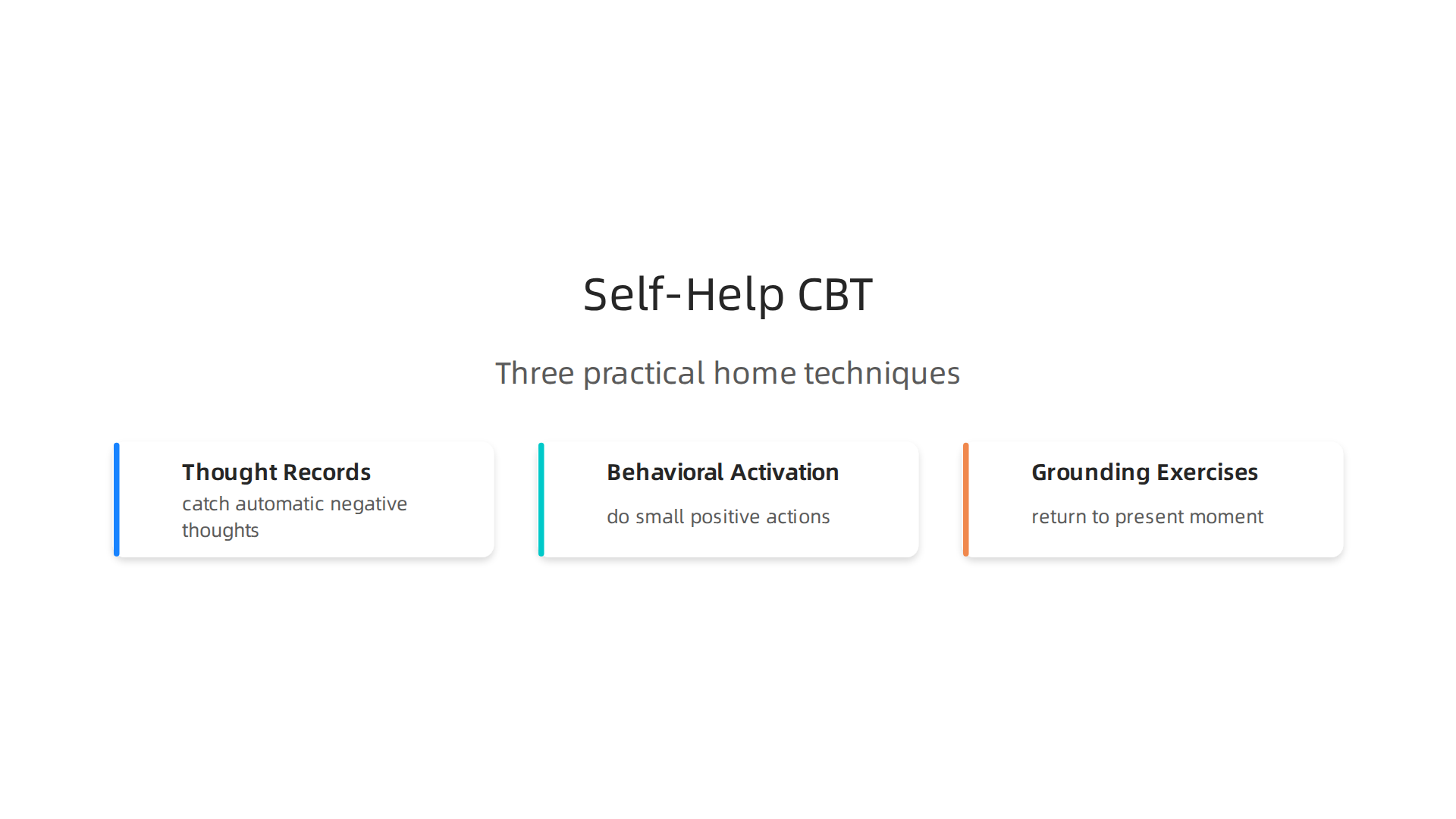
A thought record helps you catch automatic negative thoughts after a trigger. You write down the situation, the thought, the emotion, and then a more balanced response. Over time, this trains your brain to default to realistic thinking instead of fear-based reactions.
Behavioral activation means doing small positive actions even when you do not feel like it. A short walk, a phone call to a friend, or finishing a small task can shift your mood and reduce avoidance. The goal is to break the cycle of withdrawal that keeps anxiety alive.
Grounding exercises bring you back to the present moment when flashbacks or anxiety hit. Focus on five things you see, four you can touch, three you hear, two you smell, and one you taste. It sounds simple, but it works. These techniques are also useful for anyone working on general treatment for anxiety.
Research shows that PTSD and social anxiety often go together, with comorbidity rates between 14.8% and 46%. Because of this overlap, self-help strategies that address both conditions are especially valuable.
Here is the key point to remember. Self-help should support professional therapy, not replace it. For moderate to severe PTSD, working with a trained therapist is still the best option. If you want reliable tools for your journey, these therapy aids for social anxiety proven to work in 2026 are worth exploring.
When you feel ready to move past the fear of judgment, Break the Social Pressure that has been holding you back.
When and How to Seek Professional CBT for PTSD
Self-help strategies are a solid start, but they are not the whole answer. For many people dealing with PTSD, working with a trained professional is the step that leads to real freedom.
How do you know when it is time to seek professional cognitive behavior therapy for PTSD? Watch for these signs.

Your symptoms are getting worse instead of better. You struggle to get out of bed or do basic daily tasks. You feel hopeless or have thoughts of hurting yourself. If any of these feel true for you, please reach out for help right away. Strong research from the Mayo Clinic confirms that CBT is a very helpful tool for treating PTSD, especially when guided by a professional.
When you look for a therapist, find someone trained in trauma-focused CBT. The APA Clinical Practice Guideline recommends specific approaches like Cognitive Processing Therapy (CPT) and Prolonged Exposure (PE). These methods have the best results for trauma.
Do not let logistics stop you. Check your insurance plan for mental health coverage. Online therapy is a great option if leaving home feels too hard. You can also look for an intensive therapy near me to get focused, faster support. Thinking about the different roles of a therapist vs psychologist can also help you pick the right expert for your needs. The VA lists CBT as the first line treatment for PTSD, and it works for both short-term and long-term relief.
If the fear of being judged is what stops you from calling a therapist, you do not have to carry that weight alone. Break the Social Pressure that has been holding you back and take that first step toward healing.
Summary
This article explains how cognitive behavior therapy (CBT) works as the evidence-based, first-line treatment for post-traumatic stress disorder (PTSD). It describes the core symptom clusters of PTSD, why unhelpful beliefs and avoidance keep trauma active, and how CBT breaks that cycle through techniques like Prolonged Exposure (PE), Cognitive Processing Therapy (CPT), and Stress Inoculation Training (SIT). The piece reviews the strong research showing large, lasting benefits across different populations, covers practical CBT tools for intrusive thoughts and avoidance, and offers self-help strategies you can use between sessions. It also reviews common treatment combinations—EMDR, medication, mindfulness, and yoga—and explains how CBT can address social anxiety that often co-occurs with PTSD. Finally, the article guides readers on when to seek professional care, how to find trauma-focused therapists, and options for intensive or online treatment so you can take concrete steps toward recovery.